Chatbots Deployed by Local Governments for Constituent Services
Nearly half of U.S. cities now use chatbots to handle everyday constituent requests.
Local government chatbots now handle real municipal work: reporting potholes, checking permit status, answering unemployment questions at 2 a.m. What started as a pandemic workaround has hardened into standard infrastructure. The story of how that happened says less about governments "finally catching up on tech" and more about what they'll automate, what they won't, and where that line keeps moving.
Before 2020, chatbot adoption in state and local government was thin and scattered. Mississippi's MISSI, launched in 2017, was one of the only systems running at any real scale. Most agencies hadn't touched the technology. Two doubts held things back: could a government stand up a conversational tool fast enough to matter, and would residents actually use it once it existed?
COVID answered both at once. Kirsten Wyatt, who works with the Beeck Center's Digital Service Network, said the pandemic "prompted the need to be able to really swiftly and consistently give information to people about government services." Chatbots, she says, "really have become a cornerstone of making sure that somebody, when they're accessing government services, can understand or be able to ask a question in their own way to get to what they need." Once agencies built that infrastructure for COVID inquiries, most didn't tear it down when the emergency passed. They expanded it instead. An emergency stopgap turned into a standing piece of how local government does business, and nobody's gone back. That's the shift worth tracking.
What local government chatbots actually handle day to day
Most deployments cluster around a handful of jobs, and volume drops off fast as the tasks get more complicated.
The highest-volume, lowest-complexity layer is FAQ automation: office hours, locations, meeting schedules, holiday closures. Simple stuff, but it's the bulk of traffic on most systems. One step up is 311-style service requests, where a resident reports a pothole or a missed trash pickup and the bot logs the case and routes it to the right department.
Permit and license inquiries make up another common category: what documents are needed, how to walk through an application, where the payment portal lives. Case status tracking sits close by, letting a resident check a submitted request without picking up the phone. Some systems handle benefits and employment navigation, too. A state virtual assistant might cover unemployment insurance, job search help, and tax forms. During fast-moving events, chatbots push out consistent emergency information to residents who'd otherwise get five different answers from five different sources.
A less obvious use case is gaining ground: civic literacy. Some chatbots exist to help residents understand how their government actually works, not just to process a request. The GRASP framework fits this tier. It's built specifically to help residents ask questions about a municipality's budget and what's being spent where, rather than just filing a complaint.
One distinction gets flattened constantly, and it shouldn't be: a chatbot and an AI digital agent are not the same thing. A chatbot answers a question or hands over a link. A digital agent manages a full multi-step transaction inside the conversation itself: a series of qualifying questions, a document upload, pre-screening, all for something like a building permit application. Cities are starting to procure the latter, and that shift is the real measure of how far this technology has gone, not the adoption headline.
Two structural points round this out. Availability comes first: public service needs don't clock out at 5 p.m., and a resident working a night shift gets a real benefit from a tool that's there at 11 p.m. on a Tuesday. Language access comes second. Phoenix's myPHX311 offers English and Spanish support across 69 conversational intents, built on Amazon's Lex platform, which is a narrower claim than "dozens of languages" but a more honest one about where most cities actually stand.
How far adoption has actually spread, and how fast
The 2024 Digital Cities Survey found 44% of responding cities already had chatbots deployed, and another 44% said they were on the way. Add those together and nearly the entire field is moving in the same direction at once, which is rare in municipal technology.
Gallup found that 43% of public-sector employees were using AI at least occasionally by late 2025, up from 17% in mid-2023. That jump matters more than the adoption survey does, because it means the tools showing up on city websites are part of a broader shift inside government offices, not an isolated public-facing experiment somebody in IT bolted on.
Political will isn't the bottleneck. A 2024 survey found 89% of government leaders believe AI has the potential to improve operations over the next five years. What's missing is follow-through. It's clarity about what these tools are actually for, a gap the later sections keep circling back to.
Adoption numbers count deployments, not quality, and that's the catch nobody's pricing in. A city checking the box "yes, we have a chatbot" says nothing about whether that chatbot resolves a resident's problem or just bounces them somewhere else. To see that variation, it helps to look at specific systems rather than survey totals.
Seven deployed systems that show the range of what cities are building
Atlanta's ATL311, and its chatbot channel "Ava." Atlanta's 311 system dates to 2014, but the chatbot layer, powered by Zammo, launched in 2023. Ava handles three functions: searching city information, creating non-emergency cases, and checking case status. Monthly cases processed through the chatbot channel rose from 836 in 2023 to 1,069 in 2024, and its share of total 311 requests grew from 1.79% to 2.58% over that span. Modest numbers in absolute terms, but the city reports reduced call volumes and shorter wait times as a result.
New York City's MyCity Chatbot. Launched in October 2023, MyCity uses generative AI and covers business licensing and other city services. It's one of the few public-facing municipal bots built on generative AI rather than a constrained, preprogrammed script, which gives it more range and more risk at once. Journalists and advocacy groups flagged incorrect answers on housing rights and worker protections after launch, and the city added a warning telling users the bot might get things wrong. That's a live-iteration philosophy: ship it, watch what breaks, fix it in public. This is the wrong model for anything touching housing or labor law. A resident who acts on a wrong answer about their rights doesn't get to file a bug report and wait for the patch.
Midland's AskJacky and SeeClickFix. Launched in 2024, Midland runs a dual-platform setup: SeeClickFix handles digital 311 reporting, while AskJacky is the AI chatbot layer for general inquiries. Both are built into the city website and mobile app, run 24/7, and route automatically into the municipal CRM.
Coral Gables' AIDA. Florida's Coral Gables took the opposite path from New York. Its Innovation and Technology team (CGIT) put real effort into human-centered design for the newest version of AIDA before testing it publicly in 2024. Design first, launch second. That order looks like the safer bet for anything resident-facing, even if the resident-satisfaction numbers aren't fully in yet to prove it.
Phoenix's myPHX311 Virtual Assistant. Built on Amazon's Lex platform with 69 conversational intents, available in English and Spanish. It started narrow, scoped mainly to the payment portal and water and waste services, and expanded from there.
Mississippi's MISSI. One of the longest-running state-level chatbots in the country, launched in 2017 and powered by Tyler Technologies. MISSI directs residents to the correct agency, links out to online services, handles digital payments, and covers a range of state services and resident information needs. More than 2.5 million users have interacted with it since launch, and department CIO Matt Foley reports a 97% accuracy rate on the queries it handles. That number is the tell: MISSI works because it stayed narrow. It didn't try to be everything to everyone, and the accuracy rate is what a chatbot looks like when the scope matches the ambition.
Adoption isn't just a big-city story anymore, either. Davis County, Utah runs a chatbot built by Polimorphic, and Cuyahoga County, Ohio uses one from Citibot. Mid-size counties picking this up is the real signal here, more than any flagship metro deployment. It means the market has moved past the pilot phase.
What governments beyond one particular country are doing differently
Singapore's SG OneService Chatbot meets residents where they already are: text "Hi" to a public number on WhatsApp or Telegram, and the bot detects intent, categorizes feedback, and routes service requests from there. Most cities elsewhere haven't made that channel choice, sticking instead to dedicated websites and apps. Pause on that. If the tool lives somewhere a resident has to go find it, rather than somewhere they already spend their day, who exactly is it actually reaching?
In Greece, opencouncil.gr uses AI to transcribe local council meetings automatically and generate summaries, social media content, and personalized neighborhood updates delivered through messaging apps. It's aimed at transparency and civic literacy, not service transactions.
Israel's Kol Zchut ("All Rights") is a repository of residents' rights, developed by a civil society organization working with the Ministry of Justice and the National Digital Agency. Its AI chatbot layer accepts queries in Hebrew, Arabic, and Russian. That's multilingual access framed as a rights issue, not a convenience feature, and the framing changes what the tool is accountable for.
Cambridge City Council in the UK used an AI sensemaking tool, Go Vocal, to cluster and prioritize citizen opinions submitted during a public consultation. The council reported saving half the estimated manual processing time. That's AI deployed to analyze public input, not to answer questions about it.
Some deployments abroad have used chatbot-adjacent tools to help citizens, journalists, and civil society groups navigate the results of deliberative processes through an interactive interface, AI as a lens on collective opinion rather than a service channel.
Some German city governments have deployed chatbots to handle billing and tax-related questions directly.
The thread connecting these examples: chatbots abroad have pushed past service transactions into what the OECD's 2025 AI report calls "civic tech," meaning digital tools that reinforce democracy by helping the public stay informed, participate in decisions, and hold government accountable. That's a wider ambition than most domestic deployments have taken on, not necessarily a better one, just a different bet about what the technology is for. Few cities in that country have built anything resembling opencouncil.gr. Worth asking why that gap exists, and whether it's a resourcing problem or a values one.
The fiscal case that is driving procurement decisions
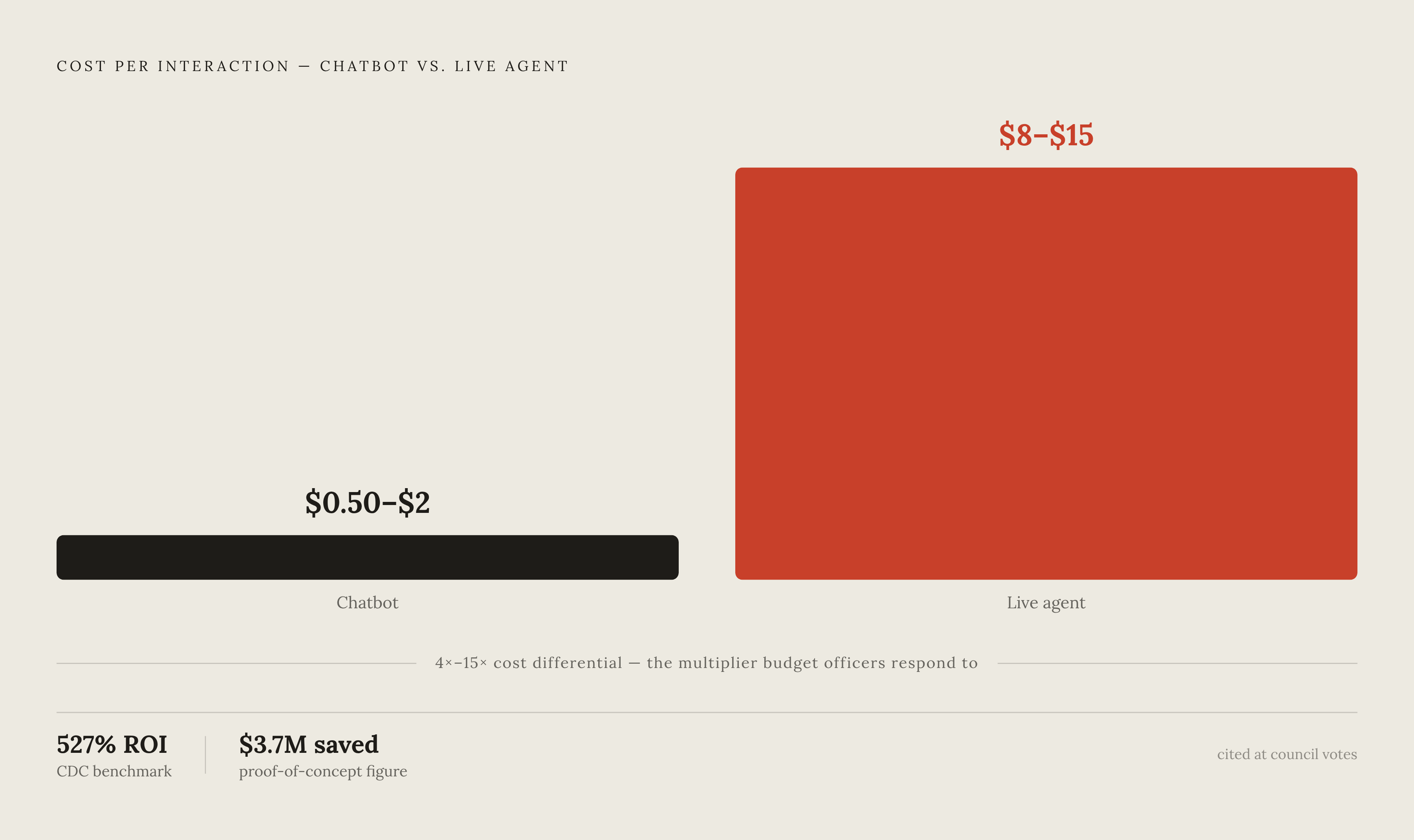
Money is doing most of the persuading, and the arithmetic is blunt. A chatbot interaction costs somewhere between $0.50 and $2.00. A live agent handling the same interaction costs $8 to $15. Multiply that gap across thousands of monthly interactions, and it's obvious why budget officers keep pushing this up the priority list: a four-to-fifteen-times cost difference on the exact same transaction.
The CDC's chatbot implementation is the number that keeps showing up in municipal procurement conversations: a documented 527% return on investment, with $3.7 million saved. It functions as proof of concept, which is exactly what a city council needs before it signs off on a new vendor contract.
Funding mechanisms cleared the path too. ARPA funds and state technology grants created dedicated budgets for digital modernization, cutting through the budget-cycle friction that usually slows government tech purchases to a crawl.
But the cost story leaves out the part that actually determines whether any of this pencils out. Chatbots don't replace the need for a human on complex or sensitive cases, and nobody serious argues they should. The efficiency gain shows up on routine volume: password resets, hours-of-operation questions, status checks. So what do chatbots actually save? It's what share of a city's total inquiry load is routine enough to hand off in the first place. That share varies hard by department, and it's the number that decides whether the fiscal case holds up once the contract's signed and the invoices start arriving.
Resident demand gives elected officials cover regardless. The Center for Digital Government has found that 72% of citizens want to access government information via smartphone, and 62% want their governments adopting more innovative technology. That's a mandate an official can point to when the budget line comes up for a vote, whether or not the underlying automation math has been worked out department by department.
The vendors competing for city contracts
A handful of names show up again and again in procurement intelligence for the municipal market: Citibot, Polimorphic, and Tyler Technologies. They compete mainly on how well they integrate with a city's existing 311 system and how many departments they can support out of the box.
Behind the specific deployments named earlier, a slightly different set of platform vendors does the technical work. One powers Atlanta's assistant, another powers Georgia's, and others support state-level deployments like Mississippi's. General-purpose platforms are moving into the space too, offering configurable templates that let a government deploy something without a fully custom build.
That points to a real fork in how cities buy this technology, and here's which side wins in the long run. Purpose-built civic chatbots cost more upfront and take longer to integrate, but a city owns the outcome. Configured-enterprise platforms launch faster and cheaper, but leave a city dependent on a vendor's product roadmap for features residents actually need next year. That dependency rarely shows up in the RFP language, and it should.
Procurement activity is worth watching as a leading indicator in its own right. Civic IQ tracks active government AI chatbot RFPs, and that volume signals where procurement interest is heading. One requirement is close to a threshold feature across these RFPs now: the ability to route chatbot-generated requests directly into a city's CRM and 311 backend. Vendors that do that cleanly have a structural edge over ones that can't. It's close to a pass/fail line now, not a nice-to-have.
What separates a deployment that works from one that frustrates residents
Kirsten Wyatt names the core problem directly, and it cuts against a lot of the enthusiasm in the adoption numbers above: "A lot of it just depends on a government knowing what their [chatbot's] intended use is for, and really having that value proposition or that reason for investing in it defined up front... So people don't get too far over their skis about what it's going to accomplish, because if your sense is this is going to solve your customer service needs, it's probably a huge overreach given that not everyone is going to use the chatbot, and you're going to have to evolve your citizens or your constituents into using it."
Most cities get this backwards. They buy the broadest, most capable tool available and hope scope sorts itself out later, when the evidence here points the other way. A narrow, heavily preprogrammed system like MISSI hits 97% accuracy precisely because it isn't trying to do everything. A broader, generative system like MyCity can handle a wider range of questions, but it runs a real risk of confidently getting something wrong, which is exactly what happened with its housing-rights and worker-protection answers. The fix requires something other than more capability. It's a narrower, clearer job description written before the RFP goes out, not after the vendor's already been picked.
Design process matters here too, even if it's harder to put a number on. Coral Gables' CGIT team spent real time on human-centered design before AIDA went live in 2024, testing with actual users rather than shipping first and correcting in public. Whether that upfront investment beats the launch-and-iterate model on resident satisfaction isn't a question the data has settled yet. But the question every city has to answer before writing a check is the one Wyatt keeps circling back to: what is this chatbot actually for, and does everyone signing off on the budget agree on the answer? Skip that step, and the accuracy rate, the vendor, and the generative-AI feature list stop mattering much at all.
Sources
- Chatbots for Government in 2026: Examples, Use Cases, Statistics
- Chatbot snapshot: How state, local government websites use AI assistants | StateScoop
- AI in state and local government: Use cases, risks, and best practices
- Government AI Chatbots & 311 RFPs: Vendor Pricing Guide 2025
- oecd.org
- ordinalforgov.com
- dl.acm.org