How Large Language Models Translate Plain-Language Policy Ideas into Bill Text
LLMs can convert policy ideas into legal bill text in seconds, not days.
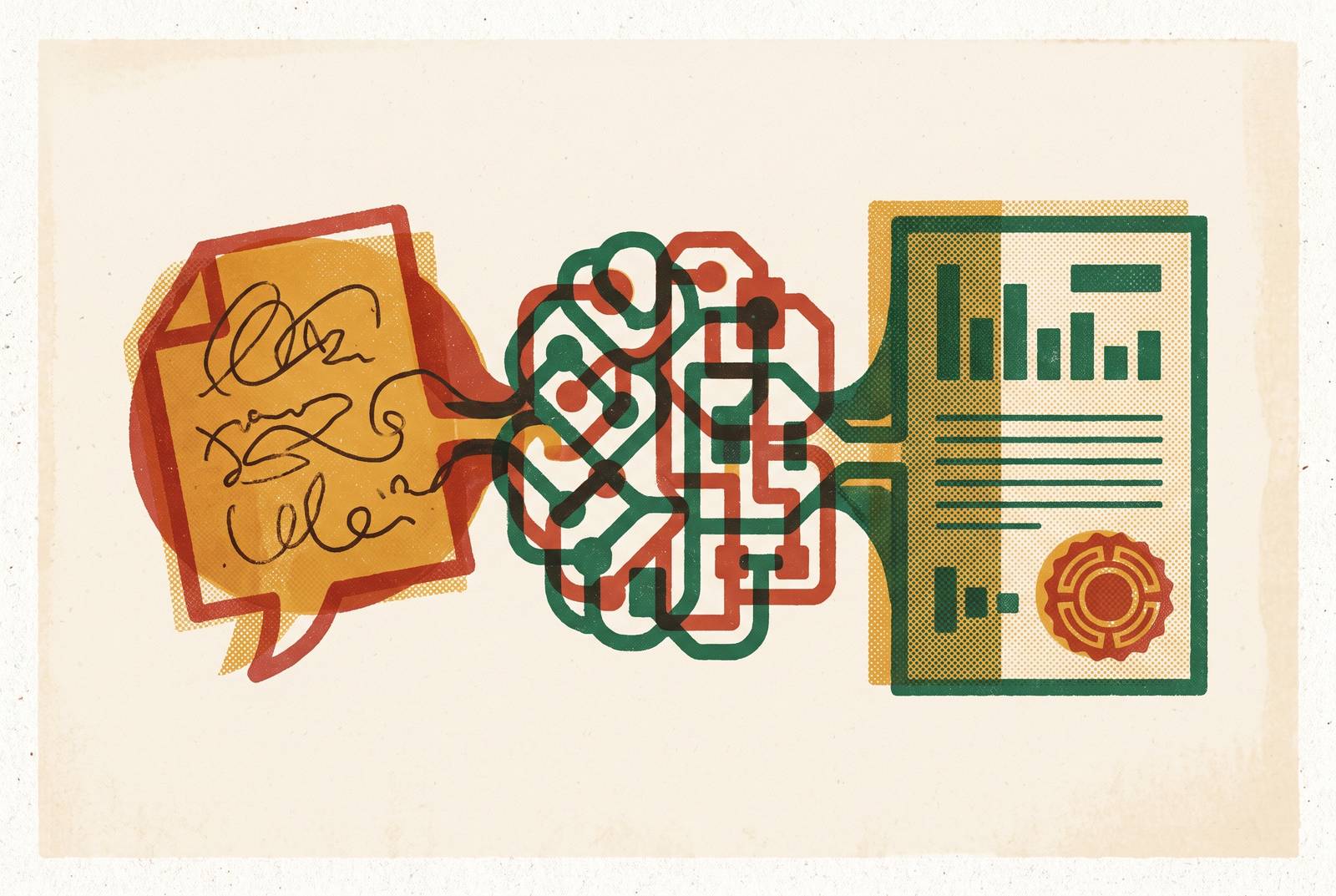
Bill text runs on machinery most people never see: enacting clauses, defined terms, cross-references to statutes already sitting on the books. Turning a plain-English policy idea into that machinery has always taken specialized skill most citizens don't have, and most legislative offices don't have enough of either. Large language models are starting to close that gap, and the tempting read is that they're democratizing legislation. That read is wrong, or at least too generous. LLMs are good at one narrow thing: converting "here's what I want" into "here's the text that does it." That narrowness is exactly what people keep missing when they either cheer this technology on or panic about it.
What bill text actually requires that plain language does not
Anyone can have a policy idea. Only a sitting member of Congress or a state legislature can introduce a bill, and everybody knows that part already. What's less obvious is the distance between an idea and an introducible bill. A petition might say "stop water companies from charging residents to replace stolen meters." A bill has to say that in a structure built to survive legal scrutiny, get assigned to committee, and get voted on section by section.
That structure has fixed parts. An enacting clause formally switches the bill on. A numbered hierarchy runs from findings to definitions to operative provisions to enforcement to effective date. Defined terms carry legal weight a dinner-table conversation never would: "resident" or "provider" might mean something narrower, or stranger, than how anyone would use the word casually. Cross-references stitch the new text into a body of law that already exists, because legislation never gets written into a vacuum. And jurisdictional framing decides whether this is federal or state business, who enforces it, which agency runs it.
Register matters just as much as structure. Legislative drafting has its own grammar: "notwithstanding any other provision," "as defined in section X," the load-bearing gap between "shall" and "may," where one wrong word can flip a mandate into an option. Research on AI-based legislative drafting technology notes that AI tools are specifically good at enforcing this kind of syntactic rule. That's exactly the register a citizen petition doesn't have. It was never built to have it.
One court decision raised the stakes on precision considerably. In June 2024, the U.S. Supreme Court overruled Chevron, the doctrine that let federal agencies fill in ambiguity Congress left behind in a statute. Take away that deference, and Congress has to write exacting text up front, instead of handing interpretive discretion to an agency down the line. Every bill now carries a heavier technical burden than it did two years back, which is exactly the kind of burden a drafting tool is built to shoulder.
The specific transformations LLMs perform when converting a policy idea into draft bill text
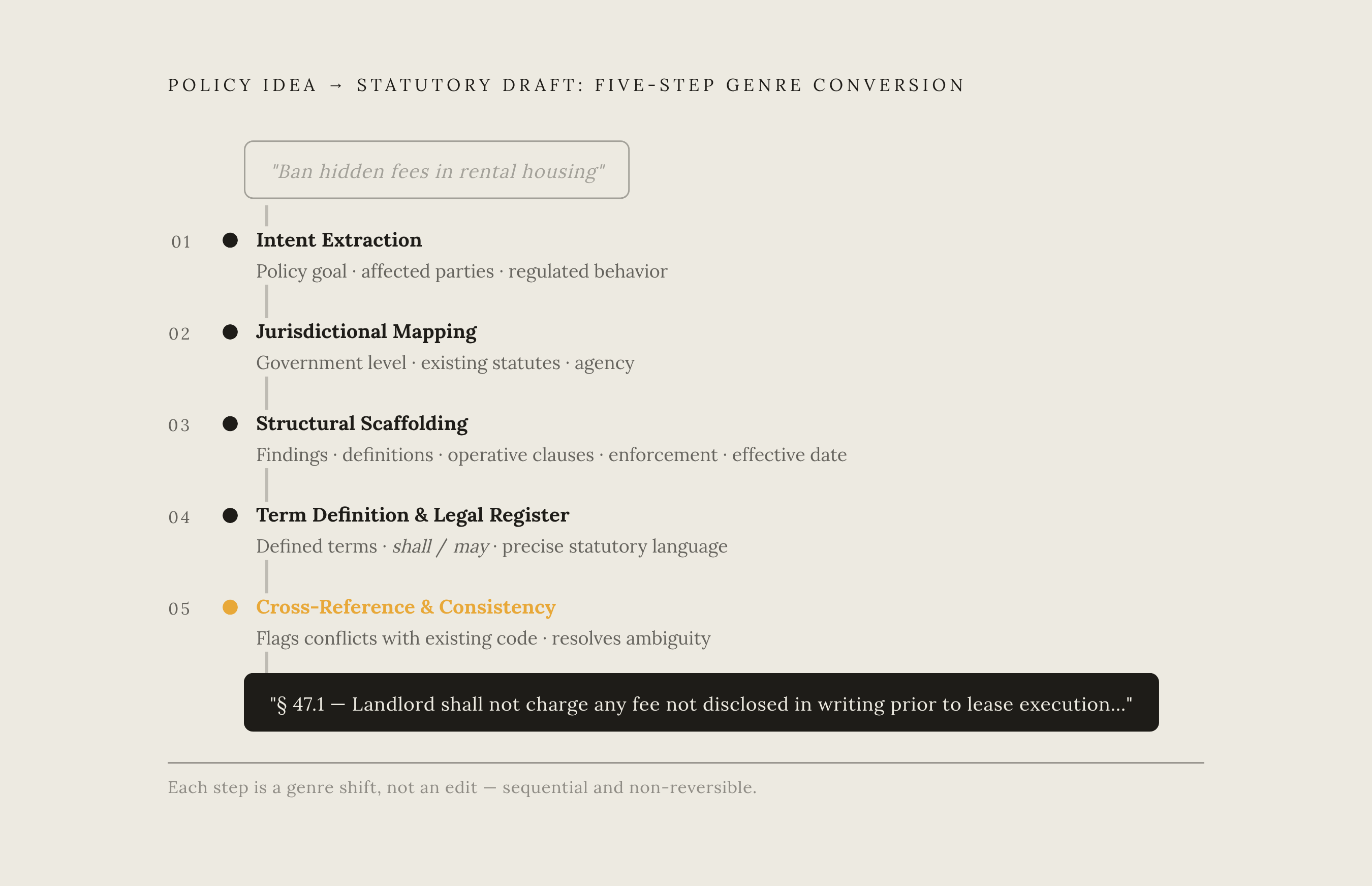
What actually happens when a plain-language idea goes into a model and a draft comes out the other side? Not one step. Five of them, each doing a distinct job.
First, intent extraction: the model reads the input for the policy goal, who's affected, what behavior gets regulated, what outcome is wanted. Second, jurisdictional mapping: which level of government applies, what existing statutes are touched, which agency would run this. Third, structural scaffolding: building the section hierarchy, findings, definitions, operative clauses, enforcement, effective date, in whatever format the target jurisdiction uses. Fourth, term definition and legal register: swapping everyday words for precise defined terms, turning casual verbs into legislative modal language ("shall," "may," "is prohibited from"). Fifth, cross-reference and consistency checking: flagging where the new text touches code already on the books.
The EU's LEOS report calls this "legal prompting," teaching a model to think like a lawyer through structured prompts, chain-of-thought reasoning, and retrieval pulled from legal corpora. Some observers have compared it to a spell checker: it speeds up the drafter's work the way autocorrect speeds up typing. That comparison is comfortable, and it's wrong in the way that matters most. A spell checker fixes errors within a genre. This is genre conversion, plain everyday language in, statutory language out, and calling that "just faster typing" hides the exact step where things go sideways.
The clearest documented case sits in Porto Alegre, Brazil. In 2023, city councilman Ramiro Rosário used ChatGPT to draft a full municipal ordinance from a 49-word prompt he wrote himself. He didn't ask the chatbot for a policy idea. He supplied the idea himself (a measure stopping water companies from charging residents to replace stolen water meters) and asked for a complete draft. The output landed in 15 seconds. The bill passed the 36-member city council unanimously in October 2023.
Porto Alegre doesn't show AI improving the drafting process at the margins. It shows AI performing the entire translation step, the one that used to eat days of a legal team's time, in the time it takes to read this paragraph. That's a different claim, and it's the one that should worry anyone who assumes AI just tidies up what a human already wrote.
How LLMs are trained and prompted to handle legal corpora
None of this happens by accident. General-purpose language models train on enormous text piles that already include legislation, court opinions, regulatory text, and legal commentary, so they show up with some rough familiarity with statutory register before anyone fine-tunes a thing.
But rough familiarity isn't domain fluency, and closing that gap takes deliberate work. Rules-as-code initiatives, including a model called SaulLM-7B, are building LLMs specifically for legal drafting, according to reporting in the Springer AI & Society journal. The EU's LEOS report points to the Digital Corpus of the European Parliament and the United Nations Parallel Corpus as legal-specific training data. And a markup standard called Akoma Ntoso, used across many parliaments, gives models a template for what a legislative document's architecture is actually supposed to look like.
Two techniques carry most of the weight. Retrieval-augmented generation (RAG) lets a model pull the actual current statutory text at the moment someone asks a question, instead of relying on whatever it absorbed during training. That cuts the odds of citing a provision that's outdated or repealed years ago. Chain-of-thought prompting walks the model through something like the IRAC framework (issue, rule, application, conclusion) before it writes a word of draft text. This approach is aimed at getting a model to reason the way a lawyer reasons, rather than just produce prose that sounds like a lawyer wrote it.
Here's the design choice worth sitting with, and it's not a close call: pure LLM generation versus hybrid systems that pair a model with a rule-based legislative editor. Research on AI legislative drafting favors hybrid systems, given that a wrong citation in this setting is a serious problem, not a minor slip. The underlying split has been framed plainly in policy discussions: humans handle political judgment, value trade-offs, accountability. Machines handle syntactic consistency, cross-referencing, speed. Anyone building these systems who skips the hybrid step to save engineering time is trading a known, containable risk for an unbounded one.
Where this technology is already operating in real legislative institutions
This is happening now. It's happening now, in specific, named places, and the pace is worth noticing.
A national parliamentary chamber submitted a use case in June 2024 (per a use case registry kept by an international parliamentary organization) for AI-powered tools to help staff draft amendments, aimed at accuracy, consistency, and compliance with legislative standards. Worth flagging: that's a submitted use case, not a confirmed live deployment. The European Commission's Directorate-General for Digital Services commissioned a study in October 2024 on AI-based legislative drafting tools, centered on the LEOS platform (Legislation Editing Open Software) mentioned above. In one country, the governing administration is reportedly planning to use a major AI vendor's model to help draft federal transportation regulations, and one government department is reportedly experimenting with AI-assisted regulatory drafting too.
On the commercial side, FiscalNote (NYSE: NOTE) added an AI-powered drafting feature to its PolicyNote platform on July 10, 2025, letting users generate and refine bill language, model legislation, and amendments tailored to specific sectors and jurisdictions. The company says it counts clients across all three branches of the federal government, plus dozens of state and local entities. PolicyNote followed in October 2025 with a bill comparison tool that redlines differences between bill versions in seconds. Elsewhere, a startup accelerator-backed company founded in 2025 is building what it calls a "regulatory operating system," and another company offers a layer for interrogating statutory text from a couple of countries.
The scale shows up in the numbers too. The 2025 AI Index Report looked at legislative debate minutes across 75 countries and found the number of proceedings mentioning AI grew more than ninefold between 2016 and 2024, hitting 1,889 proceedings in 2024 alone. That's a 21.3 percent jump from the year before.
Adoption is still early, still limited to a handful of parliaments. But it's spreading without anyone rewriting a single rule of legislative procedure, which is exactly why it's moving fast and why oversight is lagging behind it. State legislatures are the likeliest place for this to matter most: smaller staffs, higher demand for drafting help relative to headcount, and a growing share of actual policymaking as congressional output has slowed, according to Lawfare's analysis. The Chevron overrule works as an accelerant here too. With less room to hand off interpretation to agencies, legislators carry more of the technical drafting burden themselves, which only raises the appeal of an AI assist at the federal level as well.
The real risks that follow from delegating drafting to LLMs
The core technical risk is hallucination: the model states something false with total confidence. In a legal drafting context that's not a cosmetic flaw. It's the kind of defect that can survive into enacted law, sitting quietly in a section nobody double-checked.
The numbers here aren't small. More than 300 cases of AI-driven legal hallucinations have been documented since mid-2023, with at least 200 of those recorded in 2025 alone, according to BriefCatch. Studies testing general-purpose AI chatbots on legal research queries have found hallucination rates that researchers describe as substantial, and even specialized legal AI tools built on RAG still hallucinate at a meaningful rate. A hallucinated cross-reference, a citation to a statute section that doesn't exist or says something different than claimed, is the kind of error a proofreader skims right past. It's exactly the kind of error that can ride quietly into a passed bill.
South Africa gives the clearest cautionary example at the policy level. Its Draft National Artificial Intelligence Policy 2026 went out for public comment on April 10, 2026. Sixteen days later, on April 26, Minister Solly Malatsi of the Department of Communications and Digital Technologies pulled it, after a scandal broke over fake, AI-hallucinated citations sitting in the reference list. The policy is currently halted. What makes this case worth remembering is that it happened at all. It's where it happened: the reference list, the part of a document readers trust as a plain factual record rather than generated prose. That's exactly the part that got corrupted, and it should unsettle anyone who assumes hallucination risk only lives in the "creative" parts of a draft.
Courts have their own version of this failure. Courts have seen rulings withdrawn after AI tools were used in drafting without adequate checking, raising questions about oversight of AI-assisted legal work.
There's a bias dimension too, and it doesn't get enough attention. Concerns have been raised that LLMs may produce different outputs depending on demographic cues embedded in inputs. In a drafting context that raises a question worth sitting with: does AI-generated bill text quietly encode assumptions about who the "affected population" is, based on cues nobody meant to give it in the first place?
Then there's the accountability gap, and it's the widest one of all. Regulatory frameworks specifically governing the use of AI in drafting legislation remain limited and are still catching up to the practice. The Porto Alegre council voted unanimously on Rosário's bill without knowing it was AI-drafted, and the council president only called it a "dangerous precedent" after Rosário disclosed it himself on social media, well after the vote had already happened. The regulatory response is starting to catch up, though not aimed at drafting specifically. California's Transparency in Frontier Artificial Intelligence Act (SB-53), introduced by Senator Scott Wiener on January 7, 2025, passed the Senate 29-8 that September, and was signed by Governor Gavin Newsom on September 29, 2025. It applies to companies with at least $500 million in annual revenue training models above 10^26 FLOPS, requiring public safety frameworks and whistleblower protections. But it targets AI safety broadly, not legislative drafting, so the exact gap Porto Alegre exposed stays open.
None of this adds up to a case against the technology. Every risk listed here has a known fix: RAG grounded in live statutes, human review, hybrid drafting systems. What it argues for is discipline in how the tool gets used, not shelving it.
What responsible AI-assisted drafting looks like in practice, and why human judgment remains the non-negotiable layer
Go back to Pahlka's split: machines handle syntactic enforcement, consistency, cross-referencing, speed. Humans handle intent, value trade-offs, accountability. Skip that split, and you don't get a faster process. You get Porto Alegre's near-miss instead of a system anyone can actually trust.
In practice that means a few concrete things, not a vague nod to "oversight." RAG against live statutory databases, so a draft cites what's actually in the code right now, not what the training data implied was there two years ago. Hybrid systems pairing an LLM with a rule-based legislative editor, the approach the EU's LEOS report recommends specifically because it catches errors a pure generation model would miss. Human review as a mandatory last gate, not an optional courtesy: the use case submitted for Italy's Senate describes AI-powered tools assisting parliamentary staff with drafting amendments.
Disclosure matters just as much as verification, maybe more. Rosário's decision to keep the AI's role quiet in Porto Alegre is what turned a drafting shortcut into a governance scandal. No law required him to disclose it. But the backlash suggests transparency about AI involvement is becoming the baseline expectation anyway, whether or not a statute demands it yet. Legislatures that wait for a mandate before adopting that norm are choosing to learn the lesson the hard way, on the record, in public.
The mechanics of turning a plain-language idea into functioning bill text can be automated well enough to save a legal team days of work, as Porto Alegre showed in 15 flat seconds. What can't be automated is the judgment about whether that idea deserves to become law at all, whose interests it actually serves, and who answers for it when it goes wrong. Read the Porto Alegre case again with that in mind. The AI produced text in 15 seconds. It took a human disclosing that fact on social media, after the vote, before anyone thought to ask whether that was the right way to do this at all.
Sources
- Drafting of amendments to legislative texts | Inter-Parliamentary Union
- site.unibo.it
- AI Will Write Complex Laws
- Transparency in Frontier Artificial Intelligence Act - Wikipedia
- Full article: Legislatures and legislation in the age of artificial intelligence
- From pen to algorithm: optimizing legislation for the future with artificial intelligence | AI & SOCIETY | Springer Nature Link
- investors.fiscalnote.com
- Draft South Africa National Artificial Intelligence (AI) Policy 2026 - Wikipedia