Neighborhood Association Structures and Their Legal Powers
Two groups can call themselves the "Maple Street Neighborhood Association" and mean completely different things. One might send you a friendly newsletter and ask for five bucks a year, while the other can put a lien on your house. I've spent years untangling this confusion for residents who got a notice in the mail and had no idea whether to panic or shrug, and the honest answer is: it depends entirely on which legal universe that notice came from.
That's not a small distinction. Roughly 373,000 community associations house about 78.1 million residents nationwide, which works out to something like 35% of all U.S. housing as of 2025. So this isn't a niche question for people who happen to live somewhere unusual. It's a coin flip for a huge chunk of the country, and the type of organization you're dealing with determines whether you're looking at persuasion or legal obligation.
Where HOA authority actually comes from — the documents that create it
An HOA's power doesn't come from being well-organized or well-liked. It comes from paper, specifically three documents that stack on top of each other like layers of a foundation.
The first, and the one that actually binds you, is the Declaration of Covenants, Conditions, and Restrictions, usually just called the CC&Rs. This gets recorded against the property title itself, and that's the detail people miss: it attaches to the land rather than requiring a signature. Buy the house, and you inherit every obligation in that document whether you read it at closing or not. The CC&Rs spell out what you have to do and what the HOA can make you do.
Then you've got the bylaws, which handle the internal mechanics: how meetings run, what the board is responsible for, how voting works. And you've got the Articles of Incorporation, which is the paperwork that makes the HOA a real legal entity under state law, similar to how a business incorporates.
Here's the part residents underestimate. The board of directors runs the show day to day, but its authority is capped at whatever the Declaration and state law actually permit, nothing more. A board can't invent a rule out of thin air just because it feels reasonable, and if the CC&Rs don't address something, the board's authority over that thing is thin at best.
And this situation is only growing. The share of new homes built inside HOA communities has climbed significantly over the past decade and a half, reaching 65% by 2023. More people are getting bound by these documents automatically, often without ever seeking out that kind of governance.
What HOAs can legally enforce and what they cannot
So what can an HOA actually do to you? Quite a lot, it turns out.
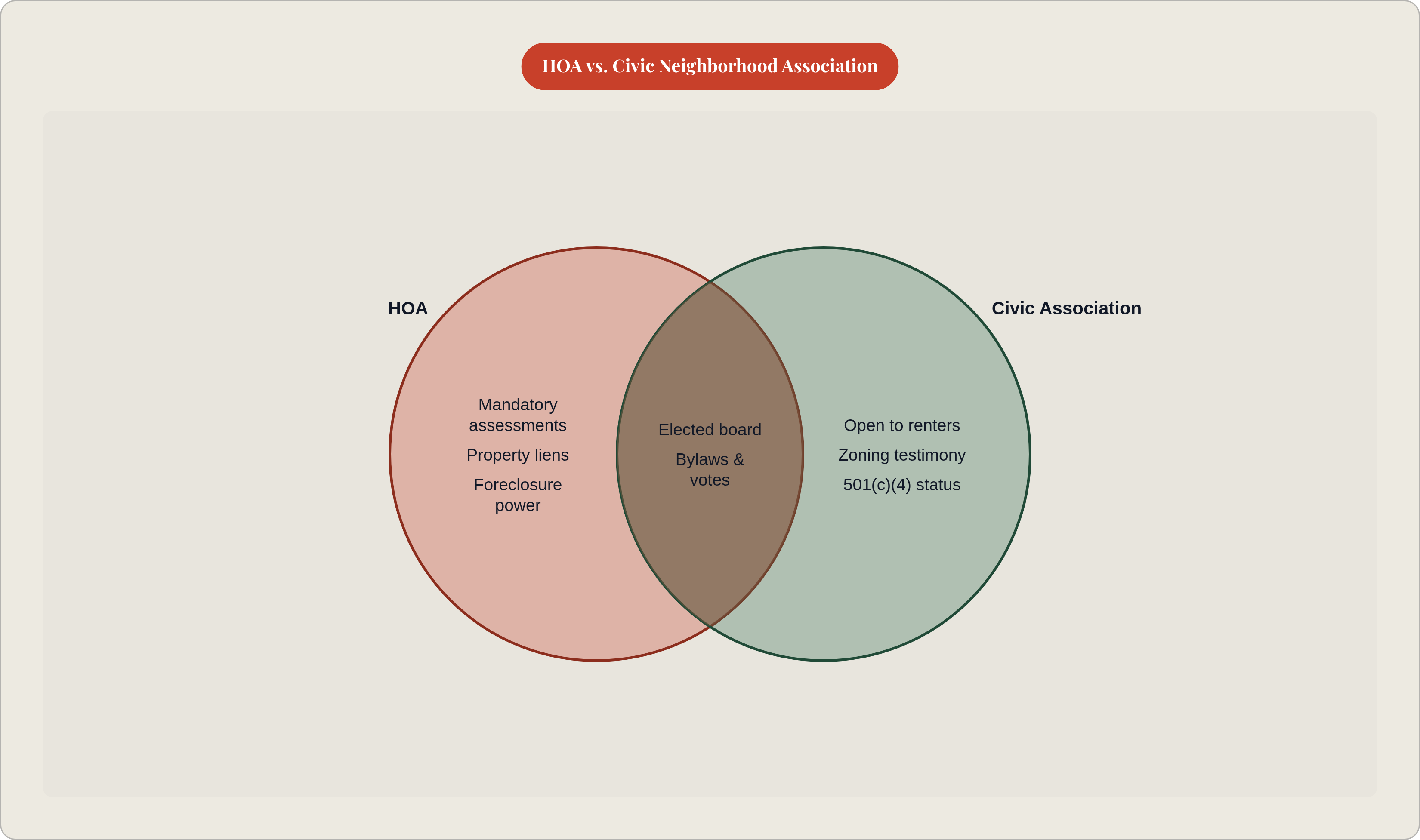
It can levy mandatory assessments and collect them, and it can enforce architectural standards, things like paint colors, fence heights, what your landscaping looks like. In most states, it can place a lien on your property for unpaid dues or fines. And in many states, it can initiate foreclosure over noncompliance, which is the power that catches people off guard more than any other. Most residents think of an HOA as an annoyance that fines you for an unmowed lawn, but fewer realize that unpaid fines, left unresolved long enough, can spiral into losing the house.
But authority has edges, and those edges matter just as much as the powers themselves. An HOA cannot override federal or state law, and fair housing protections and disability accommodation rights sit above anything in a Declaration. An HOA also can't enforce rules that contradict its own CC&Rs, or that got adopted through some improper backroom process, or apply rules selectively depending on who the board likes.
State law sets the ceiling here, and it's worth saying plainly: what flies in Texas might not fly in New York. There's no single national rulebook.
Why does enforcement feel like it's tightening lately? Follow the money. According to industry research, 91% of community associations reported unexpected cost increases in the past year, driven mostly by management fees and insurance, and 71% of HOA boards planned fee increases heading into 2025. When costs climb, boards get stricter about collecting what they're owed, and that's arithmetic more than anything else.
If you think an HOA has stepped outside its documented authority, you're not stuck arguing with the board forever. Every state has its own dispute processes for exactly this, separate from whatever internal appeal the HOA offers.
What a voluntary neighborhood association can and cannot do
Now for the other universe entirely.
A civic neighborhood association has no legal authority over your property. It can't require compliance with anything, can't fine you, can't place a lien, can't sue you into doing what it wants. Membership is open to anyone in the area, homeowner or renter, and dues, if they exist at all, are voluntary and usually small, with nobody excluded for not paying.
Some of these groups incorporate as a 501(c)(4) nonprofit. That gets them tax-exempt status and a cleaner organizational structure, letters and grants and the like, but it doesn't hand them a shred of enforcement power. The bylaws of a typical civic association set up a board, officer roles, a meeting schedule, and voting procedures for taking official positions on local issues. One distinction shows up again and again in these bylaws: the association can weigh in on policy, but it generally can't endorse political candidates, and any official stance usually needs board sign-off first.
So what's the actual toolkit? Civic associations show up at zoning and planning hearings, submit written comments, organize testimony, and get residents to turn out in numbers. They build relationships with city staff and elected officials over time, and some apply for grants that only incorporated nonprofits qualify for.
The power here is relational rather than legal. It works only to the degree that officials and institutions decide to treat the association as a credible voice worth listening to.
How civic neighborhood associations exercise political influence in practice
Zoning hearings are where this plays out most often, and Calgary in 2024 is a case worth sitting with for a minute.
Fifty-two community associations signed a joint letter opposing a blanket rezoning proposal, and of more than 6,000 written public submissions, 88% opposed it. That's an overwhelming, organized, well-documented wave of resident opposition. City council passed the rezoning anyway, 9 to 6.
What does that tell us? It tells us civic associations can generate real, measurable weight in a public process, and it tells us that weight has a ceiling. When a legislative body has the votes to go a different direction, organized opposition doesn't stop it, and the Calgary case shows both halves of that truth in the same breath.
There's a broader trend worth watching too. British Columbia's housing legislation between 2023 and 2024, Bills 44, 46, 47, and later Bill 18, eliminated public hearings for certain kinds of development applications. That's a government directly narrowing the formal channels neighborhood associations used to rely on. Under housing pressure, some governments are trimming the very consultative mechanisms that gave civic groups their seat at the table.
None of this makes the work pointless. Researchers have called neighborhood associations "schools of democracy," and there's something to that: people who participate in them tend to build broader civic habits that carry into other parts of their lives. But if you're relying on one of these groups to shape a decision, it pays to know which processes still guarantee public comment and which ones have quietly been closed off.
Resident rights inside an HOA — participation, voting, and challenging board decisions
If you live under an HOA, you're not just subject to rules, you have rights too, and a lot of residents forget that part.
You typically have the right to attend and speak at board meetings, and you have the right to vote in board elections and on major decisions like budget ratification or rule changes, depending on the bylaws. You usually have the right to inspect governing documents, financial records, and meeting minutes, though the exact scope varies state by state. And you can often petition for a special meeting if you gather enough signatures from fellow members.
If you want to challenge a board decision, there's a sequence to it. Start with the association's own dispute resolution process, and if that doesn't resolve things, many states offer mediation or arbitration programs built specifically for HOA disputes. Civil court is the last stop, not the first.
Here's something people overlook: running for the board yourself is often the fastest path to changing a rule you think is unreasonable. It's slower than complaining, sure, but it tends to be more effective.
Worth noting, the overall picture isn't grim. The Foundation for Community Association Research's 2024 survey found 60% of HOA residents rated their experience positive, another 26% neutral, and 94% said they got along well with their immediate neighbors. Conflict is the exception here, not the rule. But if you're in that smaller group dealing with a real dispute, knowing the mechanisms above is the difference between feeling stuck and actually moving something, and plenty of HOA governance problems exist simply because members don't show up to vote or attend meetings in the first place.
What neither type of association can substitute for — and where direct legislative engagement fits
Step back and the boundary gets clear. HOAs govern private community rules, while civic associations advocate for public ones. Neither has binding authority over an elected legislative body.
Each does best when it stays in its lane. HOAs are built for shared amenities, community aesthetics, splitting maintenance costs, the practical stuff of living close together. Civic associations are built for weighing in on planning decisions, building long-term relationships with city offices, and giving a neighborhood a coordinated voice in public hearings.
Neither one can draft actual legislation, and neither can compel an elected official to act. Neither can give a neighborhood's position formal standing inside a legislative chamber. The Calgary vote and the British Columbia hearing changes both point at the same gap: organized, sincere civic participation, overridden, because it never carried formal legislative weight to begin with.
That gap seems to bother people, and not in some abstract way. The 2025 Democracy for All Project found only about 24% of Americans believe U.S. democracy is functioning well, and just 30.6% agree that government laws and policies actually uphold freedom and justice. That's a lot of dissatisfaction pointed at a system people feel locked out of shaping directly.
So where does that leave someone who wants their neighborhood's concern to become something more than a letter? This is the gap that newer civic technology tools are starting to poke at, platforms that take a resident's idea and turn it into an actual structured draft bill, routed to the elected officials who'd need to act on it. A petition is input, one voice among thousands that an office can file away, while a properly drafted bill with verified co-signatories is something an official can actually pick up and act on.
It's a distinction worth sitting with. A neighborhood association, civic or HOA, gives you a voice inside its own defined space, private property on one side, public opinion on the other. Turning that voice into law is a different kind of work entirely, and it's work that's only just starting to get easier.