Barriers to Civic Tech Adoption in Small and Rural Municipalities
Small towns lack the broadband, trust, and staff to make civic tech work.

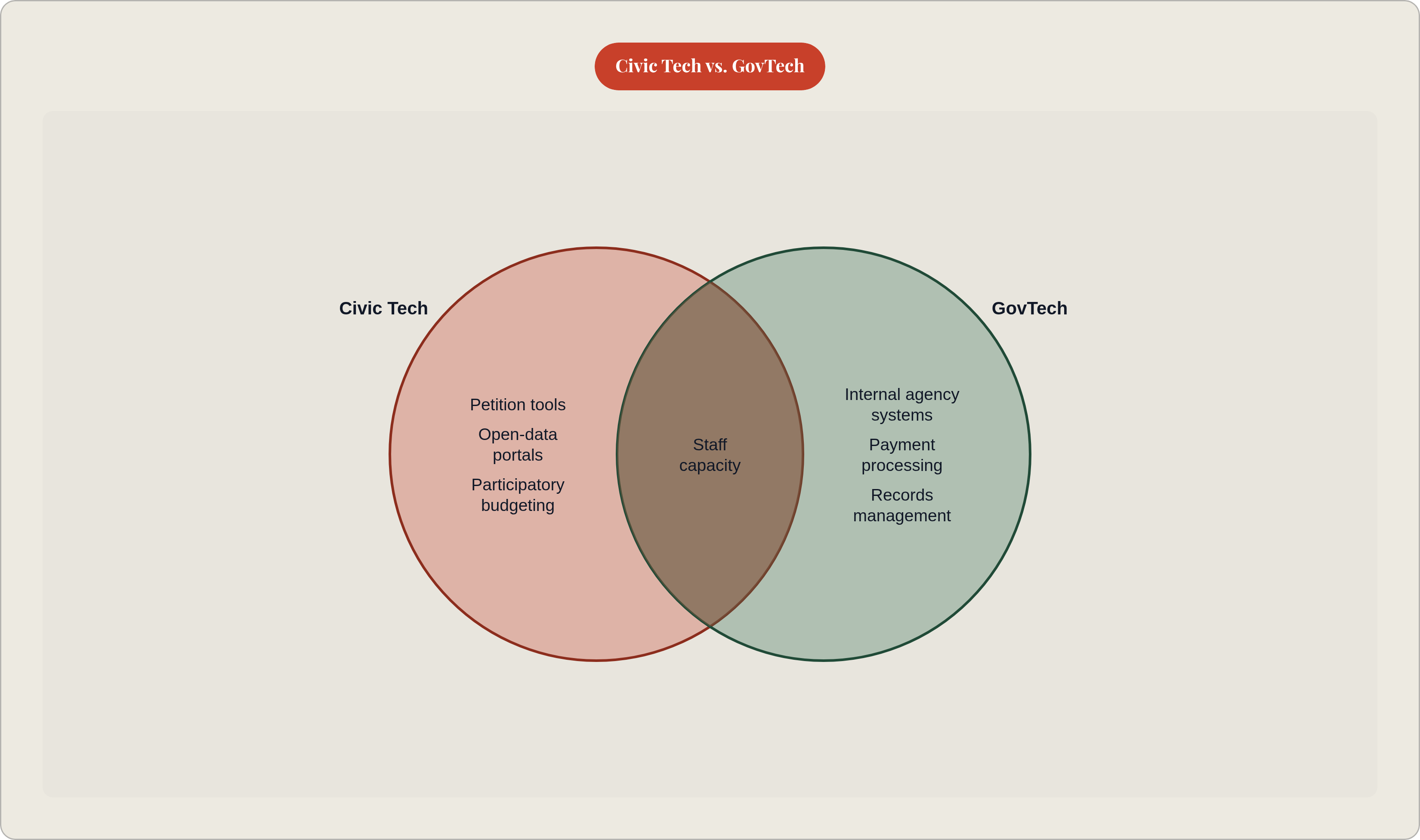
Civic tech means the digital tools that let residents deal with their government: issue-reporting apps, participatory budgeting platforms, petition tools, open-data portals, legislative drafting software. It's worth splitting that from govtech, which covers the internal plumbing agencies use to run themselves more efficiently. Both matter, but when civic tech fails in a small town, the cost isn't just inefficiency. A resident tried to participate, hit a wall, and probably won't try again.
Partners in Democracy, in a paper the Harvard Ash Center put out in December 2025, frames a healthy civic tech ecosystem around three functions: Connect, Learn, Act. Residents need a way to connect with each other and with officials, a way to learn what's actually happening in their government, and a way to act on it. Most of the case studies people point to when they talk about civic tech working, Taiwan's vTaiwan getting past 80% of its proposals implemented, Massachusetts tools like FindIt Cambridge and MAPLE, come out of cities with money, staff, and organized civic groups already in place. Rural adoption is a different problem, not a smaller version of the same one, and it's the more common problem: over 16,000 U.S. municipalities have fewer than 5,000 people. That's most of American local government.
Why participation at the local level is already starting from a deficit
Before you can talk about tech adoption, you have to talk about who's even in the room. Municipal election turnout in the U.S. is widely documented to be far lower than national elections, and local school board races are often decided by a small fraction of registered voters. Compare that to the turnout recorded in recent presidential elections, which routinely reaches well above half of eligible voters. Something is badly broken at the level of government that touches people's lives most directly.
Texas gives a clean, ugly example. In the state's recent local elections, large counties have at times reported single-digit turnout figures. This isn't a rural quirk; it's showing up in some of the biggest counties in the state, which tells you the problem isn't sparse population, but something structural.
Part of it is plain confusion. People often don't know who's running, what the office does, or which decisions actually sit with a city council versus a state legislature versus Congress. Research on local election timing points to a structural consequence of low turnout: off-cycle local elections skew toward voters who are older, whiter, and wealthier than the community as a whole, which hands outsized influence to whichever special-interest group shows up while everyone else stays home.
Underneath all of it sits a trust problem. OECD data from 2025 found that only 39% of people across member countries have high or moderately high trust in their national governments. Local trust is not immune to the same slide. Only 30.6% of Americans, per the 2025 Democracy for All Project from the Kettering Foundation and Gallup, agree that government laws and policies uphold freedom and justice for everyone. So when civic tech shows up in a town like this, it's trying to rebuild a habit that's already atrophied, not simply solving a software problem.
The connectivity gap that makes digital participation a privilege in rural areas
At the start of 2025, 93.1% of the U.S. population was online. Flip that number and you get 23.9 million Americans who weren't, and they're disproportionately rural. Rural adults are slightly more likely than city residents to lack fixed broadband at home, and that gap hasn't closed as national numbers have climbed.
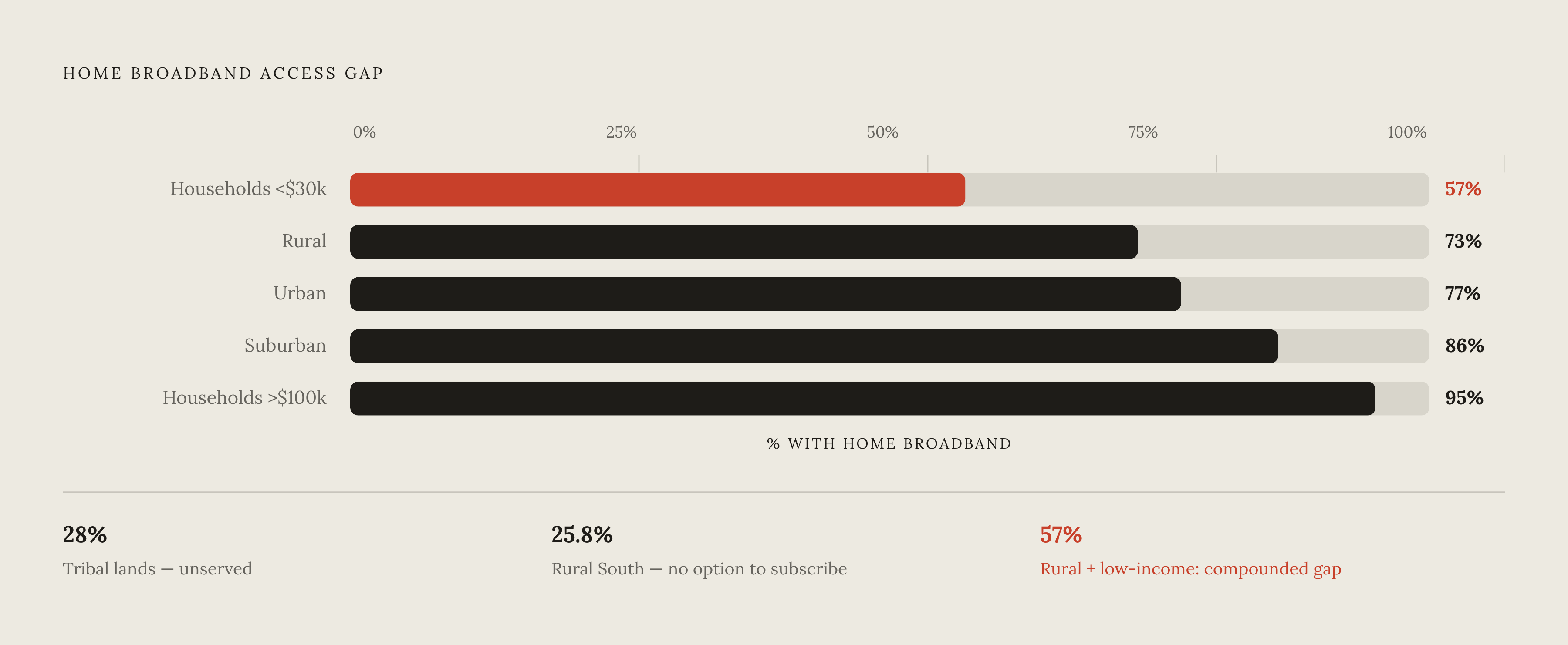
Pew Research Center's 2023 numbers put home broadband access at 73% for rural adults, versus 77% in urban areas and 86% in the suburbs. The sharpest gap runs between rural and suburban areas, more than between rural and urban ones. Income stacks right on top of geography: Pew's 2025 data shows only 57% of adults in households earning under $30,000 have home broadband, against 95% for households over $100,000. In a lot of rural counties, low income and rural geography are the same population, so the two gaps hit the same people twice.
On Tribal lands, the unserved rate climbs to nearly 28%, per USDA data citing the FCC in 2024. In the rural South, about 25.8% of residents have no option to subscribe to fixed broadband at all, according to the Joint Center for Political and Economic Studies. Why hasn't the market fixed this? Aerial fiber installation in rural areas runs $40,000 to $60,000 per mile by 2025 industry estimates, and at low population density, that math doesn't close for a private provider. The unit economics, not neglect, explain the gap.
Mobile-only access isn't really a substitute, either. A resident relying on a phone plan is dealing with data caps, throttled speeds, and a screen too small for the kind of long-form public comment or multi-step signup that a lot of civic platforms still demand. Another wrinkle: flawed federal broadband mapping may be steering BEAD program funds toward places that already have service, while the towns that actually lack it stay in line. Since voter registration, public comment periods, and community engagement tools are all increasingly online-first, this isn't a side issue. A lot of people are standing outside the front door to participation.
Why small-town governments lack the staff and budget to adopt technology even when they want to
Say a town has decent broadband and residents willing to try a new platform. Who on the government side is going to run it? Research on municipalities under a certain population size found that 55% named lack of staff as the biggest barrier to adopting e-government tools, and IT staffing came out as the single strongest predictor of whether a town adopted new technology at all. High-adopting towns averaged 2.0 full-time IT employees, while low-adopting towns averaged 0.87.
A 2025 report from KSM, "The State of Local Government in Indiana," found more than half of local governments naming funding and staff capacity as their top barriers to adopting new technology or AI. ICMA's PM Magazine described the texture of this in August 2026: some departments are one or two people total, and a town manager is running finances, fielding constituent calls, and overseeing operations, often all before lunch. IT support, if it exists, is frequently shared regionally or contracted out to whoever's available.
There's an institutional memory problem sitting underneath the staffing problem. Expertise in a lot of these towns lives in the head of whoever's been there 20 years, not in any documented system. When that person retires, the town loses its own history of how things work, not just a job.
Here's a number that should stop you: the most complete recent survey on local government AI adoption got responses from just 12 communities under 5,000 people, out of more than 16,000 such municipalities nationwide, according to Route Fifty in January 2026. Why so few? Professional associations survey their own members, and most small towns don't belong to those associations. Surveys often go out to city managers, and a lot of these towns don't have one. Outreach happens by email, and plenty of these jurisdictions don't run a dedicated government email system in the first place. The blind spot is built into how the data gets collected.
None of this comes free. The White House's 2025 executive order on modernizing federal payments cited more than $657 million in fiscal year 2024 costs tied to keeping paper-based payment and recordkeeping systems running. The financial case for going digital is real. The towns that would benefit most are often the ones least able to make the jump, so they stay reactive, costs keep climbing, and the staff who are left burn out faster.
The trust and cultural barriers that technology alone cannot fix
Suppose a town somehow clears the money and staffing hurdles. Does the tool get used? Research across both big cities and rural areas keeps landing on the same finding: leadership commitment and organizational culture predict whether a new system actually gets adopted better than how sophisticated the system is. A brilliant platform with no one championing it inside city hall goes nowhere.
The OECD's 2025 work flags specific risks that come with rolling out new civic tech: mistrust in the process, threats to civic space, unequal access, toxic online environments, privacy exposure. In a small town, skepticism toward an outside-built platform is often just rational thinking, not stubbornness. A tool built for a city of 400,000, with different norms and different scale, shows up with zero track record in a town of 4,000. Why would residents assume it was built with them in mind?
Privacy concerns aren't paranoia here either. Anonymity is much harder to hold onto in a town where everyone knows everyone. A resident might reasonably worry that flagging a pothole or backing a petition online could come back to them at the grocery store or the next town meeting, in a way that just doesn't happen in a city of a million people.
A 2025 study in Frontiers in Political Science, based on 412 respondents and structural equation modeling, found that digital readiness and service quality alone don't drive participation. Sustainable engagement in digital governance needs citizens' digital competence alongside access, and competence here is really a trust question wearing a skills costume. On the inside, some agencies treat transparency tools as a threat to how things have always worked, rather than as a service to the people they answer to. The bottom line: a platform nobody trusts doesn't get used, no matter how many features it has. Trust has to be built before the tool launches, not patched in after adoption stalls.
How these barriers compound each other — and why treating them in isolation has failed
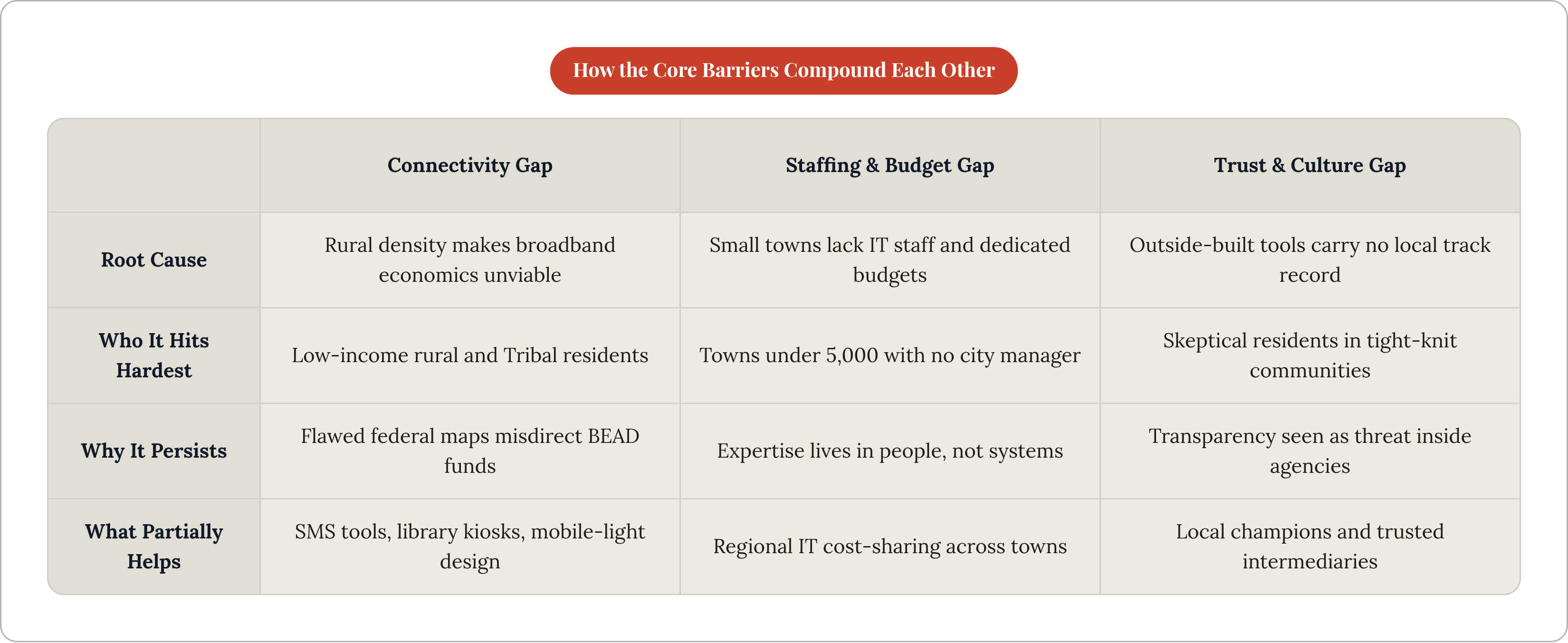
None of these barriers sits alone, waiting to be knocked down one at a time. A town that fixes its broadband but has no staff to run a new platform gains almost nothing. Add staff but no resident trust, and the result is a platform that sits mostly empty. Add trust but no broadband, and the platform reaches only the residents who already had an advantage.
Research on rural municipalities consistently finds that infrastructure gaps don't disappear after initial adoption: rural towns often can't properly monitor or manage the digital tools they've already deployed, even after clearing the adoption hurdle. Low turnout feeds itself, too: a platform used by a self-selected sliver of residents produces outputs that don't represent the town, which chips away at trust further, which drags turnout down again next cycle.
The 12-community survey problem is a policy gap wearing a data gap's clothes. Funders and researchers designing rural civic tech programs are working from an evidence base that leaves out most of the towns those programs are meant to help. Meanwhile the well-resourced examples, vTaiwan, the Massachusetts civic tools, get studied and copied, but they were built on preconditions, reliable broadband, professional staff, organized civil society, that most small towns simply don't have.
Put plainly: the towns with the most to gain from civic tech are often the ones least equipped to take it on. Left alone, that gap doesn't hold steady, and it widens.
What approaches are actually working in low-resource environments
None of this means small towns are stuck. Some municipalities have turned to AI chatbots to give residents 24-hour access to basic government information, no staff member required to answer the phone at 9 p.m. Some small-to-mid-size cities have deployed generative AI chatbots, stretching thin staff further with a tool that doesn't need a raise or a lunch break.
Plain-language drafting tools attack two barriers at once: they don't demand a resident know legal or legislative language, and they don't demand a town hire a policy analyst to translate that language back into something usable. Some platforms sit in this space on the participation side, pairing AI-drafted legislative language with verified neighbor co-signatures, which builds a path from a resident's idea straight to an elected official's desk, no lobbyist or lawyer required. The verification piece matters more than it might seem. A proposal backed by confirmed neighbors carries weight in a way an anonymous online form never will; it's the difference between a submission that gets filed and one that gets read.
Regional IT sharing is quietly one of the more useful fixes going, since it spreads the cost of digital capacity across several towns instead of asking each one to build its own department from scratch. The tools that actually stick in low-resource places tend to skip the assumption of broadband and a smartphone altogether: SMS-based participation, kiosks set up in the library, interfaces built for more than one language. The UNDP's 2025 Regional Civic Tech Innovation Challenge drew 251 applications from 30 countries, and the pattern that stood out was youth-led, locally designed tools built for the specific governance problem in front of them, consistently outperforming solutions imported wholesale from bigger cities. Design for the place, not design borrowed from somewhere else.
There's a smaller, hopeful detail buried in congressional research that applies just as well at the local level: first-term and newly elected officials tend to be unusually open to ideas that come from constituents. The barrier to getting heard may be lower than most residents assume, as long as the idea arrives in a shape the official can actually act on.
What closing the gap requires — from infrastructure policy to platform design to civic habit
Start with infrastructure. BEAD program dollars only reach the towns that need them if the underlying broadband maps are accurate; Pew's 2025 warning about flawed FCC mapping data is a policy failure that decides who gets left offline for another decade.
Then there's design. Civic tech meant for rural towns has to be built from the start for low bandwidth, small screens, and one-person IT departments. Taking a tool built for a city government and shrinking it down doesn't count as a fix.
Trust has to come before launch, not after. That means local champions, and trusted go-betweens like libraries, schools, and community centers, doing the work of vouching for a new tool before residents are asked to use it. Transparent data practices aren't a bonus feature here; they're the price of entry.
Then there's the evidence gap itself. A survey that only reaches 12 towns under 5,000 people can't tell funders or researchers what's actually happening in the other 16,000. Closing that gap means someone has to go looking, deliberately, in places the usual outreach methods never reach.
Civic habit still runs into a structural wall that no app fixes on its own: only 26 states plus Washington, D.C. allow any form of citizen initiative, which leaves most of the country without a direct lever on state policy. Local civic tech can soften that, giving residents somewhere to put their energy, but it can't replace the access that structural reform would provide.
So where does that leave a resident sitting in one of these towns, wondering if it's worth showing up? The distance between a good idea at a kitchen table and an actual policy outcome isn't fixed in stone. It's built out of infrastructure, staffing, trust, and design choices, and every one of those is something people can change. The barriers in this piece are real and they stack on top of each other, but they also point straight at the levers worth pulling. Some towns, some platforms, and some policies are already pulling them, and it's showing.