Accessibility Standards for Digital Government Participation Platforms
Accessibility on a government participation platform decides whether a citizen with a visual impairment, a motor disability, or an aging pair of hands can actually take part in the lawmaking process they have a legal right to access. This piece walks through the standards that govern that access, where the system is falling short, and what closing the gap actually requires.
A private company that ships an inaccessible app might lose customers or face a lawsuit. When a government body does it, the stakes change entirely, touching civil rights alongside business concerns. The people most affected are the ones you'd expect: users with visual, motor, cognitive, or hearing disabilities, older adults, people who rely on screen readers or keyboard-only navigation or voice input. And on civic platforms specifically, comment portals, bill trackers, constituent messaging tools, there's often no offline equivalent. If the digital version fails someone, there isn't a paper form waiting in the wings.
The core legal framework: Section 508, WCAG, and ADA Title II working together
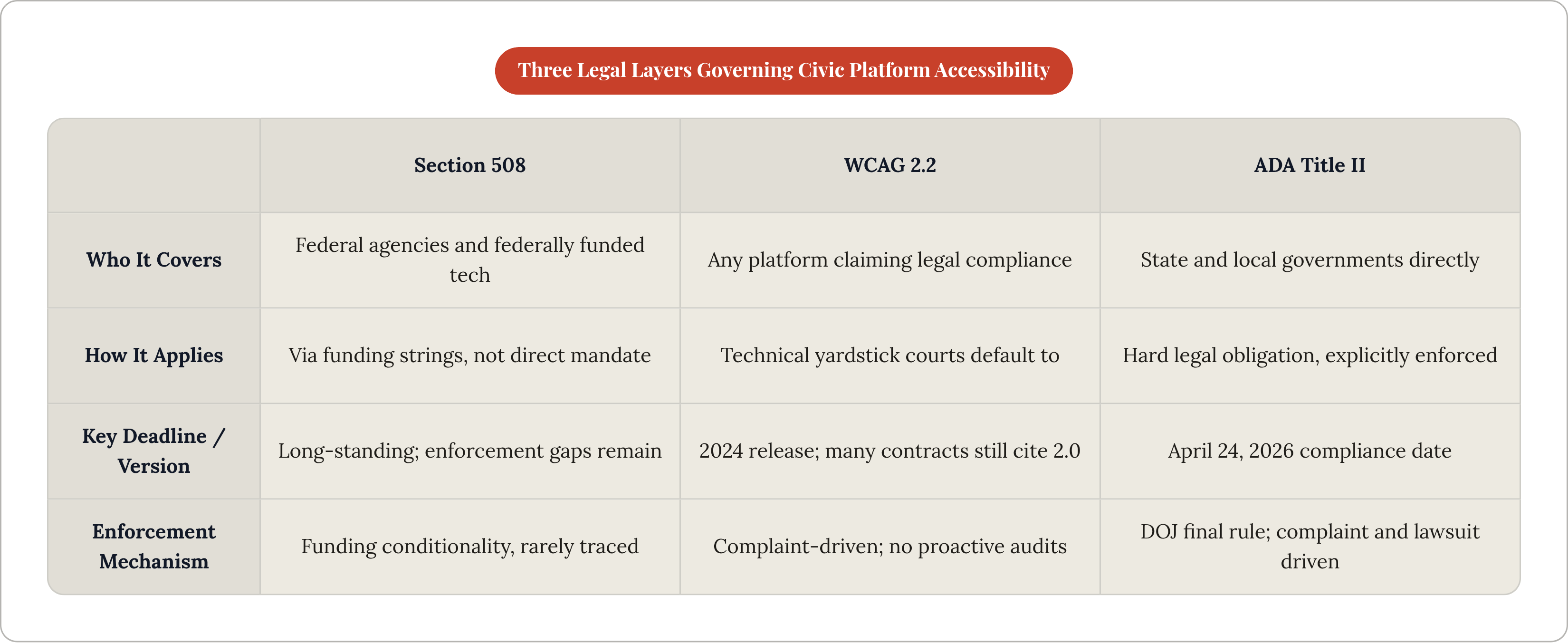
Three legal layers govern this space, and they don't operate independently so much as reinforce each other.
Section 508 of the Rehabilitation Act applies to federal agencies and to any technology those agencies fund, procure, or build. It's been on the books for years, but its reach into state and local government has always run through funding strings rather than direct mandate.
WCAG, the Web Content Accessibility Guidelines, is the technical yardstick that courts keep coming back to, even in cases where the underlying law never mentions it by name. WCAG 2.2, released in 2024, adds new success criteria on top of the 2.1 AA baseline that's dominated procurement language for years. EN 301 549, the European standard that shows up in a lot of international contracts, also anchors to WCAG 2.1 AA. So even outside U.S. borders, the same technical bar keeps reappearing.
ADA Title II is where things get sharper. It's long been read to cover government websites, but the DOJ's April 2024 final rule made that reading explicit and enforceable. State and local governments now have a hard compliance date: April 24, 2026.
Here's how the three pieces fit together in practice. A state-run civic platform might hit Section 508 indirectly, through federal grant money. It hits Title II directly, because it's a state government service. And WCAG sits underneath both as the shared technical standard everyone points to when arguing whether something actually complies.
Colorado offers a preview of what happens when states move faster than the federal timeline. State law required all Colorado government agencies to meet state accessibility standards by July 2024, well ahead of the federal deadline. Agencies turned to assistive tools like Aira and Pocketalk to help close the gap. That's a state government moving on its own clock, not waiting on Washington.
Where federal agencies actually stand on compliance right now
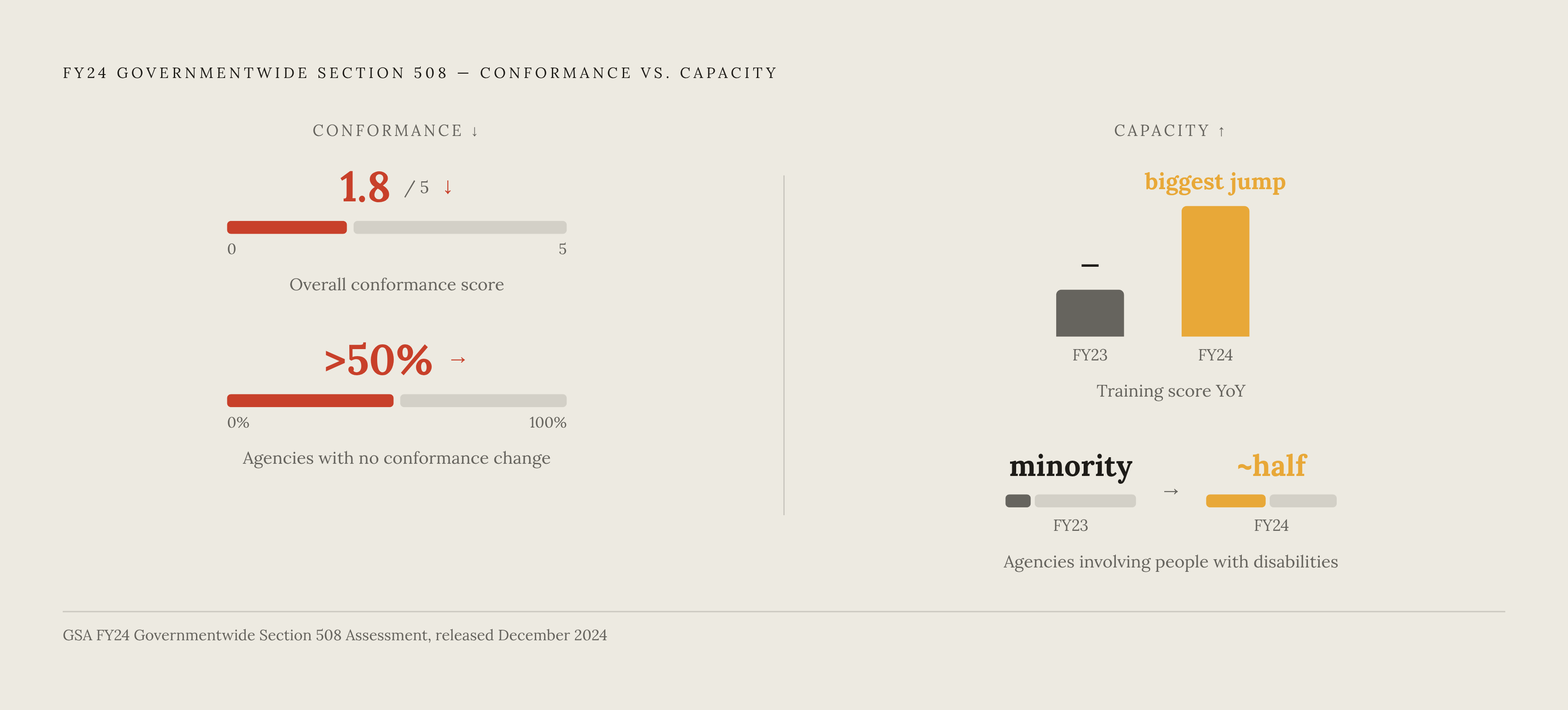
If you want a sense of how hard this actually is, look at how the federal government itself is doing. And the answer, according to GSA's own FY24 Governmentwide Section 508 Assessment released in December 2024, is: not great.
Governmentwide maturity improved only slightly. Conformance actually went down year over year, and it's still sitting low on a five-point scale. More than half of the agencies that reported data said they saw no change in conformance across their most-viewed digital content. Full conformance rates across different types of technology were low across the board. The one category that conformed best? Agencies' own posted Section 508 policy statements. The worst performers were employee-facing portals, the internal tools staff use every day.
About half of reporting agencies said they lacked the resources to even test their top-viewed content. That points to a testing gap as much as a compliance one; you can't fix what you haven't checked.
What did improve is worth noting too. Training scores had the biggest year-over-year jump. And the share of agencies actually involving people with disabilities in defining what they need from a product rose sharply, going from a small minority up to nearly half of reporting entities. That's real progress, even if it's not enough yet.
Here's the thing worth sitting with: these are federal agencies, with legal obligations and dedicated compliance staff. If they're still struggling, what does that suggest about a mid-size city government trying to run a comment portal on a shoestring budget? GSA itself recommended that Congress strengthen enforcement and clarify which agencies are even required to comply. That's an admission, coming from inside the system, that the accountability structure has holes in it.
What WCAG conformance actually requires for participation-focused features
WCAG rests on four principles: content has to be Perceivable, Operable, Understandable, and Robust. Easy to say. Harder to apply to the actual features that make a civic platform a civic platform.
Take a public comment form. It needs to work with keyboard navigation alone, no mouse required. Errors need to be recoverable, meaning a user who fills out a field wrong should get a clear way to fix it, not a form that just clears itself. Screen readers need to be able to parse the whole thing.
Document uploads are a chronic weak spot. Bill drafts, meeting minutes, committee reports get posted as PDFs constantly, and PDFs fail accessibility checks all the time. A PDF needs tagged structure, a sensible reading order, and alt text on any embedded images. A scanned image of a page, with no underlying text layer, is close to useless for a screen reader user no matter how official-looking it is.
Public meetings, live or recorded, need captions and transcripts, plus audio description where visual content matters. Live sessions need real-time captioning, not captions added after the fact. Interactive maps, the kind used for ward boundaries or district finders, need a non-visual equivalent; a map that only works by clicking colored shapes locks out anyone who can't see the shapes. And multi-step workflows, like signature collection or bill co-sponsorship, need every step to be recoverable and free of tight time limits that would exclude someone with a motor or cognitive disability who just needs more time.
WCAG 2.2 adds a few things that matter a lot here specifically: requirements around focus appearance, alternatives to dragging (critical if your platform uses drag-based ranking or signature tools), and authentication that doesn't lean on memory-based tasks. The catch is that a lot of older contracts still cite WCAG 2.0. A platform locked into an old procurement spec can be technically compliant with what its contract says and still fail the current standard, without anyone realizing it until a complaint comes in.
Where AI-assisted civic tools introduce new accessibility variables
AI features are showing up on civic platforms fast: chatbots answering constituent questions, AI-generated bill summaries, voice interfaces, sentiment analysis run on public comments. Some of this genuinely helps. A plain-language summary of a 40-page bill can lower the cognitive load for someone who doesn't have a policy background. A voice interface can serve someone who can't use a keyboard. Real-time translation can reach someone who doesn't speak English as a first language.
Portugal's government virtual assistant is a good example of what this looks like at scale: it covers information on more than 2,300 public services in 12 languages, working across over 5,000 pages of the gov.pt site. That's a real template for what AI-assisted access can accomplish when it's built with intent.
But there's a catch, and the U.S. Access Board has flagged it directly: AI systems have to account for people with disabilities in how they're trained and deployed. If the dataset behind a chatbot doesn't reflect how disabled users actually interact with technology, you get algorithmic bias, and that bias produces discriminatory outcomes. It's a design choice with consequences, not a hypothetical.
There's also a standards gap. WCAG 2.2 doesn't fully address chatbots or voice interfaces yet, which means platforms deploying them are operating in territory where "compliant" isn't clearly defined. That argues for caution rather than for avoiding AI features altogether.
Consider AI that helps a citizen turn a plain-language idea into properly structured bill language. That's a real barrier reduction: legal drafting conventions keep a lot of people out of the process entirely, and tools that translate intent into structure can open the door. But the interface generating that draft still has to be screen-reader compatible and keyboard-navigable. An AI feature built to widen access can just as easily narrow it, if nobody tests it with the assistive technology users it's supposed to serve.
The coverage gaps that leave many civic platforms in a legal gray zone
The April 24, 2026 deadline is real, but enforcement runs on complaints and lawsuits, not proactive audits. Nobody's coming to check unless someone files a complaint first. That changes the incentive structure quite a bit.
Then there's the vendor problem. A lot of cities and states don't build their own participation platforms; they buy one from a civic tech vendor. When that platform turns out to be inaccessible, who's responsible: the government that's the regulated entity under Title II, or the vendor that actually built the thing? Procurement contracts often don't spell this out, and that ambiguity is exactly where accountability goes to die.
Newer interface types make this worse. VR deliberation spaces, voice-only civic tools, blockchain-based voting systems: none of these fit cleanly into existing WCAG or Section 508 criteria. The standards were written for a web that looked a certain way, and civic tech keeps moving somewhere the standards haven't caught up to yet.
Federal funding conditionality is supposed to be a backstop here. Section 508 can apply to a state or local tool if federal money helped pay for it. In practice, that link rarely gets enforced at the project level; nobody's checking the funding trail on a given contract against 508 conformance.
Put it together and you get a familiar pattern: a government posts an accessibility policy statement, which, recall, was the highest-conforming category in the federal assessment, while the actual features citizens use to comment, track bills, or contact their representatives remain genuinely hard to use with a screen reader. The paperwork says one thing. The product says another.
What genuine accessibility looks like in practice on a civic participation platform
So what separates a platform that's actually accessible from one that just says it is?
It starts with research, and it starts early. Bringing in disabled users after launch to see what broke is retrofitting. Bringing them in before the first wireframe is design.
Automated testing tools catch a fraction of the real issues. They're useful for a first pass, but manual testing with screen readers like NVDA, JAWS, and VoiceOver, plus keyboard-only navigation, is where you find the problems that actually block someone from participating. The federal data on this is telling: agencies that involve disabled users in both defining requirements and running acceptance tests are still a minority, but a growing one. That direction matters.
Document accessibility deserves its own line item. Every downloadable piece of legislative content, bill drafts, committee reports, comment summaries, needs to be a properly tagged PDF or an HTML alternative, rather than a scanned image pretending to be a document.
Plain language belongs in this conversation too, and it's easy to overlook. Cognitive accessibility means writing that someone without a legal or policy background can actually follow. That connects directly to the broader goal of any platform trying to turn citizen ideas into real legislation: if the language locks people out before the interface even does, you've lost them at the first sentence.
Feedback loops close the circle. A platform needs an accessible way for users to flag barriers when they hit one, and it needs to publish what it actually did in response. Silence after a complaint is its own kind of failure.
A platform built to let any citizen propose legislation has to treat accessibility as structural, not cosmetic. If the tool that drafts a bill or collects co-sponsor signatures isn't screen-reader compatible and fully keyboard-navigable, the promise of open lawmaking only holds for some of the people it claims to serve. And Colorado's approach, layering tools like Aira and Pocketalk on top of platform design, shows that assistive technology can bridge gaps that interface design alone hasn't closed yet. That reflects a recognition that accessibility is a system, not a single feature.
Why the 2026 deadline is a forcing function for the entire civic tech ecosystem
April 24, 2026 sounds far off until you count backward through a procurement cycle. Redesigns take time. Testing with disability communities takes time. Any platform that hasn't started this work is already behind schedule, whether or not anyone's told them yet.
Trust in government is a real, measurable thing, and it moves for real reasons. OECD data shows that across member countries, only 39% of people report high or moderately high trust in their national governments. Research on civic participation consistently points to one lever that actually shifts that number: meaningful chances to participate, beyond mere access to information. A platform that's inaccessible isn't neutral on this. It's actively excluding the people who depend most on government services and have the fewest offline alternatives to fall back on.
That's a credibility problem for the whole civic tech sector, not just one platform. A tool that claims to democratize lawmaking while locking out screen reader users or people who can't operate a mouse is reproducing the exact exclusion it claims to fix. Taiwan's vTaiwan is worth pointing to here: it acted on more than 80% of the proposals that came through its digital participation channels. That's what an accessible pipeline can produce when it actually works, measured in policy outcomes, not just page views or engagement counts.
By April 2026, a platform should be able to say more than "we have an accessibility statement" posted somewhere on its site. It should be able to say it tested with disabled users, that its participation workflows are fully keyboard-navigable, that its AI features got audited for assistive technology compatibility, and that it has an ongoing process for fixing what it finds. Accessibility standards exist for one reason: inclusion in democratic processes isn't optional. The platforms that treat it that way now are the ones that will decide who actually gets a seat in the next generation of digital civic life, and who gets left standing outside it.