How Neighbor Co-Signature Campaigns Differ from Online Petitions
Verified neighbors beat anonymous clicks when officials decide what to support.
Petitions are good at one thing, and they're really good at it: getting a lot of eyeballs, fast. Need to raise awareness, build pressure, or show that a coalition exists before it's fully formed? A petition does that job, and I've watched high-profile campaigns bend public opinion in a matter of days, especially once a news cycle grabs one and won't let go.
Past that stage, though, the record gets thin. Government petition platforms that promised a response once a petition hit some signature threshold have produced almost nothing in the way of actual legislation, even for the petitions that cleared the bar. At least one parliamentary study finds the same pattern: a small fraction of petitions get so much as a concrete legislative outcome. And on Change.org, the vast majority of petitions don't succeed at all, usually not because the cause was weak, but because of how the thing was built, addressed, or timed.
The credibility problems aren't a bug you can patch. They're baked into the format, and bots and duplicate signups are a documented issue, with a signer who might live nowhere near the jurisdiction the petition targets. The list is flat: everyone's just a name, nobody's verified as anything, and an official has no way to separate a constituent from someone three states away who saw a link on Twitter.
Researchers who study participation have flagged something else worth sitting with: online petitions tend to mobilize people who were already politically engaged, rather than pulling in anyone new. So petitions carry real weight for awareness and comparatively little for legislation. Most decision-makers figured that out a while ago; the rest of us are catching up.
How verification and geography change what a signature means
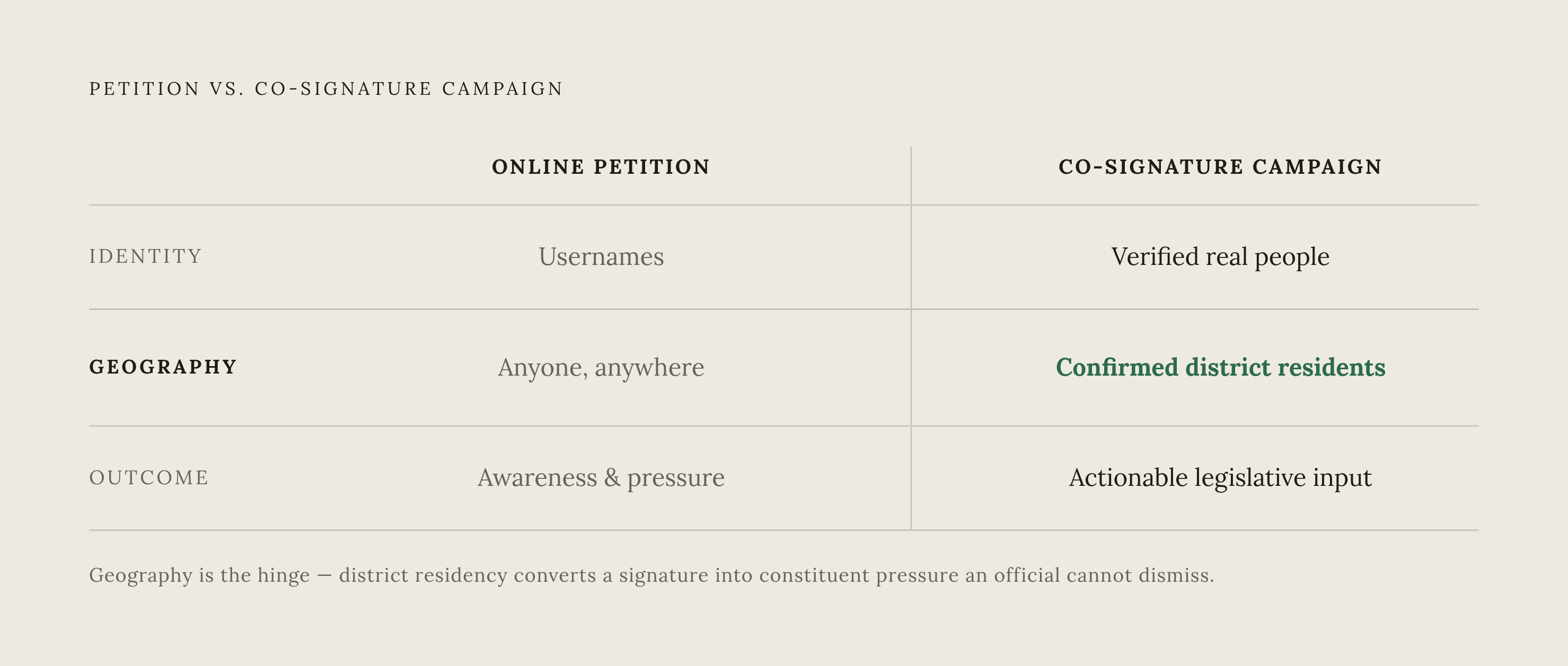
Strip away the differences in enthusiasm or volume, and the real gap between a petition and a co-signature campaign comes down to one question: what can the signature actually be verified to represent?
A neighbor co-signature campaign asks for things a petition never bothers with. Identity verification, so signers are real, named people instead of usernames. Geographic eligibility, so signers actually live, work, or hold some defined tie to the place the campaign is about. And strict format compliance: the form, the deadline, the minimum threshold, none of it negotiable.
Talk to anyone who's run one of these campaigns and they'll tell you to collect well past the stated minimum, since invalid signatures, out-of-district signatures, and incomplete entries don't get a pass. It gets thrown out, full stop, and that fact alone reshapes how you plan the whole effort from day one.
Once verification and geography are locked in, what you're holding is a constituency. A confirmed, geographically bounded list of signers is hard for an official to wave off, because dismissing it means dismissing specific voters in the district that official represents, with the electoral consequences attached. Geography does something else too, quietly: people who live near each other tend to actually care about the same road, the same school, the same zoning fight. A co-signature list reflects a community of interest; a petition, more often, reflects a community of clicks. Local officials in particular have come to treat verified signatures as the real signal, the one that separates serious constituent pressure from noise.
Why neighbor-to-neighbor outreach produces a qualitatively different kind of support
Neighbor co-signature campaigns run on relational organizing. That means they travel through trust that already exists, rather than broadcasting to strangers scrolling past a link at 11pm.
Think about what that actually changes. A neighbor asking you to co-sign something on your porch is a different social act than tapping a button on your phone, and there's accountability built into the ask, since the person doing the asking is someone you actually know. Usually there's a real conversation too, one that builds understanding of the issue instead of prompting a quick, passive nod.
Research on relational organizing in elections keeps landing on the same finding: contact from someone the voter personally knows produces engagement rates well above stranger-to-stranger outreach or digital-only contact. It's especially effective at reaching people who are usually checked out of civic life, a group that online petitions are less well suited to engage.
The Gardiner Democratic Committee's Neighbor-to-Neighbor initiative captures this well: people reaching out to neighbors they already know, sharing information, building trust that outlasts a single campaign. What comes out the other end is a network of people who've already talked the issue through together, and that's a sturdier base for advocacy than any signature collected cold.
The structural gap between local democracy and the tools citizens actually have
Most of what government touches in your actual day, streets, schools, zoning, parks, trash pickup, is local. Yet local participation sits at the bottom of the pile, consistently below state or national turnout.
Why, when local decisions are the ones you'll feel by Friday? Some of it's just perception. People file local politics under "small stuff," background noise next to the national headlines, even though the zoning vote next Tuesday will change their commute more than anything happening in Washington this year.
Some of it is structural, and this part matters more. Ballot initiatives and citizen-led referenda aren't available to roughly half of Americans at the state level, and access thins out even further at the municipal or neighborhood level. Los Angeles Neighborhood Councils are one attempt at a fix: built to give residents the closest form of government available, open to anyone eighteen or older, including non-citizens, requiring nothing but a genuine connection to the neighborhood. Proximity is the qualification, and that's the exact same design principle a neighbor co-signature campaign runs on, just without a City Charter backing it up.
Where the formal structure doesn't exist, co-signature campaigns step into the gap. They impose the same geographic and relational discipline a formal process would demand, minus the official apparatus. This is the layer of civic life that both petitions and national advocacy tend to skip: one ignores geography entirely, the other ignores scale.
What makes a co-signature campaign credible enough for officials to act on
Officials, especially at the local and state level, respond best to input that already looks like the way they think about their own job: by district, by ward, by constituency.
A verified list of signers from one specific zip code reads nothing like a national count with no borders on it. At least one House communications director has said as much: organized constituent pressure and real constituent stories ranked among the richest sources for actual legislative ideas, well above generic noise.
Credibility here comes down to three things landing together. Verification, so these are confirmed real people. Geography, so they're your voters, specifically. Structure, so the ask is concrete rather than a vague complaint. A co-signed proposal with a defined legislative ask attached reads as something you can act on; a petition that just says people are upset carries less weight on its own. Officials need to know what to do about a problem, not only that it exists, and that's where the shape of the document starts mattering almost as much as who signed it.
Partnerships push this further. When civic associations, faith groups, and neighborhood organizations co-sponsor a campaign, the breadth of support shows up in the coalition itself, not buried in a raw signature count. And the organizers who do this well will tell you plainly: petitions and co-signature drives work best next to other organizing, not instead of it.
How civic technology is closing the gap between a citizen's idea and a formal legislative proposal
Good civic technology lowers the barrier to structured participation without giving up the rigor that makes the participation legible to whoever has to act on it. Petitions are the cautionary tale here: optimized for volume and ease, at the direct cost of verification, geography, and specificity.
The better model pairs digital tools with the same discipline relational organizing already runs on. Taiwan's vTaiwan platform is worth studying for this: it earned actual government responsiveness by combining structured digital deliberation with a direct line into the policy process itself, reaching further than simply broadcasting sentiment into the void and hoping someone reads it. Local governments using neighborhood platforms like Nextdoor have found something similar. Geographic organization makes online talk feel accountable in a way national social media never quite pulls off.
AI is starting to matter here too, functioning less as a replacement for citizen voice and more as a translator between plain language and the structured form a legislative process actually needs. Local governments already use it for drafting, summarizing, and communicating policy. Greece's opencouncil.gr platform is a good example: it uses AI to transcribe council meetings automatically and generate neighborhood-specific summaries residents can actually sit down and read.
PollSee runs on that same idea: an approach where an idea becomes an AI-drafted bill, and signers verify their identity with real geographic accountability built in from the start. It reaches officials already shaped into something actionable, carrying the structure and legislative ask a bare petition usually lacks. Verification is part of the foundation rather than something bolted on afterward, and the geographic grounding functions the same way, as a core design choice rather than a limitation. And what comes out the other side is a draft bill, not a list of names sitting in an inbox somewhere.
What citizens should understand before choosing between a petition and a co-signature campaign
Pick the format based on the goal, not on whichever one is easier to launch this afternoon.
If the goal is awareness, or pressure, or a first read on whether a coalition even exists, a petition is fast, it scales, and it's the right tool for that job. But if the goal is a specific legislative change at the local or state level, the verification and geographic structure of a co-signature campaign stops being optional. That's the difference between an official noting your name and an official acting on it.
The strongest campaigns I've seen use both, in sequence: a petition to surface and test sentiment, a co-signature drive to convert that sentiment into something formally actionable. Before collecting a single signature for the latter, know the exact eligibility rules and deadlines, and build in a real buffer above the stated minimum, since disqualified signatures can sink a strong drive without warning. Bring in community organizations and faith groups as partners; they demonstrate the breadth of support, not just its depth. And show up with something specific: a draft proposal, a clear outcome, a named decision-maker who can actually act on it.
Officials respond to input organized the way they think about their own job: by constituency, by jurisdiction, by a clear ask they can act on. Citizens who get that have a real structural edge over the ones who sign something online and wait for a reply that mostly never comes.