How a Bill Becomes a Law at the State Level
Most laws that actually touch your life, your kid's school, your street, your rent, get written in your state capitol, not in Washington. Housing, education, health care, criminal justice: these are state matters, hashed out in sessions almost nobody watches. Statehouses introduced more than 76,765 bills during the 2024 state legislative sessions, and over 14,088 of them became law, according to Quorum. I've spent enough time around this process to know that number surprises people, and it should, because it means the doors are open a lot wider than most of us were ever told.
I don't want to give you a civics lecture. I want to walk through where a regular person can actually step into this machine, and where showing up just adds noise.
How a bill originates and who actually drafts it
Ideas come from everywhere. Some legislators cook them up on their own, while others land from advocacy groups, a state agency with a problem to solve, or a constituent who calls their rep's office to complain about something and ends up handing over the seed of an actual bill.
Once a legislator decides to run with an idea, they don't sit down and write the thing themselves. They send it to the Office of Legislative Counsel, the people who handle the actual legal language. At that point it's a request number, not a bill, and it only becomes real once it's delivered to the chamber floor and the Chief Clerk stamps it with a bill number.
Most people assume their involvement ends right there, since they don't have a law degree and wouldn't know statutory language if it bit them. But you don't need one. A constituent who shows up with a clear, well-formed idea hands a legislator something they can move on immediately. Legislative offices regularly report that constituent ideas drive some of their most meaningful bills. Newer legislators want causes to champion especially, since they're building a record early in their term, and a solid local idea from a real person in their district is exactly the kind of thing they're hunting for.
So the earliest point of leverage in this whole system costs nothing, since it's a phone call or a fifteen-minute sit-down, not a lawsuit and not a lobbying budget.
What actually happens inside a committee, and why it's the most important room in the building
Once a bill gets introduced, leadership hands it to a committee. That's not a formality to skip past, since no bill reaches the floor without clearing committee first, and this is where the real decisions happen, quietly, away from cameras.
Committees hear public testimony, read written analyses laying out who's for and against, and vote by roll call. From there a bill can pass as written, get amended, get tabled indefinitely, get killed outright, or get punted to another committee entirely. Most bills die right here, and the dramatic floor fight you picture in your head mostly already happened behind a much smaller door, in front of far fewer people.
Bills sit in the Daily File for four days before a hearing can happen, which gives you a real window to prepare. Public hearings aren't some courtesy tacked onto the process afterward; they're built in structurally as the public's main point of entry. And committee members treat an individual citizen differently than a paid lobbyist. Someone describing exactly how a bill hits their block carries a weight that no amount of polish can fake.
How to actually testify: what to say, how long to take, and what to bring
Every state runs its own rules, so check yours before you show up. Hawaii requires written testimony at least 24 hours ahead of the hearing. Most states run on something close to that clock, and it's posted right in the Daily File.
Washington State lets citizens register their position and testify remotely over Zoom through leg.wa.gov. That single change, remote access, quietly lowered the barrier to entry across a lot of states, and you no longer need to burn a vacation day and drive three hours just to say three sentences into a microphone.
When you do testify, keep it tight. State your name, say you're a constituent (or name the group you represent), and say where you live, since geography lands differently with committee members; someone from their own district hits home in a way an out-of-town advocate never will. Keep spoken remarks short: one clear ask, one specific reason, one real example pulled from your own life or your own street. Save the deeper material (the data, the petitions, the signatures from neighbors) for written testimony, where you've got more room to actually build a case.
Before the hearing, call the bill author's office and ask who else is weighing in, for or against. Coordinate with people already on your side so five of you aren't repeating the same three minutes of testimony and burning through the committee's patience. This isn't a protest, but a structured information-gathering exercise, and the committee, whether members admit it or not, is genuinely open to being persuaded.
The floor vote, the second chamber, and what happens when the two versions of a bill disagree
Once a bill clears committee, it gets a third reading and a floor debate before the full chamber votes. In California, most bills need a simple majority: 21 votes in the Senate, 41 in the Assembly. Urgency measures and appropriations need two-thirds, 27 and 54. Most states run some version of this tiered system, with the numbers shifting but the logic staying the same.
If the bill passes, it crosses to the other chamber and starts the committee-and-floor process over from scratch. If that second chamber changes anything, even a single word, the bill bounces back to where it started. When the two versions can't be reconciled, a conference committee (members pulled from both chambers) gets convened to hammer out one final version. Budget bills go through this dance constantly, sometimes more than once in a single session.
It's tempting to think your job ends once a bill clears committee, but it doesn't; legislators stay reachable during this back-and-forth, and constituent contact during that stretch has shaped real amendments before. Track which chamber your bill sits in, since most legislatures post real-time status online, so there's no excuse for losing the thread halfway through.
The governor's desk: signing, vetoing, and the ten-day window citizens often overlook
Once both chambers pass identical language, the bill lands on the governor's desk. In California, and in most states, the governor gets 10 days, excluding Sundays, to sign it or veto it. Leave it untouched past that window and, in most cases, it becomes law anyway by default.
A veto isn't the end of the road, necessarily. In California, a two-thirds vote in both chambers can override it, and most states have some override path built in, though they get used rarely.
That ten-day stretch is a real pressure window, not a ceremonial pause before the inevitable. Letters, organized calls, visible community support: any of it can shift whether a governor signs quietly or vetoes without much fanfare. Governor's offices track how much constituent contact a bill generates, and a bill with a documented trail of public support is a much harder thing to kill without anyone noticing.
So knowing all these stages exist, where should you actually be putting your energy?
Where citizen voices carry the most weight across the full process
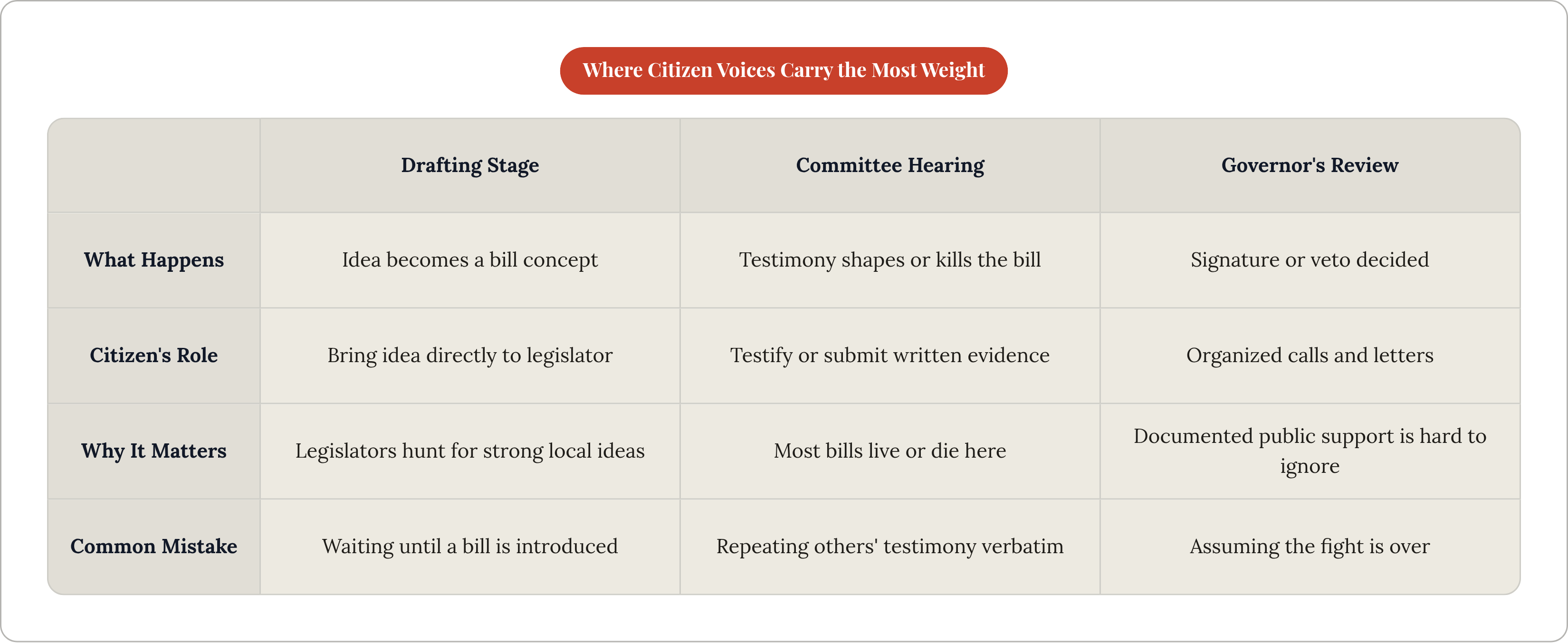
Three moments matter more than the rest: the drafting stage, when you bring an idea to a legislator before it's even a bill; the committee hearing, where testimony and written submissions actually move outcomes; and the governor's review window, when pressure can still tip a signature one way or the other.
Floor debates, by comparison, are mostly theater. The real negotiating happened in committee weeks earlier, and the floor vote is often just confirming what a smaller room already decided among themselves.
Local and neighborhood issues, oddly enough, are where an individual voice carries the most relative weight. Fewer organizations are fighting over those bills, which means one constituent showing up again and again can matter more at the state level than it ever would at the federal level. Consistency counts here, since legislators notice volume and pattern, not a single email that arrives once and disappears. Pair that with a handful of verified neighbors backing the same ask, and one person's opinion starts reading like community consensus.
The Minnesota Civic Education Coalition is worth studying if you want to see what patience buys you. After seven years of sustained advocacy, Governor Walz signed a civics course requirement into law, with $300,000 attached for civic programming. Seven years is a long haul, longer than most people would stick with anything, but it's a concrete, traceable win, and it happened because people kept showing up past the point most groups quit.
How technology has changed what citizens can realistically do in a state legislative session
Remote testimony changed the math on who gets to participate. Zoom hearings and electronic submission mean you don't need to burn a vacation day driving to the capitol to say three sentences into a microphone. Bill tracking tools let you follow a specific piece of legislation in real time instead of hoping a local reporter covers it before the vote happens, if a local reporter is even still covering the statehouse at all.
The OECD describes civic tech as digital tools that let the public stay informed, take part in decisions, and hold government accountable. Fair enough. I'd push that further: this isn't a nice-to-have, it's infrastructure, the same way roads and water systems are infrastructure.
Taiwan's vTaiwan platform is probably the clearest example anywhere in the world of this working at scale. It blends online deliberation with in-person dialogue, and it's led to government action on more than 80% of the proposals that pass through it. The appetite isn't confined to one country either. The UNDP's 2025 Regional Civic Tech Innovation Challenge pulled in 251 applications from 30 countries, covering everything from citizen feedback tools to digital petition platforms to AI-assisted public service work.
None of that solves the real gap, though. Most people know their state rep exists, but almost none of them know how to move an idea off their kitchen table and into an actual legislative pipeline. The tools above fix the information problem: knowing what's happening and when. They don't touch the drafting problem at all.
Why plain-language ideas rarely make it into legislation on their own, and what AI drafting changes
Say you've got a fully formed idea and a legislator who's genuinely interested. You're still stuck, because the Office of Legislative Counsel is the bottleneck standing between you and an actual bill. Turning a plain-language idea into properly structured bill language takes legal skill most of us don't have and can't easily hire out on a whim, not at the hourly rates real legislative attorneys charge.
Without that structure, your idea just stays a suggestion. A legislator can nod along, tell you it's a great point, and then it goes nowhere, because there's no draft sitting on anyone's desk to actually introduce.
This is where AI drafting starts to change the equation. It's now possible to take a citizen's plain description of a problem and turn it into a structurally sound bill draft, no lawyer, no lobbyist required. Lawmakers already treat AI as a serious governing tool themselves: across all 50 states, AI-related bills were introduced at a striking pace in 2025. That same underlying capability now sits on the citizen's side of the table too, not just the legislature's.
PollSee runs on exactly this idea. A citizen writes their proposal in plain language, AI turns it into proper bill format, verified neighbors co-sign it, and it gets routed straight to the relevant elected official. It's the full path from idea to formal proposal, no law degree required, no lobbyist on retainer.
There's a real difference between this and a petition. A petition tells a legislator that people care about something, while a structured draft bill hands them something they can actually introduce on the floor tomorrow morning. That gap (caring versus actionable text) is what civic tech is closing right now, piece by piece.
What a citizen-drafted bill actually needs to be taken seriously by a legislator
When a proposal lands on a legislator's desk, they run it through a quick set of filters, whether they say so out loud or not. Is this actually within my jurisdiction? Does it cover something existing law doesn't already handle? Does this person have backing beyond just themselves and a strong opinion?
Verified neighbor co-signatures answer that last question directly. They show the idea reflects something the community actually wants, not one person's bad Tuesday, and that distinction is often the line between a proposal that gets filed away and one that gets introduced.
Structure matters just as much. A proposal that already looks like a draft bill (stated purpose, the statutes it touches, actual operative language) is far easier for Legislative Counsel to work with than a heartfelt paragraph in an email. Timing isn't nothing either, and the best window to approach a legislator sits before session starts or in its early weeks, while committee assignments haven't locked in yet and agendas are still soft.
Local issues (zoning, school policy, park access, local ordinances) sit in the least crowded space in the entire legislative landscape. Fewer organized interests fight over them, the impact on constituents is easy to see and explain in one sentence, and the line between "I proposed this" and "this got a vote" is shorter than almost anywhere else in the system. The YIMBY movement is worth studying here: neighbor-driven coalitions pushed through zoning wins in Minneapolis, Portland, Cambridge, and Seattle, and at the state level in California, Connecticut, Minnesota, and Washington. None of that came from a massive lobbying budget. It came from coordinated, structured constituent pressure, applied consistently over years, not weeks.
How to move from understanding the process to actually using it
Laid out end to end, none of this is actually mysterious: idea, draft, introduction, committee hearing, floor vote, second chamber, governor's signature. Every step has a door built into it, and some doors are wider than others, sure, but none of them are locked.
The real entry points (drafting, committee testimony, the governor's review window, sustained contact along the way) are structural, not symbolic gestures. They're not consolation prizes handed to citizens so we feel heard. They're places where outcomes have actually moved because someone showed up and then kept showing up.
What usually stands between a person and using any of this comes down to one of three things: not knowing how to draft something properly, not knowing how to find people to back it, or not knowing who to even send it to. Start by figuring out which level of government actually has jurisdiction, local or state, before writing a single word of anything. Use your state legislature's bill-tracking system to find the right committee or the right legislator for your specific issue, then line up verified community support before you ever walk into anyone's office. Put your idea into as much structural detail as you can manage on your own, or use something like PollSee to turn it into an actual bill draft. And once a hearing gets scheduled, watch the Daily File and get written testimony in at least 24 hours ahead of time.
The distance between having an idea and having a bill with your name on it is smaller than most of us were ever told growing up. I didn't believe that either, until I watched it happen from the inside.