Citizen Petition Laws vs. Ballot Initiatives vs. Legislative Bills
Only 26 states let citizens bypass lawmakers and take issues straight to voters.

Three roads exist for turning a citizen's idea into law: the legislative bill, the ballot initiative, and the citizen petition. Each hands the final call to a different party (voters, lawmakers, or an official acting on their own judgment), and that one difference explains almost everything else about how these paths play out. Picking the wrong pathway and burning months on it is a common and avoidable mistake.
The confusion usually starts with the word "petition" itself. People use it for a Change.org page, a formal filing with the FDA, and a signature drive to get a measure on the ballot. Those are three different animals, and mixing them up costs real time. You pick a petition when you needed an initiative, or you try to run an initiative in a state that doesn't allow one at all. There's no federal citizen initiative process, and no state process scales up to cover that gap either. Where you live decides what's even possible before you've written a single word.
How a legislative bill actually moves, and where citizens fit in
The textbook version goes like this: introduce, send to committee, floor vote, second chamber, then the executive. What the textbook skips is where the bill actually dies. Nine times out of ten, that's committee, so if you're going to spend your political capital anywhere, spend it there.
So where does an ordinary person fit into that machine? A few real entry points exist. You can petition a member of Congress to introduce a bill, a recognized channel for citizen participation in the legislative process. You can testify at a committee hearing, open to the public at the federal level, and most states run something similar. Calling, writing, or emailing your representative rounds out the list — the easiest option here and also the least binding, since nobody's required to write back.
Then there's the kind of advocacy that actually moves an office: the organized "Hill Day," where constituents show up in person, in numbers. A stack of form letters reads as noise, while a room full of voters from your own district reads as something else entirely. A letter costs nothing to send; showing up costs a day of work, gas money, maybe a babysitter. The signal is a lot harder to fake when it costs you something.
The veto override sits at the far end of all this, rarely used, but a good reminder that even the executive branch doesn't get the last word.
What does the bill pathway actually give someone? Legitimacy, mostly. There's staff who know how to draft language, and a process that in theory ends in a recorded vote you can point to. But it costs something too: you need a sponsor. Without one, a genuinely good, specific, well-reasoned idea has no formal way to move. That's not a merit problem; that's a missing mechanism.
Ballot initiatives: direct democracy and the geography of access
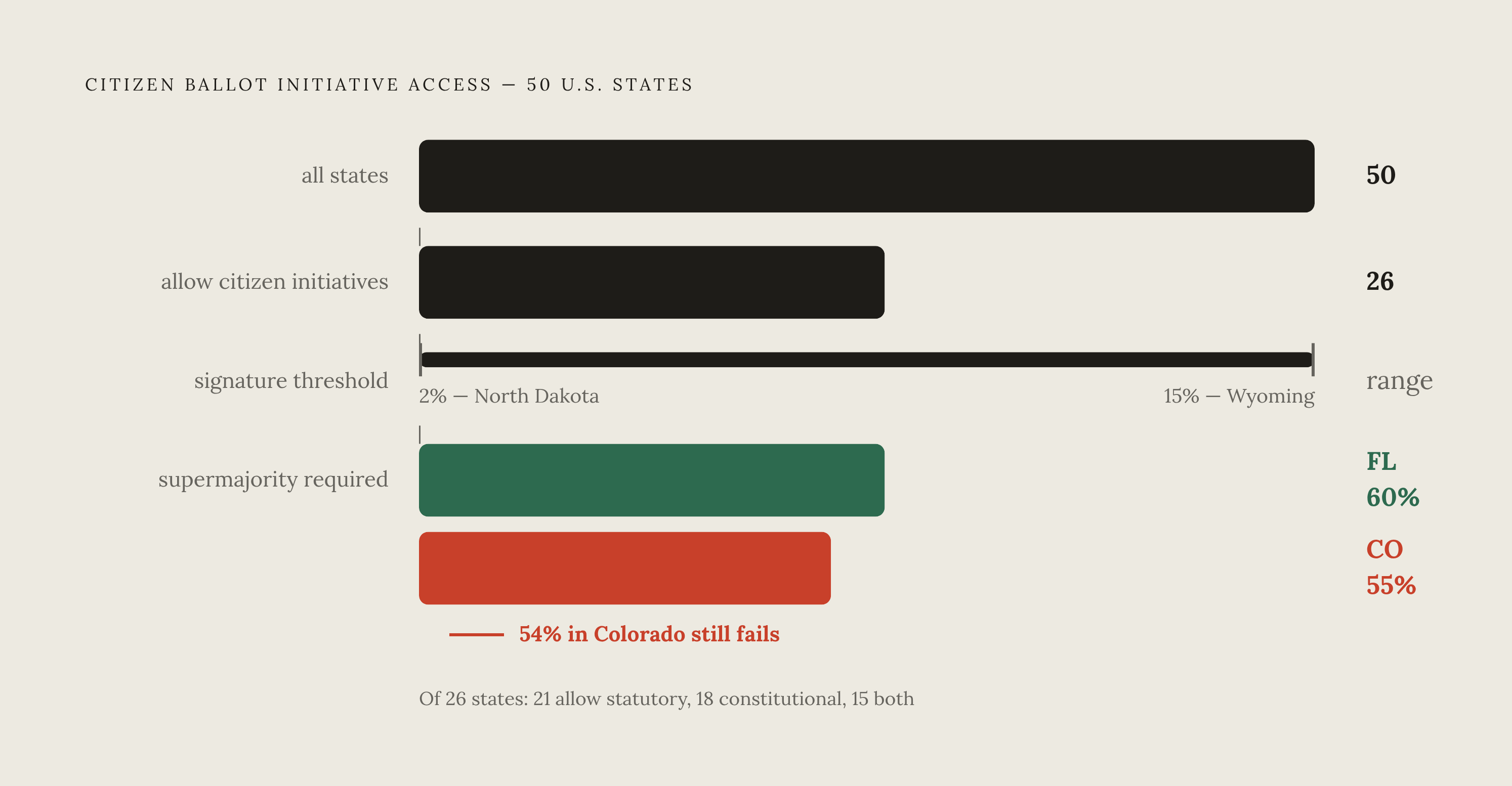
The pitch is obvious: citizens propose it, citizens vote on it, the legislature gets skipped entirely. That pitch only holds if you happen to live in the right state. Only 26 states run any statewide citizen-led ballot measure process at all. Of those, 21 allow statutory initiatives, 18 allow constitutional amendments, 15 allow both. No federal version exists, so if your issue is national, this door is closed before you've knocked on it.
Even inside those 26 states, the mechanics shift under you. A direct initiative goes straight to voters. An indirect initiative goes to the legislature first and only reaches the ballot if lawmakers sit on it past a set deadline. A veto referendum works backward, asking voters to keep or repeal a law already on the books; it's reactive by design, not something you'd reach for to introduce a new idea. Seventeen states let citizens initiate constitutional amendments specifically, and those sit in their own category, since a legislature can't just undo them with an ordinary vote later.
Getting on the ballot is its own fight before you get near a vote. Signature thresholds run from 2% of voters in North Dakota to 15% in Wyoming. That gap is the difference between a manageable local push and something that needs real organizing muscle, paid canvassers, the works. Add in the geographic distribution rules some states impose, requiring signatures spread across multiple counties, and you start to see how much work happens before anyone's cast a ballot.
Winning the vote doesn't always mean winning, either. Florida requires 60% approval for a constitutional amendment. Colorado requires 55%. A measure can pull 54% in Colorado, a clear majority of actual voters, and still fail. That cuts against the instinct that direct democracy just means majority rules.
Here's a detail people miss: legislatively referred measures (proposals the legislature itself puts on the ballot) actually outnumber citizen-initiated ones nationwide. In 49 states, constitutional amendments need voter ratification no matter who wrote them first. A legislature-driven layer runs underneath the citizen-facing surface of this whole process, and most people never notice it.
For anyone in one of the 24 states without initiative rights, none of the above applies. The ballot pathway isn't there, and the legislative bill becomes the only formal option left standing.
Citizen petitions: the broadest access and the weakest structural guarantee
Anyone can petition the government, thanks to the First Amendment, with no qualifying test attached. But that open door comes with a catch: "petition" covers two genuinely different things, and mixing them up wastes a lot of effort.
There's the formal regulatory petition, filed with an agency like the FDA or EPA, asking for a specific rule change. These carry real weight; the agency has a legal obligation to respond in some form. Then there's the legislative advocacy petition, recommending a bill to a member of Congress or a state legislator. This one carries no binding obligation at all. The recipient can read it, ignore it, or hand it to an intern, and nothing in the structure demands more than that.
Digital petition platforms run alongside both of these: wide reach, almost no barrier to starting one, zero structural claim on anyone in government. A petition can rack up thousands of signatures and still go nowhere, because going viral and having legal standing are unrelated things. Signature counts alone don't predict outcomes.
It works sometimes, and it's worth digging into when. In 2024, parents across Nassau and Suffolk Counties petitioned for fair pay for disability childcare providers. Nassau responded with a 25% pay increase, and Suffolk followed with 11.5%. Neither county was required to act; local political will moved on its own, with no procedural rule forcing anyone's hand. That's the whole point of a petition: it can signal demand, draw press, pressure officials, but it can't compel a vote or force anyone to draft a bill.
So what's the actual gap? It's the distance between a petition going viral and a petition producing an actual law. Crossing that distance takes structure the petition itself was never built to provide.
What citizen-led ballot initiatives have actually changed
Look at what landed on ballots in November 2024: 46 state measures spanning a wide range of consequential policy questions. That's a real cross-section of American political life, decided directly by voters instead of filtered through a statehouse.
Take minimum wage. Federal minimum wage has sat frozen at $7.25 since 2009. Into that vacuum, voters approved 14 separate citizen-led ballot initiatives to raise wages at the state level. In 2025, states with inflation-adjustment provisions built into those initiatives saw nearly 6 million workers get a raise as a direct result. That's not a rounding error; that's a real policy outcome the federal government simply refused to produce.
Reproductive rights tell a similar story. Since Roe was overturned, voters have protected reproductive rights every time the question reached a ballot. Ohio's 2023 Issue 1 is the clearest case: it passed even though Trump carried the state with more than 53% of the vote in 2020. That's a real signal this pathway can cut across party lines in ways legislative votes rarely do.
Redistricting reform tells you something more structural. Redistricting commissions have repeatedly emerged from citizen-led ballot initiatives precisely because no legislature is eager to build a commission designed to strip away its own power over district lines, so voters have had to go around it, because asking nicely was never going to work.
D.C.'s Initiative 83 passed in 2024 with nearly three-quarters of residents in favor, bringing in ranked choice voting. But the supermajority win wasn't the end of the story; it still needed legal defense and follow-up action from the council before it actually took effect. Winning the vote and getting the policy running are two separate fights, and I'd wager most voters don't realize that until it happens to them.
Missouri and Oklahoma expanded Medicaid through ballot initiatives in 2020, after their own legislatures had already blocked the same expansion outright. That pattern keeps showing up: initiatives tend to succeed most visibly exactly where a legislature already said no.
The growing effort to constrain direct democracy after voters win
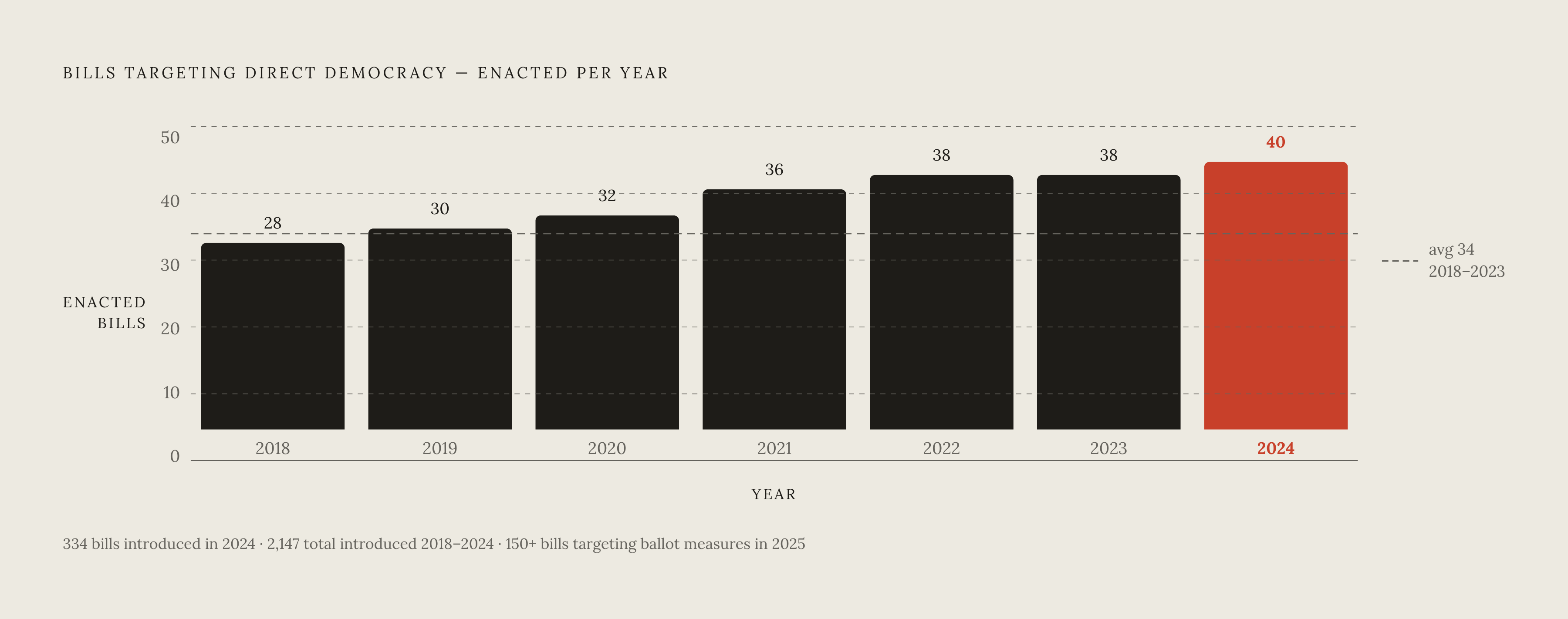
Here's the part that should give any initiative supporter pause. In 2024 alone, lawmakers introduced 334 bills related to direct democracy processes, and 40 of those got enacted, well above the 2018-2023 average of 34 enactments a year. From 2018 to 2024, the total count of bills targeting direct democracy across all 50 states hit 2,147, an annual average of 307. In 2025, the Ballot Initiative Strategy Center tracked more than 150 bills aimed specifically at weakening the ballot measure process. Sit with that number for a second: 150 bills, one purpose.
What do these bills actually do? They raise the signature threshold, impose a supermajority requirement where a simple majority used to be enough, and hand the legislature power to amend or repeal a measure voters just approved. Different tactics, same direction: making a citizen-initiated win harder to hold onto once it's already won.
Michigan is the case worth remembering. In 2024, the state Supreme Court ruled that the legislature's habit, adopt a citizen initiative, then immediately water it down through amendment, violated the state constitution. The ruling restored the original minimum wage and paid sick leave language voters had passed back in 2018. Years of legal work, just to get back to what voters had already approved once. Think about that: an entire legal battle fought to arrive exactly where the ballot box already put everyone.
Missouri and Nebraska show the same pattern: lawmakers moved to weaken voter-approved economic measures after those votes were in.
There's a counterpoint worth holding onto, though. When citizens get a direct vote on measures designed to curtail their own initiative rights, they've almost always voted those measures down. People seem to know, instinctively, when someone's trying to take a tool out of their hands.
Winning an initiative vote isn't the finish line. A passed measure still has to survive a legislative and legal environment built to delay it, defund it, or reverse it outright, and that environment doesn't clock out just because voters spoke.
The money and infrastructure required to actually run an initiative campaign
Initiatives were built on a simple premise: let citizens go around entrenched interests. The criticism aimed at the process today flips that premise on its head, arguing initiatives have become a tool wealthy actors use to go around the legislature instead.
Consider Washington in 2024. Hedge-fund manager Brian Heywood spent roughly $6 million of his own money to put six ballot measures in front of the legislature. Lawmakers approved three outright; the other three went to voters, where all three failed. Whatever you make of that outcome, the number alone tells you something: $6 million dwarfs what any ordinary citizen has sitting around, and it should.
Costs climb for a structural reason, not a conspiratorial one. As a state's population grows, so does the number of signatures needed to qualify a measure. Past a certain size, volunteers can't realistically collect enough on their own, so campaigns bring in professional signature-gathering firms. That's a real line item on a budget, often running into six figures by itself, and it prices out exactly the grassroots effort the initiative process was supposed to protect in the first place.
So what does that mean for a neighborhood group with a genuinely good local idea and no campaign war chest? A statewide initiative probably isn't a realistic tool for them, whatever the merit of the idea. The mechanism was built for statewide fights, not neighborhood ones. Most of what actually touches daily life, zoning, local services, neighborhood ordinances, sits at a level where neither the state initiative process nor a federal bill really applies. Local and municipal ballot measures exist and tend to cost less to run, but the rules shift so much from one jurisdiction to the next that there's no single playbook to just pick up and use.
How the three pathways compare across the dimensions that actually matter to citizens
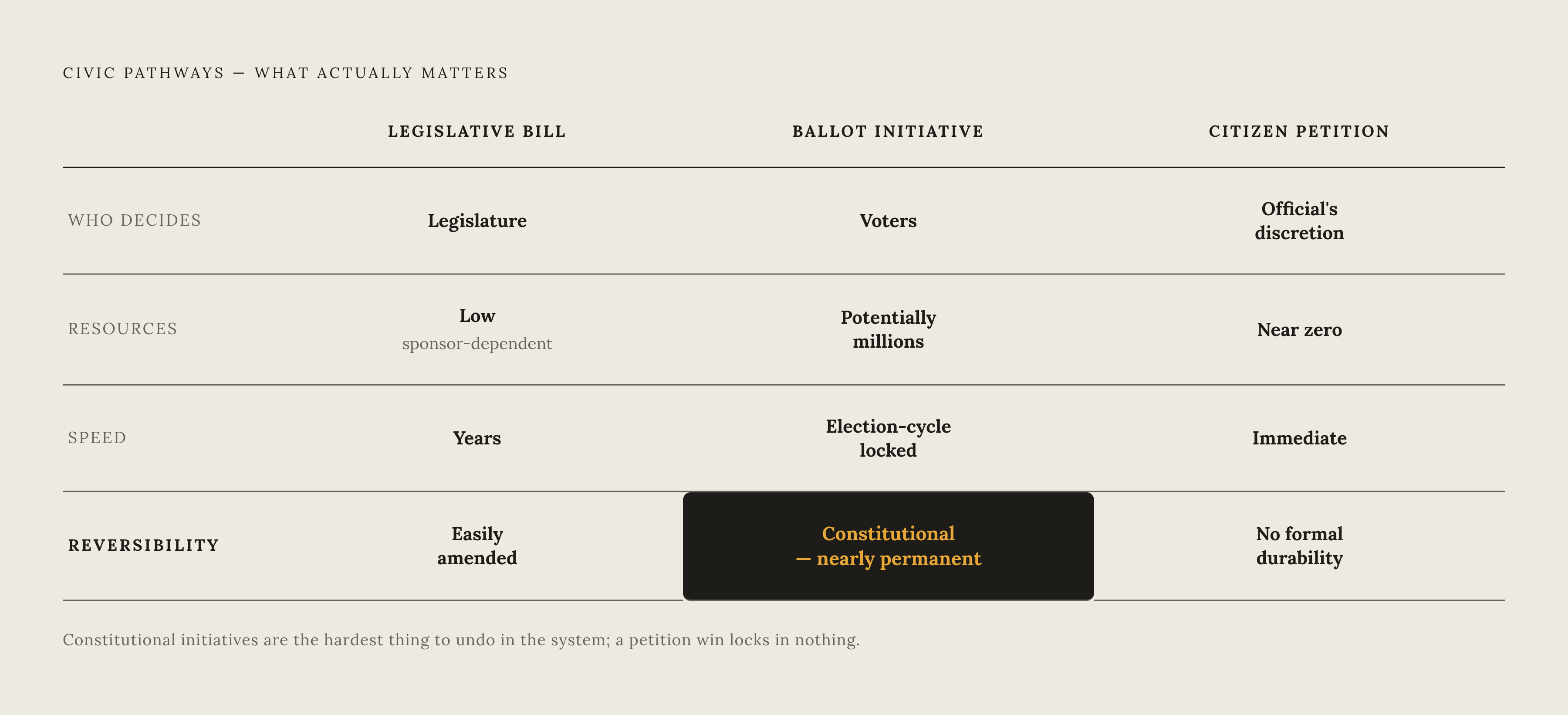
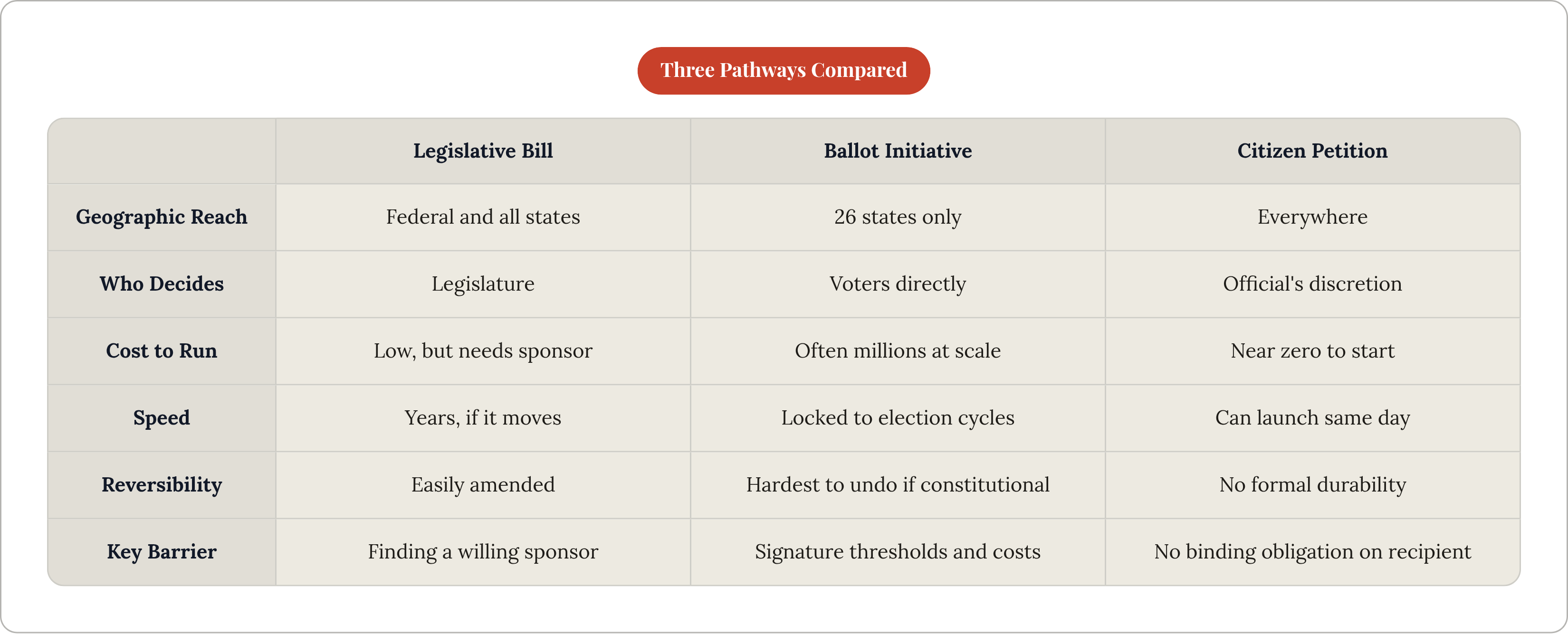
Geographic reach is the first place they split. The bill pathway works everywhere, the initiative works in just 26 states, and the petition works everywhere but guarantees the least of the three. Who actually decides tells a similar story: the legislature for a bill, the voters for an initiative, whatever official happens to open the envelope for a petition, entirely at their own discretion.
Resources follow their own logic. Bill advocacy costs relatively little, but it lives or dies on finding a willing sponsor. Initiative campaigns can run into the millions once signature-gathering and legal costs pile up. Petitions cost close to nothing to start, which is exactly why they're the most common entry point, and also the easiest for someone in power to ignore.
Speed varies just as much. A bill can take years to move, if it moves at all. An initiative is locked to election-cycle deadlines and signature windows that don't bend for anyone. A petition can go out the door this afternoon, with none of that lag.
Reversibility might be the sharpest contrast of the three. Ordinary legislation can be amended by the very body that passed it, sometimes in the same session. A constitutional amendment passed by initiative is about the hardest thing to undo in the entire system. A petition outcome, whatever it produces, has no formal durability at all; nothing legally locks it in place.
More direct power comes bundled with higher barriers and narrower access. More accessible pathways come with weaker guarantees. The bill pathway covers the broadest scope, federal and state both, but it puts a legislator between your idea and anything resembling a final answer. No single pathway wins on every count, and I don't think one ever will. The right one depends on the issue, the state you're standing in, the resources you can scrape together, and whether you can find someone in office willing to carry it.
Why the gap between a citizen's idea and a usable proposal is the real barrier across all three
One requirement shows up in every one of these three pathways, quietly, almost never said out loud: the idea has to get turned into language government actually recognizes. A bill draft. A petition framed in statutory terms, or an initiative written with the legal precision courts expect.
That translation step is where most citizen ideas actually die, and it's rarely about conviction. Legal drafting is the missing piece. Platforms like pollsee, a civic tech tool that uses AI to turn citizen ideas into actual draft bills, are built specifically for that gap. Most people with a good idea for a law have never written one in their life, and honestly, there's no reason they should have. Nobody grows up learning statutory language for fun.
Go back to the petition-to-nowhere problem. A broad, general petition can go viral and land nowhere, because it arrives in a format nobody can act on. The Nassau and Suffolk example worked specifically because it made a quantified, concrete demand: a specific pay bump, for a specific group of workers. Vague energy doesn't move officials, though specific asks sometimes do.
The initiative process assumes this drafting work is already done before a single signature gets collected; the language has to hold up legally just to start circulating. In practice, groups often spend months on legal drafting alone before signature collection even starts. On the bill side, a citizen without a sponsor has no formal path forward at all, since even getting a sympathetic legislator's attention means showing up with something that already reads like legislation, not just an idea with potential.
Verified community support, real co-signatures from real neighbors, only starts working as an actual signal once that drafting barrier gets cleared. Before that, it's just noise with good intentions behind it. The proposal has to land on an official's desk already shaped into something they can act on, rather than something that gets filed away with a form-letter reply.
None of this replaces the three pathways already in place. It just points at the one barrier sitting in front of all three: the gap between having a good idea and having something government is actually built to respond to. Close that gap, and the three roads start looking a lot more open than they do right now.