How Constituent Correspondence Reaches a Legislator's Desk
Your message gets sorted into a spreadsheet tally, not read aloud to your legislator.
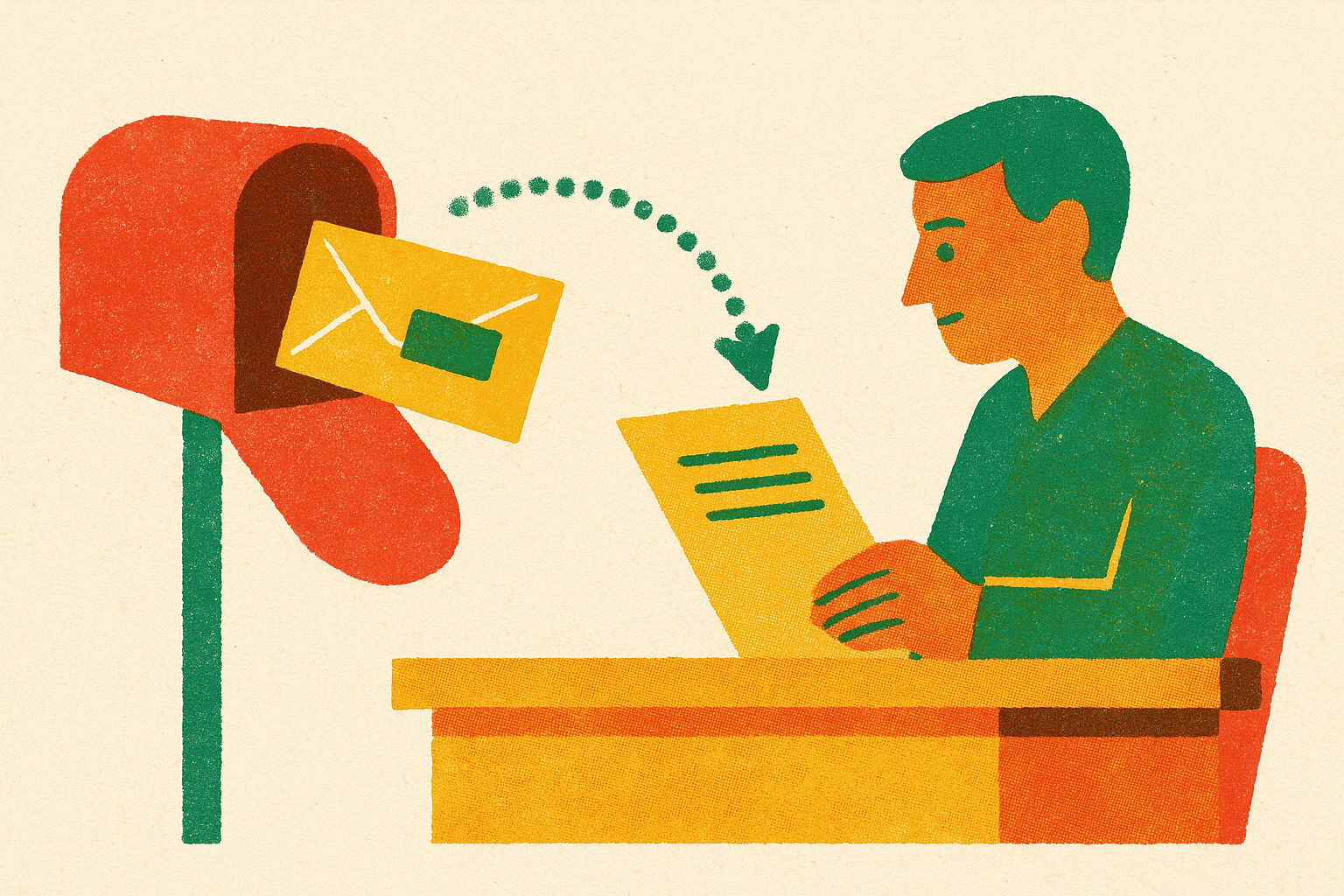
I write to my member of Congress like I'm dropping a note in a friend's mailbox. Draft it, hit send, picture someone nodding along as they read it. Your message actually enters a staffed processing system built for enormous volume, and whether it survives that system depends on things almost nobody explains to you before you hit send.
Start with the math, because the math is the whole story. Congressional offices field emails, calls, faxes, web forms, social posts, all stacked on top of what used to be just paper mail, and staffing hasn't grown anywhere close to matching it. District populations keep climbing too. The system reads far less than everything now; mostly it counts, sorts, and triages. Nobody forgot to fix that. It's the design, on purpose.
The first gate: constituent status, and why everyone else gets filtered out
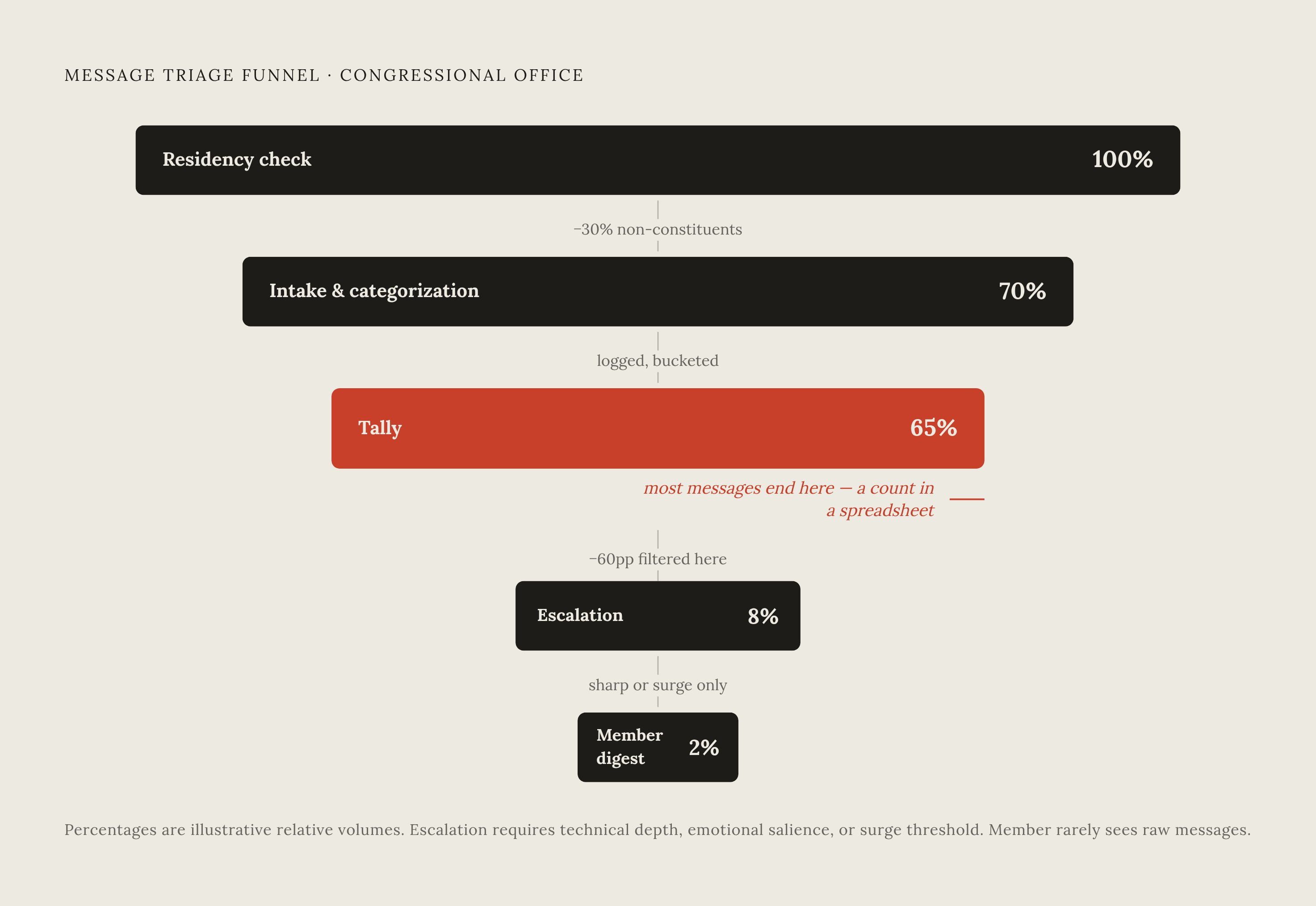
Before anything else happens, an office checks one thing: are you from the district or state this member actually represents?
That check happens fast, sometimes in the first few seconds of a call, sometimes in the first scan of an email. Former congressional staffers have confirmed it was regular practice to screen all mail based on the sender's residence, with correspondence from outside the district routinely going nowhere. Not logged, not tallied, not forwarded — it just stops, the way a piece of mail with the wrong zip code just stops.
This has nothing to do with how good your argument is. A sharp, well-researched letter from the wrong district gets treated the same as a rambling one from three states over: filtered out, no hard feelings. So say where you live, clearly, near the top. It's your ticket in. Bury it or leave it vague and you might not clear the first gate at all.
State and local offices run the same play, usually with even less staff around to catch the edge cases. If anything, the filter gets tighter as you move down the ballot, not looser.
How staff triage a message once residency checks out
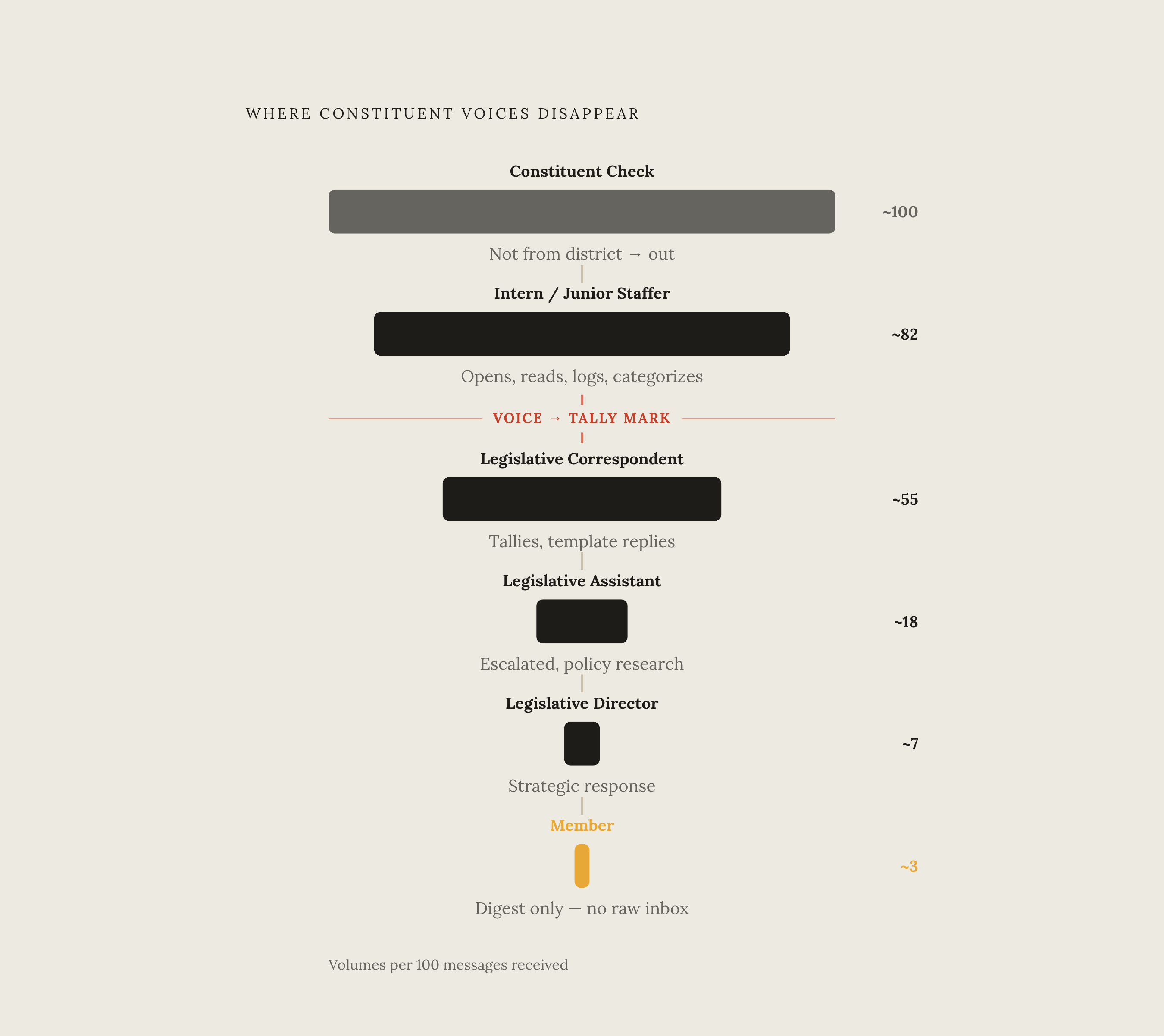
So you're confirmed as a constituent. Who reads it? Not the legislator, and usually not senior staff either. First eyes on your email or letter typically belong to an intern or a junior staffer, and their job is to process it: open, read, log, categorize, tally, repeat, a few hundred times a day.
Messages land in a handful of buckets: constituent service, like a flag request, a Capitol tour, or help with a federal form; casework, when something's stuck at the VA, at Social Security, or in an immigration file; meeting requests; and policy input, meaning where you stand on a bill.
What moves up the chain is usually the tally, not your actual sentences. Offices track weekly counts: how many people wrote in about a bill, which side they landed on. Your email becomes a checkmark in a spreadsheet column more often than it becomes a paragraph someone reads aloud. Full text gets escalated only when something stands out, technically sharp, emotionally distinct, or riding a surge too large to treat as background noise.
Software helps sort this now, tagging sentiment, routing by topic. The logic underneath hasn't moved an inch, though. Faster assembly line, same assembly line.
The staff hierarchy standing between your message and the member
Who's actually in this chain?
Legislative Correspondents write the reply letters, the templated "thank you for contacting my office" notes. Their job is volume control. One level up, Legislative Assistants are the policy people: they research bills, track hearings, brief the member, and they're the ones who actually see an escalated message. Above them, Legislative Directors run the whole legislative portfolio and help decide which fights the office picks. If a wave of constituent contact is ever going to shift strategy, that judgment call gets made here.
A big chunk of a Hill office's staff hours, across every one of these roles, goes toward some version of constituent communication, reading it, answering it, or turning it into intelligence the member can actually use. The member sits at the top of the funnel, getting digests and summaries rather than raw inboxes.
What does it take for your message to reach the legislator directly? Realistically: a surge big enough that the tally becomes the story, a message distinctive enough that a staffer flags it up personally, or a face-to-face meeting. Senate offices scale the whole thing up with bigger staffs for bigger constituencies, but the shape stays the same. More people, more staff, same bottleneck sitting at the top.
Why form letters and mass campaigns tend to cancel themselves out
Advocacy groups love the form email. Click a button, your name auto-fills into a pre-written message, and it lands next to a thousand identical copies. Feels like action. Does it move like action?
Staff spot a form letter almost on sight. Once spotted, it becomes one data point: "form campaign on Issue X," tallied once, not read a thousand separate times as a thousand separate voices. Some former staffers will tell you heavy form-letter waves can actually backfire. They read as organized pressure, and organized pressure is exactly what makes a message easy to write off as astroturf rather than something the district actually feels. Petitions hit the same wall: the number gets noted, no single signature inside it carries much weight on its own.
Now add AI to the picture, because offices are getting nervous about it. A Cornell field experiment found legislators were only marginally less likely to respond to AI-generated messages than to ones a human actually wrote. The AI messages still mostly worked, at least by that measure, which is its own kind of unsettling. Staff are getting warier of any surge that looks coordinated, machine-written or not.
The public warning signs are already out there. The FCC's comment system got flooded with AI-generated submissions during a fight over a regulatory rollback, showing how cheap it's become to fake the appearance of mass concern. California officials called for an investigation into alleged AI astroturf campaigns that swamped air quality regulators, citing it as a threat to the integrity of public input.
Here's the quiet cost for anyone doing real advocacy: the more common these tactics get, the harder it is for any high-volume campaign, real or fake, to prove it's the real one. Volume alone stopped meaning anything a while ago.
What actually gets through, and why
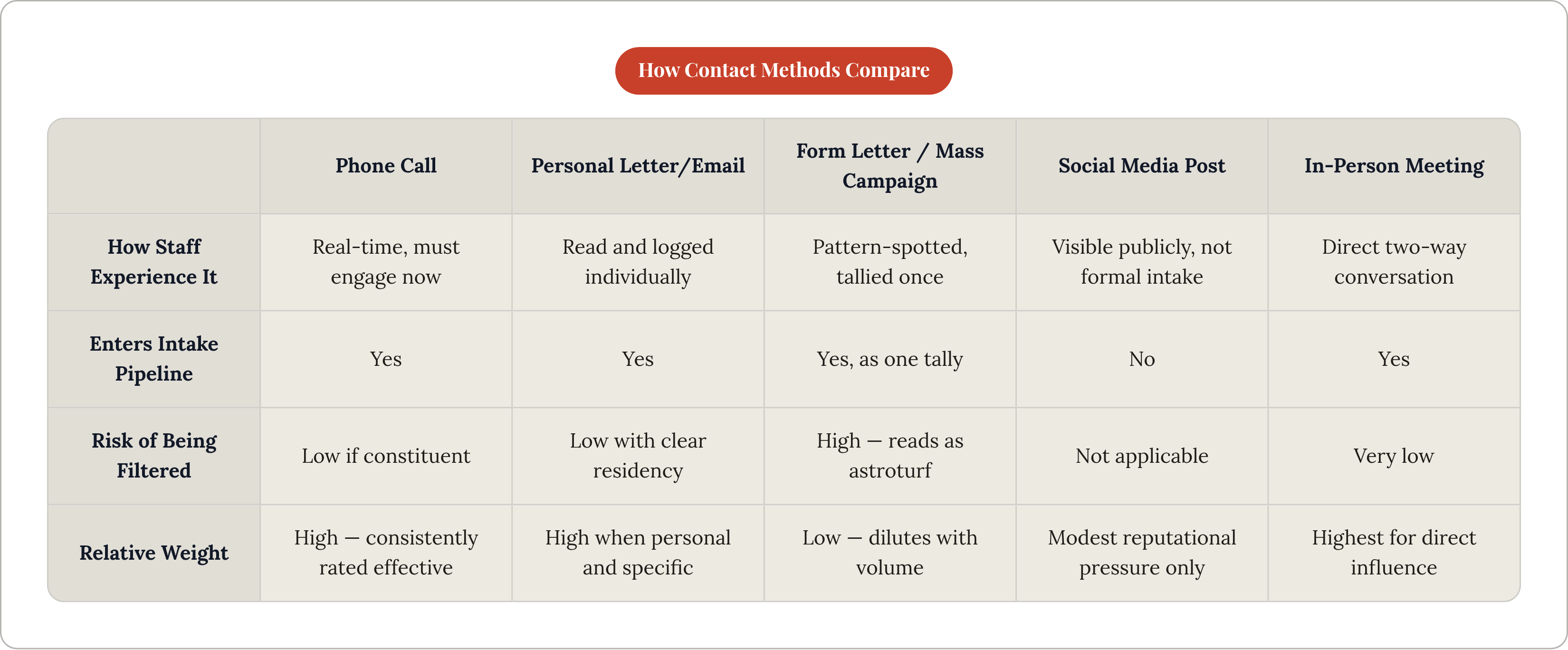
If templates dilute themselves into noise, what cuts through?
Personal, constituent-written messages beat anything templated, and staffers can tell within a sentence or two. A few things reliably earn extra attention: a real story tying the issue to something happening in the district, a specific ask (name the bill, name the vote, name the exact action you want), local or technical detail that actually teaches the staffer something new, and timing, meaning the office is already working the issue when your message shows up.
Phone calls live in their own tier. A call forces a staffer to stop and engage right then, in real time, rather than getting filed away and read whenever, the way email can. People who've worked the Hill consistently rank calls among the more effective routine forms of contact for exactly that reason. In-person meetings sit above even that. A scheduled sit-down is about as close as a regular person gets to an actual two-way conversation with someone making the decision.
This matters even more with newer members. Accounts from House communications staff working for first-term lawmakers describe several successful bills that traced straight back to a constituent's story. New members want a legislative identity, fast, and championing a real person's cause is one of the quickest ways to build one.
Casework opens a quieter second channel. When a staffer helps someone untangle a VA claim or an immigration backlog, that staffer, and eventually the member, learns firsthand how the program actually functions on the ground, not on paper. That knowledge doesn't vanish once the case closes. Sometimes it turns into an oversight hearing or a bill months down the line. Service work feeds lawmaking in ways nobody outside the building tends to notice.
Where social media fits, and where it just doesn't
Everyone's online, so it's tempting to think a tweet at your senator counts the same as a letter. The intake system disagrees.
Staff surveys suggest a modest wave of coordinated posts, especially tied to a visible local group, can catch an office's attention on something already under consideration. A post at a member's public account isn't correspondence, though, not formally. It never enters the intake pipeline the way a letter or call does. It's visible to reporters and the public instead, which makes it a different animal: reputational pressure, not procedural pressure.
The POPVOX Foundation points out that mail and calls still occupy an outsized place in how legislators think about constituent contact, even though they're one slice of a much wider toolkit now. Social sits inside that wider landscape, next to the formal channel, as a complement to it rather than a replacement for it.
So what's the actual move? Tag the legislator publicly if that's your style, sure, but pair it with a real letter or call through the office's actual intake system. A post with no follow-up just gets lost in everyone else's posts.
How civic tech is starting to reshape the intake side
AI is showing up on the office's side of this now too. Worth asking what that does to everything above.
Automated classification tools route incoming messages by topic and urgency before a human opens them, sentiment analysis tracks the district's mood on an issue close to real time, and AI-assisted drafting is starting to produce individualized, record-grounded replies alongside the older, more generic form letters many offices still lean on.
What does that mean if you're the one writing in? Probably makes it harder for a thousand identical mass emails to each land their own personal reply; the system gets better at spotting the pattern underneath. It might also make a genuinely sharp, well-argued message more likely to get flagged and surfaced, since these tools exist to find signal inside noise. Public trust hasn't caught up to any of this yet: surveys show most people are still skeptical of AI chatbots as a way to reach government, mostly because people want to feel like an actual person heard them.
Taiwan is the clearest example I've found of this done well. Its vTaiwan platform blends official government infrastructure with independently built civic tools, and it's built a genuinely strong track record of government actually responding to citizen proposals. It grew out of Taiwan's g0v civic tech community, founded in 2012, which people in this space treat as something close to a foundational model. The lesson is less about any single slick app and more about how independent tools and official platforms reinforced each other instead of competing for the same lane.
POPVOX frames this moment as a real transition point. The old mail-based system is under genuine structural strain, and the open question, the one nobody's fully answered yet, is whether these new tools carry citizen voice further or just automate it into something thinner and harder to actually hear.
From correspondence to legislation: when a constituent idea actually lands
At its best, constituent input becomes the bill itself, not just a nudge on someone's position.
The pattern shows up again and again, especially with newer members building a record: someone shares a personal story, a staffer flags it, a Legislative Assistant works the policy angle, and eventually the member introduces legislation that traces straight back to that one conversation. There are other formal doors too: testifying at a committee hearing, filing a comment during a federal rulemaking process, and in states that allow it, putting an initiative straight on the ballot. Citizen initiatives exist in roughly half the states, letting voters pass laws or constitutional amendments without the legislature at all. A real parallel track, for when the correspondence pipeline just stalls.
But here's the gap underneath all of it. Even a strong constituent idea, if it arrives as a plain email or a phone call, still needs a staffer to translate it into legislative language before it goes anywhere. Most people have no way to hand over an idea that's already shaped into something the process can act on. It waits in line for someone else to do that work, if anyone ever gets around to it.
That's the gap a platform like PollSee is trying to close. Instead of raw input that needs a staffer's time to interpret, PollSee pairs AI-drafted legislative language with verified co-signatures from the surrounding community, so the idea arrives already built: a structured bill with actual, demonstrated support from actual neighbors attached to it.
That distinction, a structured bill with real co-signers versus a generic petition, is really just the earlier distinction again: personal letter versus form email, wearing a different outfit. Different stage of the pipeline, same underlying logic. Credibility and structure decide which messages move through the system, and which ones just add height to the pile.