Legislative Transparency Tools That Track Bill Status in Real Time
Ordinary citizens can now monitor bills as closely as Washington insiders do.
Legislative transparency tools that track bill status in real time give ordinary people the same situational awareness that lobbyists and public affairs teams have had for decades. Once you can see exactly where a bill sits, and how fast it's moving, you have a shot at influencing it before the window closes. Most people never get that shot, because the clock runs out before they even know it started.
The legislative timeline is unforgiving. A bill gets introduced, referred to committee, amended, maybe scheduled for a floor vote, and if none of that happens before the session ends, it dies. Full stop. Under the federal Constitution, a bill has to pass both chambers in identical form and get signed by the President, or become law through an override or presidential inaction; anything not finished by the end of a Congress gets cleared off the books and has to start over from zero. Professionals who work in government affairs track this stuff for a living. Everyone else finds out a policy changed after it already has.
What real-time bill tracking actually means, and what it doesn't
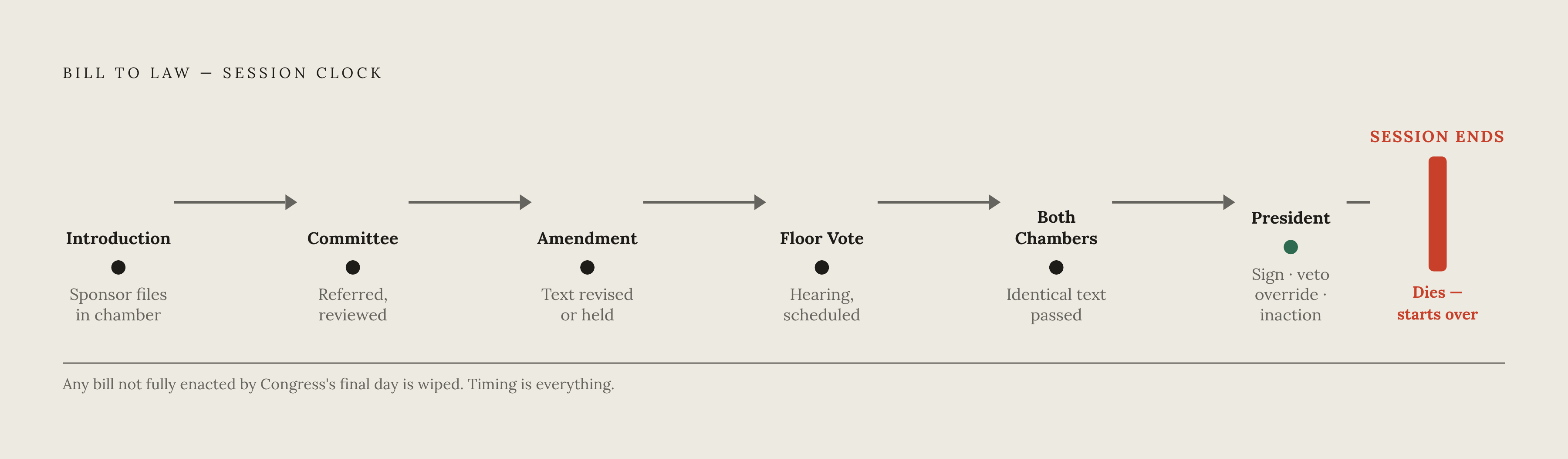
Real-time tracking means automated monitoring of official legislative sources, with alerts that fire the moment something changes. Introduction, committee assignment, amendments, hearing dates, floor votes, executive action: a real tracking tool watches all of it and pings you when the status moves.
Compare that to what most government websites already offer. You can search for a bill and see its current status, sure. But you have to remember to go back and check again. Nothing pushes information to you; you have to pull it, over and over, hoping you don't miss the day it mattered.
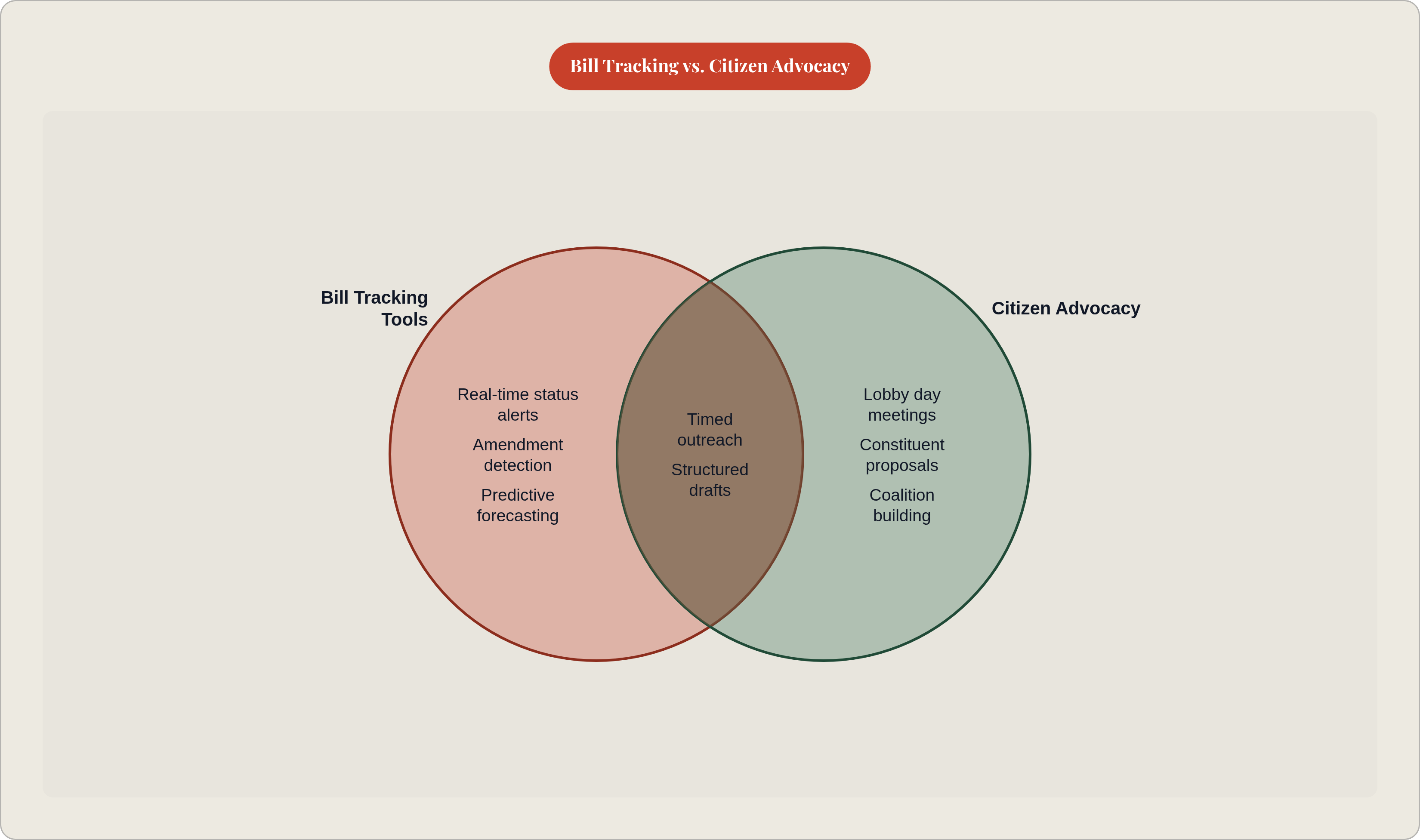
Good tools pull from official state legislative feeds, Congress.gov, committee calendars, voting records, and increasingly, full transcripts and amendment text. That last part is where things get interesting. There's a real difference between tracking and intelligence: knowing a bill moved to the Senate floor is tracking. Knowing it moved because one senator got persuaded in a private meeting, or predicting it's about to stall in committee, that's intelligence. A handful of tools now offer both.
Amendment tracking is where most people get burned. A bill's title can stay exactly the same while its substance gets rewritten underneath it. Missing that rewrite is easy if your tool only flags status changes. Catching it before it becomes law is what happens when the tool flags text changes too.
Why does this matter more at the state level than federal? State sessions can run just a few weeks. A bill can go from introduction to a floor vote with almost no public notice in between. At the federal level you usually have more runway. At the state level, blink and it's over.
How the open government data movement built the foundation citizens now use
Here's a detail that says a lot about how we got here. GovTrack.us launched in 2004, and its founder had asked the Library of Congress back in 2001 to share its legislative data. He got turned down for more than a decade, because the Library's law division didn't see data publishing as part of its job.
Think about what that means. The infrastructure that lets you check a bill's status on your phone was built by citizens who got tired of waiting for government to do it. That origin still shapes how these tools think about their mission: transparency as something you build yourself when the institutions won't hand it over.
GovTrack eventually became as widely used as Congress's own site. Elected officials' offices, including Senator Elizabeth Warren's, now use its API to display their own voting records back to constituents. There's something almost funny about that: the workaround became so good that the people it was built to check started relying on it too.
Open States took the same logic and applied it to all 50 state legislatures, plus D.C. and Puerto Rico, aggregating data that no single official source had ever pulled together in one place. LegiScan went further still, building a nonpartisan, uniform interface across Congress and every state, now tracking a volume of legislation, hundreds of thousands of bills per two-year cycle, that no individual or small team could ever monitor by hand.
The through-line across all of it: public data should be publicly accessible, and access is what makes participation possible in the first place. Without it, you're a spectator who occasionally gets asked to vote.
The manual tracking problem these tools were built to solve
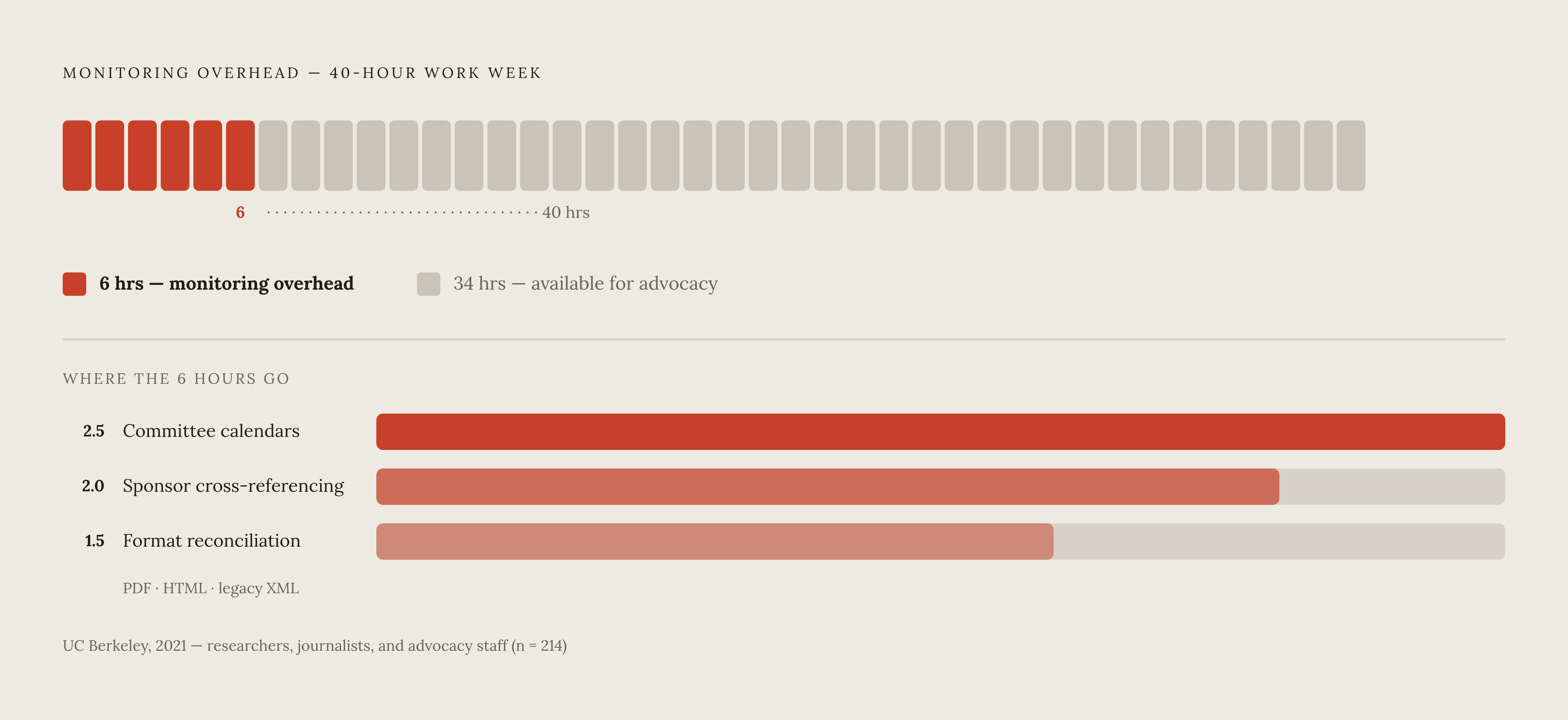
Before any of this got automated, tracking a bill meant real, grinding research. Checking committee calendars by hand. Cross-referencing sponsors against voting records. Comparing amendment language across file formats that weren't built to talk to each other.
A 2021 UC Berkeley study found that researchers, journalists, and advocacy staff spent around six hours a week on exactly this kind of manual monitoring. Six hours. That's six hours just figuring out what's happening before you can decide what to do about it.
The format problem made the time problem worse. Official sources publish in PDFs, HTML, and legacy XML feeds, and none of them reconcile with each other automatically. Someone has to sit down and do it by hand.
The error rate compounds the time cost, too. Miss an amendment or misread a committee vote, and you can send an entire advocacy campaign chasing the wrong target. A volunteer-run citizen group simply doesn't have six hours a week available for monitoring. The information gap turns into an access gap: the people with the least time are the ones locked out first.
The case for tracking tools rests on how much they lower the floor. They make it possible to stay informed enough to act without needing a full-time staff to do it.
The landscape of tools available today, from free public resources to enterprise platforms
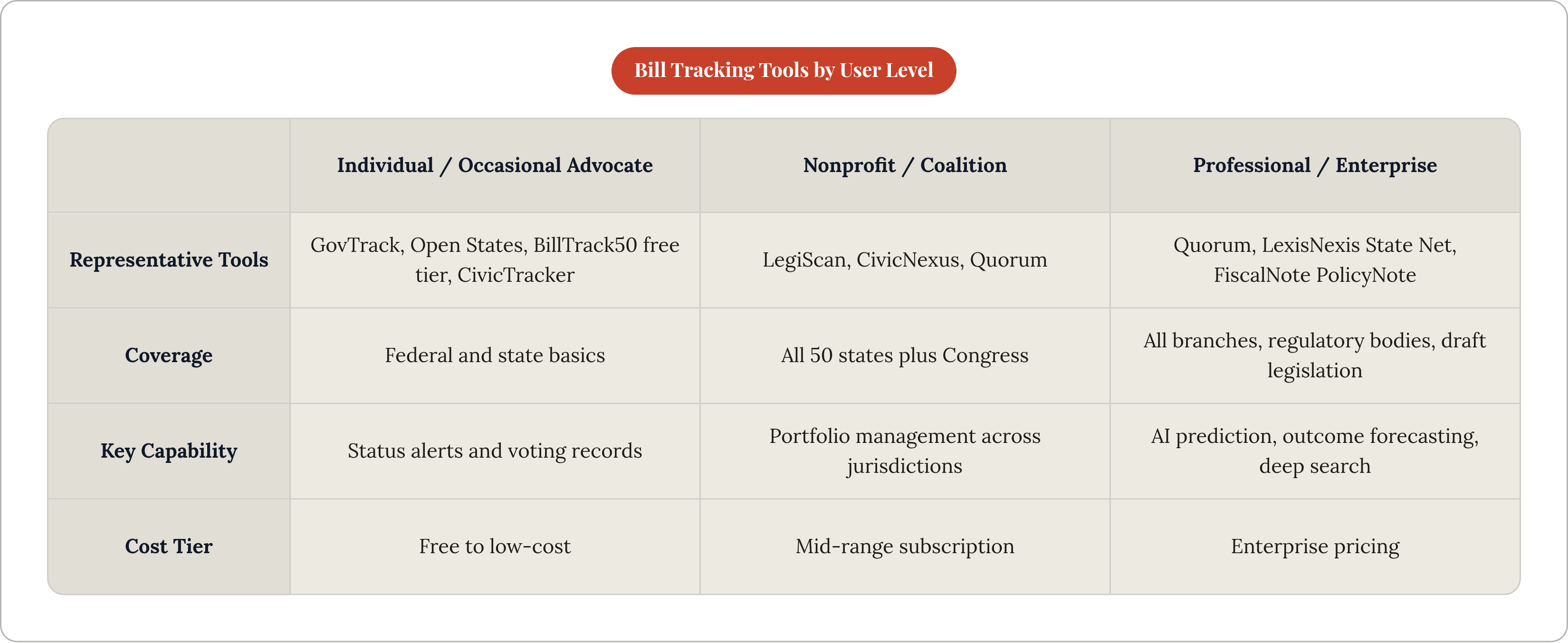
For most people reading this, the free and low-cost tier is where you'll actually live. GovTrack covers federal legislation, voting records, and representative profiles, and in 2025 it expanded into tracking White House actions too. Open States, now run by Plural Policy, covers all 50 states and serves the public directly, alongside activist groups, journalists, and researchers. BillTrack50 monitors Congress and every state legislature with alerts you can customize, and its free basic tier keeps it within reach of individual advocates and small nonprofits. CivicTracker lets you follow a bill from introduction to final vote, with a notification at each stage; its Pro tier opens up everything in the current Congress.
One tier up, you find tools built for organizations with an actual policy portfolio to manage. LegiScan offers that same nonpartisan, uniform interface across all 50 states and Congress, and it's been in institutional use for decades across public agencies, nonprofits, and corporations. Quorum uses AI to rank bills against a user's stated priorities, summarize provisions, and search committee transcripts by keyword; its assistant, Quincy, answers plain questions like "summarize this bill in five sentences." CivicNexus tracks bill movement, flags exactly what changed, and converts updates into testimony you can actually submit, with AI-driven alignment that catches bills matching your priorities even when the language doesn't match your terms (a bill about "transient accommodations," for instance, is really a bill about short-term rentals). USLege.ai claims live tracking of every bill and hearing across all 50 states, federal sources, and regulatory bodies, with full-text search of spoken testimony.
At the enterprise end, LexisNexis State Net is one of the oldest players in the space, searching across more than 1,200 topics from hundreds of legislative sources and thousands of regulatory agencies, with outcome forecasting built in. FiscalNote's PolicyNote is an AI-driven tracker used by clients across all three branches of the federal government, covering new bills, executive actions, and draft legislation as it forms.
Whatever tier you land in, look for the same two or three things. Amendment-level change detection, not just status updates. Coverage across multiple jurisdictions if your issue crosses state lines. And alert settings you can actually tune, so the tool gives you signal instead of burying you in noise.
That terminology mismatch problem deserves its own moment. Bills get named and tagged in language that often has nothing to do with how advocates talk about the issue day to day. AI-powered alignment features exist specifically to bridge that gap, and honestly, it's one of the more underrated uses of the technology in this space.
How AI is changing what tracking tools can tell you
First-generation tools answered one question: where is this bill right now? The newer generation is starting to answer a harder one: where is it likely to go, and what should I do about that?
Predictive tools from platforms like Plural Policy and LexisNexis State Net use historical voting patterns, sponsor relationships, and committee makeup to forecast outcomes. That gives advocates something genuinely useful: a sense of which fights are winnable and which bills are moving faster than anyone expected.
Summarization might be the single AI feature with the most direct impact on access. A plain-language summary of a 200-page omnibus bill takes a document that used to require a law degree to parse and makes it readable on a lunch break. That's not a small thing.
The scale of adoption is worth sitting with. The OECD's September 2025 report identified close to 200 examples of AI use across government functions worldwide, including legislative drafting and regulatory analysis. Governments themselves are running AI on the other side of the process now, which changes what tracking even needs to catch.
Italy's Senate has used AI to cluster similar amendments together and flag possible procedural tactics before they play out. Estonia's experience is the sharper example: a citizen-coded AI tool there flagged a tax loophole costing the government roughly €2 million a month, something human review had missed. That's the upside case, made concrete.
There's an honest caveat here, though, and it matters. No regulations currently require legislative text to be drafted by a human being. Experts warn AI tools can produce biased or flat-out wrong output when nobody checks it. So a real question follows: if the tracker itself relies on AI to summarize or predict, who's checking the tracker? The tools are only as good as the person reading their output critically instead of taking it at face value.
There's a subtler risk too, one aimed squarely at citizen-facing tools. Foreign actors could flood public comment channels with AI-generated submissions, drowning out the voices of actual constituents in a wave of synthetic noise. That's exactly why verified identity and community co-signatures matter as much as the tracking infrastructure itself. A tracking tool tells you the window is open. It can't tell you whether the crowd showing up at that window is real.
What the evidence shows about constituent advocacy that is actually timed and targeted
Citizens' Climate Lobby offers a clean case study in what organized, well-timed advocacy looks like when it's built on real tracking. Volunteers followed the PROVE IT Act through all of 2024, coordinated 442 lobby day meetings on Capitol Hill, and backed that up with 1,870 calls from volunteers. A bipartisan companion bill followed in the House afterward.
Those numbers aren't huge in absolute terms. What makes them matter is the coordination: the same bill, the same ask, delivered at the exact stage of the process when it could still make a difference.
Nebraska's paid sick leave initiative passed with roughly three-quarters voter approval, a margin that reflects years of coalition work anchored in specific knowledge of where the policy stood and what opposition it was up against. And in March 2024, Washington State saw three citizen initiatives become law on the same day, something the secretary of state's office noted had only happened a handful of times in the state's 110-year history. Part of why that worked: the organizers knew exactly which procedural thresholds they had to clear, and when.
The pattern holds across all three cases. The advocates knew what stage their issue was at. They knew who actually had the power to move it. And they showed up with the right ask at the right moment, which is precisely what bill tracking is supposed to make possible.
Now flip it around. Advocacy that shows up after a bill has already passed committee, or after it's been tabled for the session, is advocacy that can't change anything. The effort arrived at a door that had already closed. Timing is the variable tracking is built to solve.
The gap between tracking a bill and being able to do something about it
Here's where most tracking tools stop short. They're observation platforms. They tell you where a bill sits, but they don't hand you a way to respond in a form a legislator's office can actually act on.
The traditional playbook, call your rep, sign a petition, submit a public comment, has real limits baked in. Calls get logged, but they rarely move legislation on their own. Petitions are easy for a staffer to file and forget. Public comment processes can be slow, and sometimes genuinely opaque about whether anyone read what you sent.
One House communications director put it plainly: a lot of the legislative ideas offices actually work on originated with constituents, and new lawmakers are often actively hunting for a cause they can champion. That's the opening. A well-timed, well-structured proposal from a constituent is genuinely valuable to the right office.
The trouble is format. Offices receive constituent input in dozens of shapes, and most of them aren't actionable as legislation. A good idea, written in plain language, is not the same thing as a draft bill a staffer can hand to counsel.
Some platforms are trying to close this gap by building a pipeline from a citizen's idea to a structured, credible, co-signed draft that lands on the desk of someone who can actually move it. Verified community co-signatures do a specific job here. They tell an office that a proposal has real, identifiable support behind it, distinct from a burst of online noise that'll fade by next week.
Put the sequence together and it's simple. Tracking shows you the window is open. A structured proposal is how you climb through it before it shuts again.
How to build a personal tracking system that actually prompts action
Start with jurisdiction and issue, not with the flashiest tool you can find. Federal tools cover Congress. State-level tools like Open States and LegiScan cover the legislatures where most of the policy touching daily life, housing, education, labor, health, actually gets decided.
Get specific with your alerts. Tracking every bill in a state produces nothing but noise; tracking by keyword, sponsor, or committee produces signal you can actually use. Most platforms let you dial this in, so take the time to do it.
Don't skip amendment alerts. A bill you support going into committee can come out the other side as something you'd oppose, and the reverse happens just as often. Status alerts alone will miss that entirely.
Match the tool to your actual capacity. If you're an individual citizen or an occasional advocate, GovTrack, Open States, BillTrack50's free tier, or CivicTracker will cover you. If you're running a nonprofit or a coalition, look at LegiScan, CivicNexus, or Quorum depending on your budget and how many states you're covering. If you're doing this professionally, Quorum, LexisNexis State Net, or FiscalNote's PolicyNote are built for that scale.
Build a response plan alongside your tracking setup, not after. Decide now what you'll do when a tracked bill hits a specific stage: who you'll call, what you'll say, whether you've got a co-signed proposal ready to go alongside the outreach. Waiting until the alert fires to figure out your move usually means you move too late.
The local level is where I'd tell anyone starting out to focus first. City councils, county boards, school boards: they move on shorter timelines with smaller constituent bases, which means a handful of organized neighbors can carry real weight there in a way that's much harder to pull off in Congress. It's also the level almost nobody bothers to track, which makes the payoff bigger for the people who do.
Tracking is where this starts. The citizen who knows a bill is sitting in committee has a window. The citizen who shows up at that window with a structured, neighbor-verified proposal in hand has something closer to leverage.