How E-Petition Systems Differ Across Governments
Signature thresholds and timelines shape who gets heard before anyone in power reads a petition.
E-petition systems all look the same on the surface: type your name, click submit, watch a counter go up. But the design choices underneath, the threshold, the timeline, what happens after you hit send, vary so much from country to country that the same act of signing can mean a mandatory government response in one place and total silence in another. A petition with a million signatures can produce less legislative movement than one with ten thousand, depending entirely on which system it lives in. The question worth asking isn't how to get people to sign, but what the system was actually built to do once they have.
The structural components that differ from one system to the next
Every e-petition system, whatever government runs it, is built from the same handful of moving parts. How those parts get set determines almost everything about who gets heard and who doesn't.
The variables worth knowing:
- Signature threshold, or thresholds, since some systems have more than one tier
- Time window for collecting signatures, which can range from a few weeks to a full year
- Who's allowed to sign: citizens only, residents, anonymous or verified
- What actually happens at the end: a written response, a debate, a committee referral, or nothing binding at all
- Whether the platform lets people deliberate, through comments or forums, or just tallies names
- How much guidance petitioners get about the process itself
A 2024 analysis of 116 digital citizen participation tools found a pattern that shows up again and again: these platforms move information from citizens to government, but rarely send anything back. Governments collect signatures; they don't consistently explain what those signatures did, or didn't, change.
Somewhere in the design process, someone decided the loop didn't need closing, and that decision says something about how much accountability the system was built to deliver in the first place. Thresholds and timelines carry policy weight too; they're decisions about who gets heard and who gets filtered out before anyone in power even reads the petition.
Scotland's early experiment and what it set in motion
March 2000. The Scottish Parliament, barely a year old and still building its own legitimacy, became one of the first legislative bodies anywhere to formally accept e-petitions. It was introduced as a trial, deliberately, alongside a parliament that needed to prove its own legitimacy from the ground up.
What made it distinctive was the absence of a threshold. Any petition that reached committee got considered on its merits, full stop, regardless of whether it had 40 signatures or tens of thousands. Scotland also produced multilingual materials, in Arabic, Bengali, Punjabi, Simplified Chinese, and Urdu, walking petitioners through the entire process from submission to final decision. And the parliament built in an evaluation partnership with the Teledemocracy Centre from the start, so the system could be studied while it ran.
No threshold sends a message: the barrier to being heard is the legitimacy of your concern, not your ability to mobilize a crowd. That's a generous design philosophy. But it raises a question the Scottish system had to live with from day one: without a threshold, who decides what gets prioritized? Committee members carry more interpretive weight when volume can't do the sorting for them. Scotland's approach was among the early models that influenced how Europe began thinking about institutionalized e-petitioning.
How Germany built a higher bar and what that did to participation
Germany looked at Scotland's model, adopted the basic shape, and then added something Scotland didn't have: a hard number. The Bundestag's Public Petitions platform launched in 2005 with a 50,000-signature threshold required to trigger a public hearing, one of the highest bars in Europe. For comparison, Portugal only requires 4,000 signatures to force a parliamentary debate. That gap, more than tenfold, suggests these are different theories about what deserves institutional attention, not just different settings on the same dial.
Germany also gave petitions just four weeks, live, to reach that number. Between 2005 and 2010, only 9 petitions cleared the 50,000 threshold. The mean signature count across all petitions in that period sat around 1,170, nowhere close to what the system demanded for a hearing.
So who did manage to clear the bar? The platform did pull in younger participants than traditional political channels usually reach. But research found they skewed toward the educational elite and were disproportionately male, meaning the original goal, reaching people outside the usual political class, was only partly met. A high threshold paired with a short runway doesn't just filter for popular causes. It filters for causes that already have an organized, well-resourced campaign behind them. That's a structural outcome, and it's worth sitting with: the design shapes who wins before a single signature gets counted.
The UK system's two-tier threshold and the informal route that often matters more
The UK took a different approach: two thresholds instead of one, launched in July 2015 as a joint effort between Parliament and the Government, with a dedicated Petitions Committee overseeing it. Hit 10,000 signatures, and you get a written government response, guaranteed. Hit 100,000, and your petition becomes eligible for a parliamentary debate.
The scale this system has reached is genuinely striking. Since 2015, five UK e-petitions have crossed 1 million signatures. The "Call a General Election" petition in 2024 reached 3.1 million, roughly 7% of the entire UK electorate that year. Numbers like that look like undeniable proof of public demand.
Yet those totals don't guarantee a debate, a committee inquiry, or any actual legislative movement. The Petitions Committee decides whether to act, and that decision is discretionary, meaning even 3.1 million signatures amounts to a request rather than a mandate.
What's more revealing is research into what petitioners themselves say works. The finding: building a direct relationship with an individual MP matters more to a petition's success than crossing either formal threshold or engaging the Petitions Committee at all. That's a real gap between how the system is supposed to work on paper and how it actually works for the people using it. Citizens who understand the informal pathway, who know an MP or build that relationship, start ahead of those who treat signature-gathering as the finish line.
2025 marks ten years of this system. It launched during a stretch of real political dissatisfaction in the UK, which probably explains why the thresholds were set where they were: achievable enough to feel meaningful, without promising more than the system could deliver.
South Korea's Blue House petition system — high responsiveness, short lifespan
South Korea tried something more direct, and more fragile. On August 19, 2017, President Moon Jae-in's 100th day in office, the government launched a petition platform framed around a simple promise: the government will answer when the public asks. Hit 200,000 signatures within 30 days, and you'd get a mandatory official response from the Blue House itself.
The appetite was real. More than 357,000 petitions were submitted between launch and December 2018, a volume that shows genuine public hunger for this kind of direct channel, even as it strained the government's ability to respond meaningfully to all of it. Anonymous submission was allowed, and the platform effectively took over some of the agenda-setting work usually done by the National Assembly, political parties, or the press.
Here's the catch, though. The system lived inside the executive branch, not the legislature, and its life span was tied to the administration that built it. It was dissolved on May 9, 2022, the day that administration ended. When a petition system sits inside the executive rather than inside a parliamentary institution, its survival depends on political will rather than institutional rule. It can simply be switched off. A successor platform, Gungminjean, exists now, but under a different design and a different political context; continuity was never guaranteed to begin with.
The European Citizens' Initiative — the hardest threshold in democratic practice
Start with the outcome, because it tells you much of what follows: over 120 initiatives have been registered under the European Citizens' Initiative since it began, and roughly 14 have cleared the signature threshold, an 11% success rate. Only one has ever turned into fully binding legislation.
The threshold itself explains why. The ECI requires 1 million verified signatures from EU citizens, with minimum numbers met in at least 7 of the EU's member states, all within 12 months. That cross-national requirement solves a real legitimacy problem: who gets to claim they speak for Europe as a whole? But it creates a mobilization problem that smaller, focused campaigns simply can't clear, no matter how strongly they feel about their cause.
When an issue does resonate broadly enough, the numbers get impressive. "One of Us" collected 1,695,328 verified signatures. "Right2Water" brought in 1,673,181. Both crossed the threshold with real room to spare, proof the format can generate mass participation when the moment is right. More recently, the "Cohesion policy for the equality of the regions" initiative, submitted in December 2024, gathered over 1.2 million signatures across 8 member states; a Commission response is due in September 2025.
Even success here comes with a ceiling. Clearing the threshold means the Commission has to meet with organizers and publish a formal response. It does not mean the Commission has to act. The ECI functions as a legitimacy test more than a legislative pipeline: it proves broad support exists across borders, which is no small thing, but proving support and producing law remain separate outcomes.
The EU runs a second, quieter track alongside the ECI: Parliament petitions, which require no minimum signatures at all and relate to existing EU activities. But they can't request new legislation, a procedural ceiling that caps how far they can ever travel, regardless of how many people sign.
The US citizen initiative process — direct democracy with no parliamentary landing pad
Everything covered so far runs through a parliament or a commission somewhere. The US model breaks that pattern entirely. In 26 states, citizens can propose and pass laws or constitutional amendments directly, through the ballot, with no legislature standing as gatekeeper.
Success in this system doesn't mean a committee referral or a government response; it means a ballot outcome, decided by voters directly. There's also no single federal e-petition platform tying it all together, the way the UK or Germany have. It's fragmented across 50 states, and threshold rules, timelines, and subject-matter limits vary widely from one to the next.
The current trend is running against the format. Several state legislatures have moved to raise signature thresholds, shrink the time allowed for gathering them, and add procedural hurdles that make qualifying harder. Missouri offers a sharp example: in September 2025, a House committee passed a bill requiring majority approval in each of the state's 8 congressional districts, a bar that would make passing a statewide citizen initiative close to impossible in practice.
What that signals matters beyond Missouri. Where the initiative process gets used to override what a legislature wants, legislatures have tools available to raise the bar in response. These rules shift based on who's threatened by them. And because there's no parliamentary chamber sitting between a successful initiative and actual law, a US initiative can become binding without ever passing through a debate or a formal deliberative body. That's the format's real power, and its most obvious vulnerability.
What the threshold numbers actually measure — and what they miss
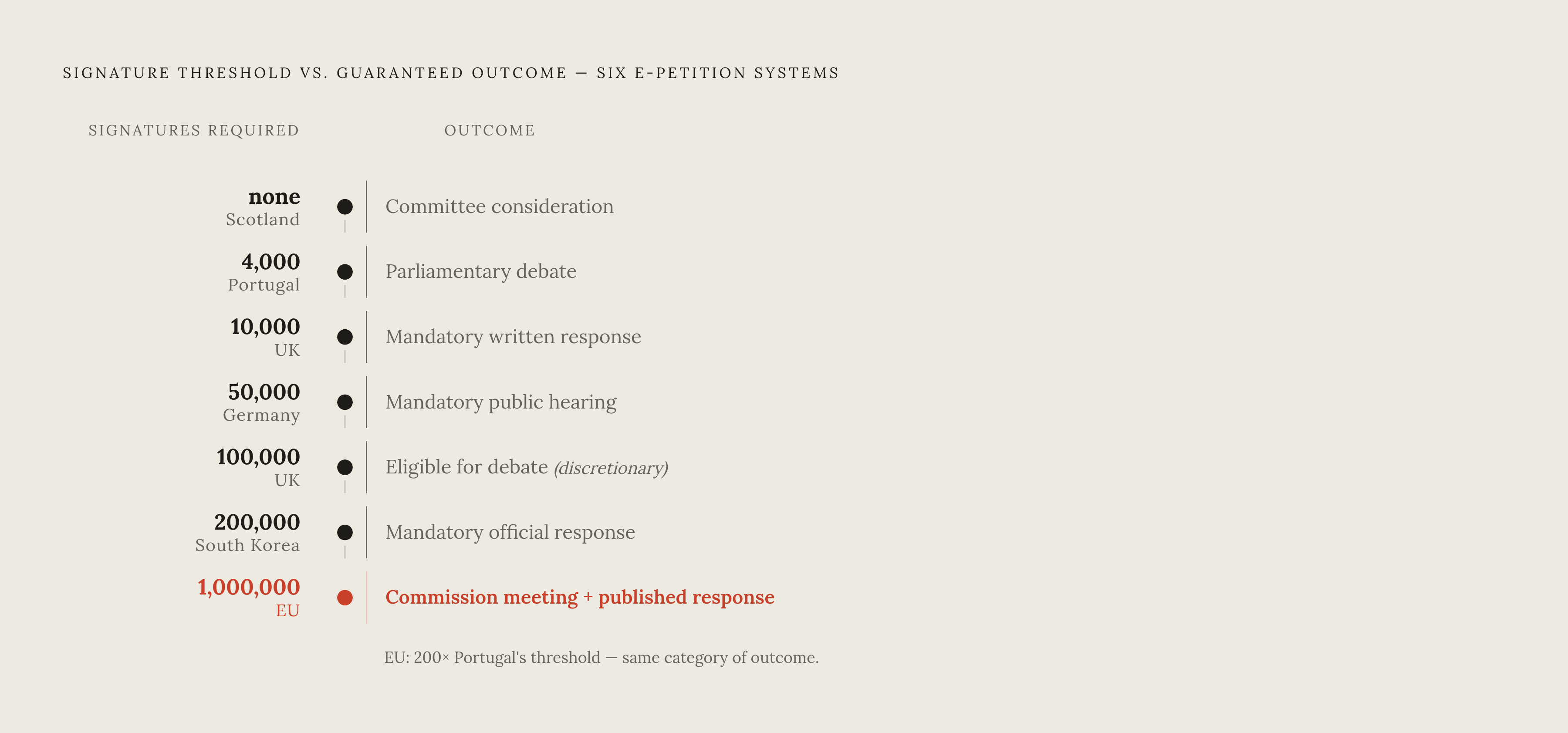
Line the thresholds up next to each other and the range is enormous: Scotland requires none, Portugal asks for 4,000, the UK's response tier sits at 10,000 and its debate tier at 100,000, Germany requires 50,000, South Korea asked for 200,000, and the EU sits at the very top with 1 million. That spread isn't random. Each number encodes a theory about what earns the right to be heard.
High thresholds tend to favor issues that already have broad public awareness, campaigns backed by organizations with existing email lists and digital infrastructure, and emotionally galvanizing events over long-simmering local concerns. Low thresholds favor something different: hyperlocal issues that matter intensely to a small group of people, first-time petitioners with no organizational backing, and problems that are serious but never went viral.
Germany's own numbers make the problem plain. A mean of roughly 1,170 signatures per petition, in a system that requires 50,000 to trigger a hearing, means most petitioners never reach the outcome the system is advertising. Many probably don't realize that going in.
One might argue thresholds simply measure how organized a cause is, not how valid it is, and that distinction matters. A petition about a rare disease affecting a small number of people can be every bit as legitimate as one that reaches a million signatures; it just can't mobilize the same numbers, and the threshold doesn't know the difference. The UK finding, that relationships with individual MPs matter more than formal thresholds, points at something uncomfortable: thresholds are partly theater, creating the feeling of democratic accountability without reliably delivering it.
What happens after the signatures — the procedural gap most systems leave open
So what does clearing the bar actually buy you? The answer changes enormously depending on where you are.
- UK, 10,000 signatures: a written government response, mandatory
- UK, 100,000 signatures: eligibility for debate, decided at the committee's discretion
- Germany, 50,000 signatures: a public hearing, mandatory but rare, only 9 cleared it in the system's first five years
- South Korea, 200,000 signatures: a mandatory official response, not a vote, not a bill
- EU, 1 million signatures: a Commission meeting and published response, not legislation
- Scottish Parliament: committee consideration guaranteed, no threshold required, but no guaranteed outcome either
The ECI's numbers say it most bluntly: 11% of registered initiatives ever clear the threshold, and out of more than 120 registered, exactly one has produced binding legislation. That gap, between reaching the finish line the system defines and actually changing the law, is the starkest version of a pattern that runs through nearly every system covered here.
Most of these platforms were built to respond rather than to legislate. They function as accountability mechanisms first, lawmaking pipelines a distant second, if at all. The 2024 analysis of 116 digital participation tools found the accountability loop, actually telling citizens how their input shaped a final decision, was the single most consistently missing piece across the board. Before investing real time into a petition campaign, knowing exactly what a "win" delivers in that specific system matters more than the campaign strategy itself. The procedural endpoint should shape the whole approach, not come as a surprise at the end of it.
Where structured civic technology is pushing the format beyond petitions
Petitions have a ceiling built into the format itself: a signature counts as agreement, but it doesn't capture reasoning. Officials learn how many people feel something. They don't learn what those people actually want done, or why they want it, or what tradeoffs they'd accept to get there.
That gap is exactly what some newer civic tools are trying to close. vTaiwan is one example worth looking at closely: it combines online participation tools with in-person dialogue sessions to build actual policy consensus, adding a layer of deliberation that a simple petition counter was never designed to hold.
That's the direction worth watching: formats that ask a harder question than "how many people agree," and actually wait around for the answer.