Open-Source Civic Tech Platforms Reshaping Local Government
Free software platforms let residents shape local decisions without vendor lock-in.

Local government makes the decisions that actually touch daily life: whether the road gets repaved, how the school budget gets split, what happens to the empty lot on the corner. Yet it's the level of government where ordinary people have the fewest real ways in. That gap has less to do with people not caring, and more to do with tools built for a different era, running on formats most residents can't even name.
Ask a resident whether their city runs on a Mayor-Council system, a Council-Manager system, a Commission, or a Town Meeting format, and odds are they won't know. Each of those structures spreads citizen power differently: some give the mayor real veto authority, some hand day-to-day power to an appointed manager answerable to a council, some put budget decisions directly in front of assembled residents a few times a year. If you don't know which one governs you, you can't know where the actual point of leverage is.
Even once someone does find the leverage point, the menu is thin. Vote, call an official, show up to a public meeting, submit a comment. Petitions and comment periods exist almost everywhere, but nothing obligates an official to act on what comes in. Jurisdictions that take federal housing money through HUD have to maintain citizen participation plans with language access built in, which sounds like progress until you notice it's a floor, and an unevenly enforced one at that. So what happens when the tools themselves change, not the incentives around them? That's the real question, and open-source civic tech is the clearest attempt at an answer so far.
What open-source civic tech actually means (and why the "open" part matters for democracy)
Civic technology, broadly, means digital tools built to help people engage with government and public institutions in ways that are more open, more inclusive, and less likely to dead-end in a drawer. The range is wide: pothole-reporting apps, participatory budgeting platforms, open legislative data feeds, deliberation tools that map where a thousand strangers actually agree. Different problems, same design goal underneath: cut the friction between a citizen and a decision.
"Open-source" narrows that further. It means the code itself is public, forkable, and governed by the community using it. That distinction carries more weight than it sounds like on first read. If the software that carries a city's participation process belongs to a private company, that company can raise its price, change its terms, or simply shut down, and the public loses its access to participate right along with it. Open-source code carries less of that risk. A city, or a coalition of cities, can fork it, translate it, rewrite the rules to fit local law, and keep running it regardless of what happens to whoever built the original version.
That's also what separates open-source civic tech from two categories it gets lumped in with. E-government portals are built and owned by government itself, so they answer to whoever's in charge that budget cycle. Civic SaaS products are professionally managed and sold on subscription, which works fine until it doesn't. Open-source platforms occupy a middle position, with publicly owned code and adaptable governance. The 2025 UNDP/People Powered guide to digital participation platforms mapped more than 80 of them operating globally, which says something about how far this category has already spread.
None of that guarantees good outcomes, though. Open code doesn't automatically mean open power. A platform can publish its source on GitHub and still be built in a way that limits what citizens can actually propose, vote on, or change. Keep that tension in mind; it resurfaces in every case that follows.
Decidim: how Barcelona turned open-source code into a replicable infrastructure for city-level participation
Barcelona's city council built Decidim in February 2016 and released it as free, open-source software, framed as a public good. The council had the option to buy something proprietary off the shelf. It chose to build instead, on the logic that democratic infrastructure shouldn't belong to a vendor; it should belong to the public that uses it.
That choice paid off in scale. More than 400 active Decidim instances now run in 20 countries, from Mexico City to Helsinki to New York to Kakogawa in Japan, and even inside the National Assembly of France. The European Commission recognized it in 2019 as one of the most innovative open-source projects in Europe.
Inside Barcelona itself, the numbers are concrete. Over 40,000 residents have taken part in decision-making activities on the platform, generating more than 1,500 proposals. The city's strategic plan was shaped by over 10,000 citizen proposals submitted through Decidim. The clearest physical example is the Superilles, or superblocks, redesign: neighbors proposed alternative street layouts, gathered support behind specific versions, and refined the plans through the platform before the city acted on them. That's a land-use decision with permanent, walkable consequences, grown out of what began as a simple proposal thread.
The use cases have widened past classic participation exercises, too, into urban sustainability policy, climate action plans, and regional mobility strategy. And the fact that Decidim now runs in cities with wildly different legal systems and political cultures says the model travels. But it travels with conditions. Each new instance needs real local adaptation, not just a fresh install; a Decidim setup that works in Barcelona doesn't transplant itself cleanly into Helsinki. Adoption by a government also doesn't guarantee citizen proposals shape the final decision. The platform makes deliberation possible, but whether officials listen remains a separate matter entirely.
Consul Democracy and the participatory budgeting pipeline from Madrid to the world
Consul started as a Madrid city initiative and then did something structurally smart: it evolved into an independent foundation rather than staying tied to one city's government. That's a governance lesson worth sitting with on its own. When a civic platform's fate is tied to whoever wins the next mayoral race in its home city, a change in administration can gut it overnight. Spinning it out into a foundation insulates the tool from that kind of political weather.
The platform now runs in 35 countries across 135 institutions. In Madrid, residents decide how to allocate roughly €100 million a year through the system, making it one of the largest municipal participatory budgets anywhere in the world. Porto Alegre, the Brazilian city where participatory budgeting was invented decades ago, has also adopted Consul, which reads almost like the idea coming full circle and validating itself along the way. The OSOR study on open-source software in European local governments cited Consul as a leading example, with specific lessons around financial sustainability and keeping community governance functioning over time.
Participatory budgeting as a category has traction well beyond the platforms themselves. In a number of U.S. cities, resident-led coalitions have pushed for formal participatory budgeting commitments, often without any civic tech platform already in place to receive them. That's worth noting: the demand for this kind of budgeting exists independent of whether the software has arrived yet.
Even where the money is real, though, there's a structural catch. City administrators usually set the boundaries of which proposals are even eligible before residents vote. So the participation is genuinely open, inside a frame that's still closed by someone else's decision. That tension doesn't disappear just because the sum on the table is €100 million instead of zero.
vTaiwan: what happens when a civic tech platform actually closes the loop to legislation
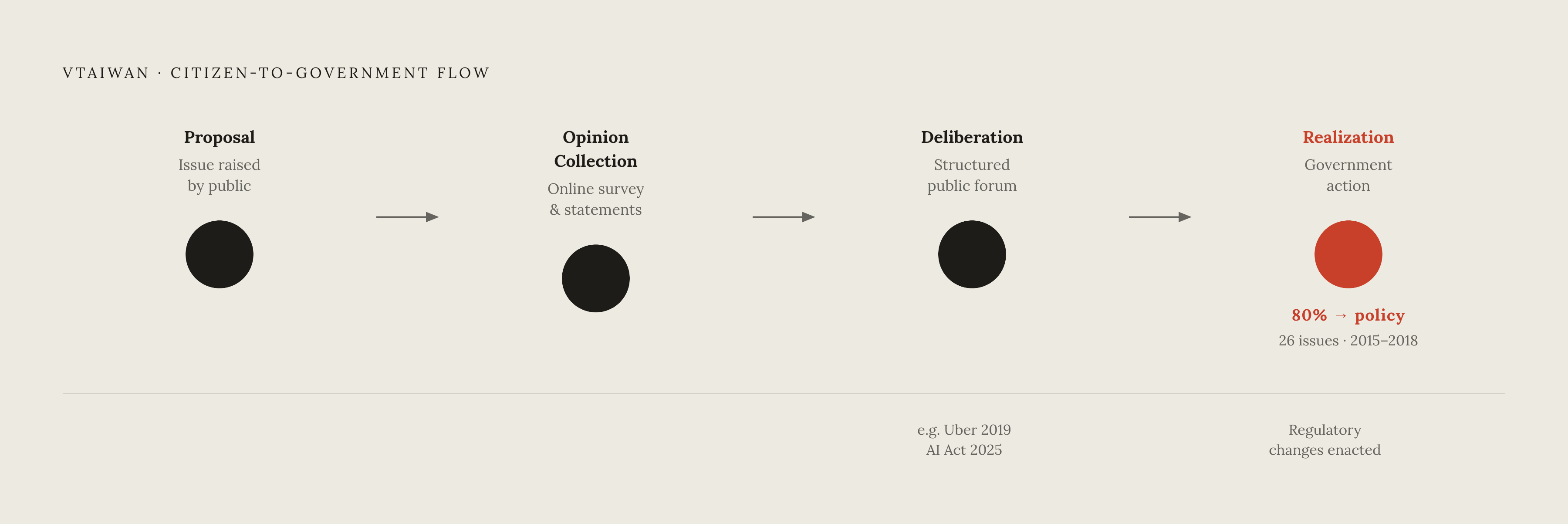
vTaiwan didn't come from inside government at all. It grew out of the g0v, or "gov-zero," civic tech community following the 2014 Sunflower Movement, born out of distrust in a closed legislative process rather than an invitation from officials to participate. That origin story matters, because it shapes what the platform was built to do: force information and disagreement into the open.
The architecture runs in four stages: Proposal, Opinion Collection, Deliberation, Realization. The Opinion Collection stage uses digital tools to map where citizen positions cluster, surfacing both the areas of consensus and the real lines of division before the debate gets amplified. That ordering, consensus first, is deliberate. It's a lot harder to turn a policy fight into pure noise once a room already knows where a large majority of people quietly agree.
The results are traceable. vTaiwan has facilitated more than 20 legislative reviews. Between 2015 and 2018, 26 issues went through deliberation on the platform, and 80% of them led to some concrete government action, not just a published summary. By 2020 its mailing list had grown to 200,000 people. The best-known case is the 2019 deliberation over Uber regulation, which produced actual regulatory changes, not a white paper that sat on a shelf. More recently, in 2025, vTaiwan's deliberation on AI governance fed directly into the National Human Rights Commission's recommendations for Taiwan's draft AI Basic Act, which is still moving through the legislature. That's about as live an example as exists of citizen deliberation shaping a bill in progress.
None of that means the model is finished or fully secure. vTaiwan now runs entirely on volunteer labor; its formal government partnership has lapsed. Nothing mandates that agencies act on whatever consensus the platform finds, and in practice agencies mostly show up when an issue is already contested or high-profile. Volunteer capacity limits how many issues can even be deliberated at once. The lesson underneath all of it: the platform's architecture matters less than whether government actually commits to acting on what comes out of it. That's a governance decision, not a code problem, and no amount of clever open-source engineering fixes it by itself.
The pattern across platforms: where open-source civic tech succeeds and where it stalls
A 2025 OECD framework offers a useful lens here, sorting what emerging tech can do in civic participation into three functions: lower the barriers to taking part, expand what government itself can process and respond to, and make the whole process more intelligible and accountable to the people going through it. Run Decidim, Consul, and vTaiwan through that lens, and each does at least one of the three well. None of them nails all three consistently.
Interviews with developers, officials, and NGO staff across Europe, Latin America, Africa, East Asia, and the U.S. between 2019 and 2025 point to a recurring pattern: most platforms end up running what amounts to reinforced consultation, dressed in participatory language, rather than any real transfer of decision-making power. Two mechanisms explain most of the shortfall. Top-down constraints come first: government sets what can even be proposed, vetoes what it dislikes, or quietly shelves outcomes it doesn't want to act on. Platform design compounds it: interfaces that reward the already articulate and digitally comfortable, asynchronous formats that quietly exclude anyone without steady internet access or spare time to engage.
What separates the cases that actually work isn't mysterious once you line them up. A structured pipeline from input to decision, not a comment box that ends in silence. Real stakes attached to the process, whether that's Madrid's €100 million or a legislative review in Taiwan. And government commitment locked in before the process opens, not negotiated after the results come back inconvenient.
There are precedents that go even further than any of the three platforms above. Such cases remain the exception rather than the rule. Even the strongest open-source platforms still operate largely on government's terms; citizens participate, but the authority to act sits with officials unless the process is formally binding from the start.
How AI is changing what these platforms can do (and for whom)
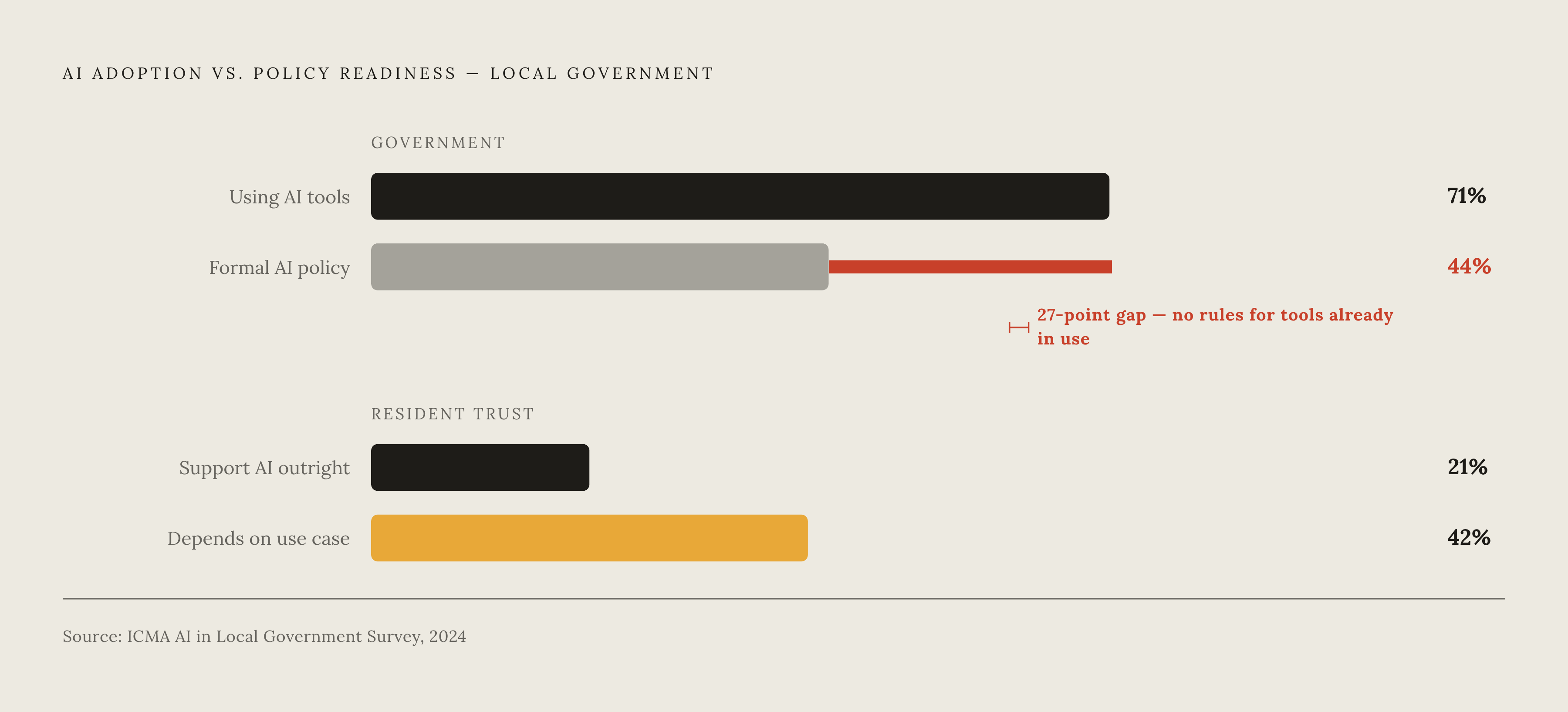
AI adoption inside local government emerged as a leading technology trend of 2025, which tells you the institutional ground underneath these platforms is moving fast, whether or not the platforms themselves are ready for it. Adoption is outrunning governance, though, and by a wide margin. A survey from Granicus and ath Power Consulting found that 71% of local governments are already using AI tools in some form, while only 44% of those governments have a formal AI policy in place. A 27-point gap between using the tool and having rules for it is not a small thing to leave open.
Inside civic participation platforms specifically, AI is starting to do real, useful work. It can translate dense policy language into plain speech that a non-specialist can actually read. It can extend multilingual support to residents who've been shut out by English-only processes. It can summarize hundreds of pages of meeting materials down to what actually matters, cutting the time cost of staying informed. The opinion-mapping tools already central to vTaiwan's Opinion Collection stage, does opinion-mapping at a scale no group of human facilitators could match by hand. And models like deliberAIde point toward a future where AI handles the note-taking and documentation of a deliberation session so human moderators can spend their attention on the quality of the actual conversation.
Public trust hasn't caught up to any of this yet, and it shouldn't be expected to on faith. CivicPlus research found only 21% of residents express outright support for AI in government; another 42% say their support depends entirely on the specific use case. Trust here gets earned one application at a time, not granted wholesale because the technology is impressive in the abstract.
The most consequential application on the horizon is turning a citizen's plain-language idea into a properly structured legislative draft, cutting out the lawyer or lobbyist that has historically been required to translate a good idea into a bill anyone official could act on. Some cities are already building the governance layer to support this responsibly: Spokane and Lewis County in Washington State adopted formal AI governance frameworks in the 2025-2026 window covering bias, data privacy, accountability, and public records. That's the policy infrastructure starting to catch up to the technology, which is exactly the order it needs to happen in.
One caution worth sitting with: AI-assisted drafting and summarization can lower the barrier to entry, sure, but if what comes out the other end still feeds into a platform with no formal route to a decision-maker, the barrier reduction is mostly cosmetic. Easier to write a proposal means nothing if the proposal still goes nowhere.
What a genuine pipeline from citizen idea to official action requires
Line up Decidim, Consul, and vTaiwan next to each other and one failure mode repeats across all three: participation that's genuinely real and entirely non-binding. Officials can read the input, nod, and let it die in a drawer, and nothing in the platform stops that from happening.
Three elements are missing, consistently, across almost every case reviewed here. Structure first: a plain-language citizen idea needs to become a properly formed proposal, shaped the way officials actually receive legislation, not a paragraph of grievance sitting in a general inbox. Credibility next: verified co-signers from the affected community, not anonymous clicks that anyone anywhere could generate, are what tell an official a proposal represents real constituents rather than a bot campaign or an outside pressure group. And a direct route, so the proposal reaches the specific official with actual jurisdiction over the issue, instead of disappearing into an archive nobody reads twice.
Verified co-signatures in particular are what separates a serious civic proposal from background noise, and it's worth noticing that both Decidim and vTaiwan lean on something like this implicitly without ever making it a hard requirement of the design. That's a gap, not a flaw exactly, but a gap.
There's a decent analogy already working at a smaller scale: pothole-reporting tools like FixMyStreet succeed because they route a complaint straight to the department responsible and leave a trackable record behind it. Nobody wonders where their pothole report went. Civic proposals need that same routing logic, just applied to legislation instead of infrastructure repair. Open States, which tracks state-level legislation and lawmakers across the U.S., is the kind of data infrastructure a next-generation platform could plug directly into a proposal pipeline, so a citizen submitting an idea would actually know which official received it and could follow its status the way they'd track a package.
That's the direction open-source civic tech needs to keep moving: toward a closed loop from citizen input to official action, free to use, governed by the communities running it, and wired structurally into the legislative process instead of sitting politely beside it. Participation volume was never the real measure of success here, even though it's the easiest number to report in a press release. The real measure is narrower and harder to fake: whether a citizen's idea, once it's properly structured and verified, can actually land on the desk of someone with the authority to act on it.