How Legislative Bill Language Is Formally Drafted
Legislative counsel's offices turn policy ideas into language that survives courts and time.
Bill drafting is a formal, learned craft, and no member of Congress or state legislator writes one alone at a desk. Behind every piece of legislation sits a legislative counsel's office, full of attorneys whose entire job is turning a policy idea into language that holds up in court, survives amendment, and does what it claims to do. Once you understand how that craft actually works, you start to see why legislation reads the way it does, and what actually stands between a citizen's idea and a real bill.
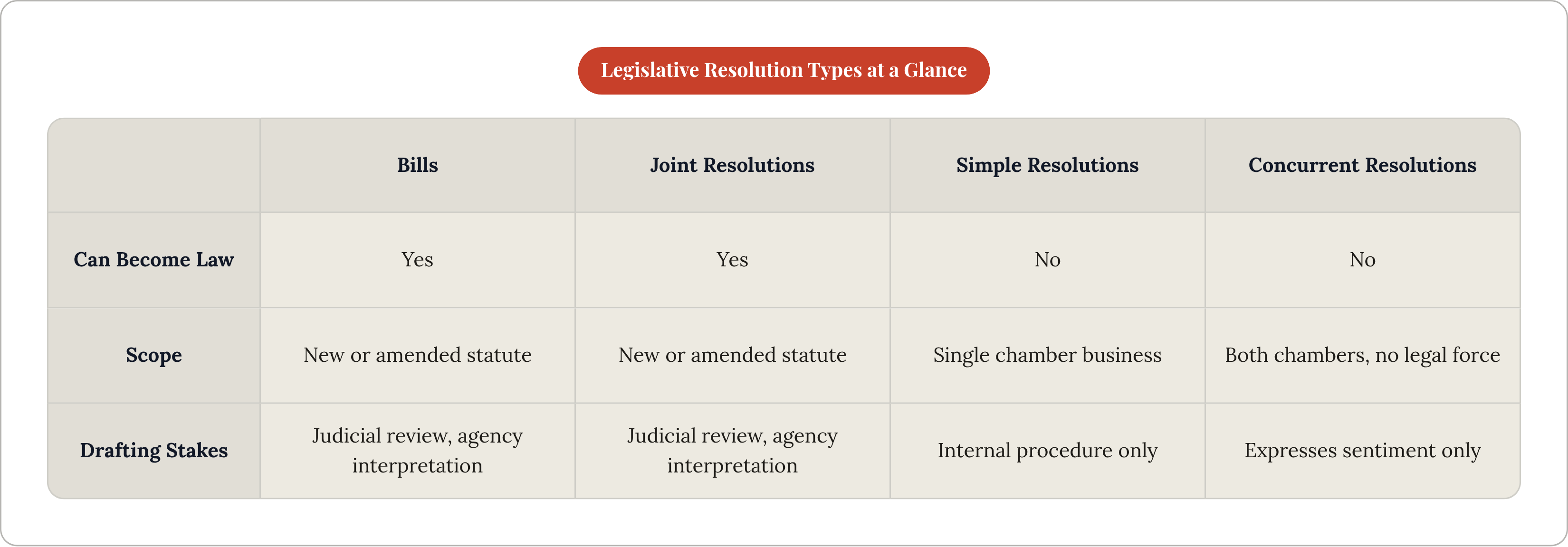
Start with the vocabulary, because it matters more than it sounds like it should. Federal legislation comes in four forms: bills, joint resolutions, simple resolutions, and concurrent resolutions. Only bills and joint resolutions can become law; simple and concurrent resolutions handle internal chamber business or express sentiment, but carry no legal force. A drafter writing a bill knows the language has to survive a president's signature, judicial review, and years of agency interpretation down the line. A drafter writing a simple resolution knows none of that applies, and it changes how they approach the page from the first word.
The institutional home for this work is the legislative counsel's office. The House has one, the Senate has an equivalent, and every state legislature keeps its own version. These offices are staffed by lawyers, not policy experts in agriculture or health care or transportation. Their job is translation: turning a member's idea into formal statutory text. A member submits an idea, sometimes with rough language attached, counsel drafts formal statutory text, the member reviews it, and often the group that originated the idea reviews it again for accuracy. California's Senate lays this pipeline out plainly in its citizens' guide to the legislature.
What strikes me most is how deliberately neutral the drafters are trained to be. Nebraska's legislative drafting manual states it outright: the drafter expresses no personal opinion on the bill, doesn't weigh whether it should pass, and treats the requester's identity and the bill's political viability as irrelevant to the quality of the work. Policy belongs to whoever asked for the bill. Precision belongs to the drafter. That split runs counter to how most people imagine legislation gets written, and it took me a while to fully absorb it myself: the drafter applies craft to someone else's idea, without ever advocating for it.
The scale of this system is easy to underestimate too. The National Conference of State Legislatures has compiled drafting manuals from all 50 states, fifty separate institutions, each with its own conventions, each treating bill drafting as a discipline serious enough to codify in writing. That alone tells you this isn't improvisation.
The first and hardest step: defining the problem before touching the language
Before a drafter writes a single operative sentence, two things have to happen. The House Office of the Legislative Counsel's January 2025 drafting guide lays out the sequence explicitly: first, identify the problem to be solved. Second, articulate a specific policy for solving it, the precise means by which the problem gets addressed rather than a general direction or a vague goal.
Why does the order matter this much? Language written before the problem is fully pinned down tends to produce statute that's vague exactly where clarity matters most, or that quietly conflicts with itself once someone tries to enforce it years later. A drafter can write clean, grammatically flawless sentences that still fail as law if the underlying problem was never nailed down. Precision at the sentence level can't rescue an unclear premise.
This diagnostic step also forces an early structural fork: does the bill stand on its own, or does it amend an existing statute? A freestanding bill is a self-contained statement of new law, not folded into an existing code section. An amendment modifies statute already on the books, with new material conventionally shown in quotation marks. Getting this choice wrong creates real interpretive chaos down the line, for courts and agencies that have to apply the law later. A bill that duplicates existing statute, or one that quietly contradicts it, invites exactly the kind of ambiguity drafters spend their careers trying to avoid.
This is the discipline that separates legislative drafting from ordinary policy writing. It's also why a citizen's idea, however well-reasoned, usually needs translation before it can function as a bill. A grievance still has to be sharpened into a problem statement. A preferred outcome still has to be translated into a policy mechanism.
The structural conventions that make a bill a bill
A bill follows a rigid anatomy: title, enacting clause, findings when they're used, a definitions section, operative provisions, an effective date, often a severability clause. Courts, agencies, and legislators all lean on that structure staying consistent, because they're reading hundreds of these documents a year and need to know exactly where to find what.
Take the findings and purpose section. Sounds harmless enough, right? The House Office of the Legislative Counsel actually discourages purpose statements that just summarize what the operative text already says. If the operative language already states what's required, permitted, or prohibited, repeating it in a purpose statement is redundant at best. The deeper risk runs worse than redundancy though: any gap between what the purpose statement claims and what the operative text actually does becomes an opening for a court to interpret the bill in a way nobody intended. Every sentence in a bill is potential evidence in future litigation. That's not an exaggeration; it's the working assumption drafters operate under every single day.
Operative provisions have to stay internally consistent across the whole document. Define a term in section one, and that definition governs how the word reads in every other section, no matter how it might get used casually elsewhere. Amendments to existing law follow their own visual conventions: inserted text in quotation marks, struck text shown as struck through, so anyone reading the bill can see exactly what's changing in the code and what's staying put.
These conventions exist to govern the interface between the bill and the legal system that has to interpret it once it passes.
The drafting rules that govern word choice at the sentence level
The governing principle across nearly every state and federal manual is the same: clear, concise, precise, in that order. Clarity comes first because a court has to read the provision and know what it means. Concision matters because extra words create extra ambiguity. Precision matters because the wrong word, even a close synonym, can shift what a law actually does.
South Dakota's drafting manual, revised in October 2024, warns against duplicative or excess verbiage. Nebraska's manual goes further and explains why: courts try to give meaning to every word in a statute, so if there's an unneeded word sitting in a sentence, a judge may assume the drafter meant something by it. Surplus language implies a distinction nobody intended to make. Sit with that for a second, because it's a strange thing to internalize: adding a word you think is harmless can quietly change what a law means five years later, once someone litigates it.
Word choice carries real legal weight in ways that trip up non-lawyers constantly. "Shall," "may," and "must" are not interchangeable, even though they sound close enough in everyday speech. Each signals something different: mandatory, permissive, directory. Swap one for another and you've changed whether a government agency has to act, is merely allowed to act, or is just encouraged to.
Defined terms work the same way. Once a word is defined in a bill's definitions section, that's the only meaning it carries throughout the document, whatever it might mean in ordinary English. This is why bill language sounds alien to most readers. It's written for courts and agencies who will parse it years later, often adversarially, rather than for a general audience encountering it once. Defensible choice? Sure. It's also the choice that creates real distance between citizens and the laws meant to govern them.
How a drafted bill moves through committee, markup, and negotiation
Introduction is the start of a bill's language journey, not the end of it. Once introduced, a bill goes to the committee with jurisdiction over its subject matter, and often from there to a specialized subcommittee for hearings and revision.
Markup is where the real changes happen. It's the formal process by which a committee debates a bill, votes on proposed amendments, and decides what text to send to the full chamber. ASU Law's legislative drafting guide identifies markup as a principal responsibility of House committees, and for good reason: every amendment adopted in markup changes the operative text, and each one has to be drafted with the same precision as the original bill. One sloppy amendment can undo careful drafting elsewhere in the same document.
Then there's the conference committee problem. When the Senate amends a bill the House passed, or the reverse, the two chambers end up holding two different versions of the same bill. A conference committee, with members from both chambers, has to produce a single identical text that both bodies then vote on again. What comes out of conference can look substantially different from what either chamber originally passed. It carries the exact same force of law once both chambers approve it and it's signed.
The constitutional endpoint is spelled out in Article I, Section 7: a bill becomes law when the president signs it, when Congress overrides a veto with a two-thirds vote in both chambers, or when ten days pass without presidential action while Congress remains in session. Knowing that endpoint is part of why drafting has to anticipate more than the bill's first reading. Every amendment, every negotiation, every future interpretive fight has to be something the original language can actually survive.
How state-level bill drafting differs from federal practice
Most of the law that actually touches people day to day, land use, education, local services, comes out of state legislatures, not Congress. And state legislatures don't all run on the same clock. That matters more than it sounds like it should.
Some states run sessions of only a few weeks a year, while others operate on year-round, two-year cycles instead. That compressed timeline in short-session states puts real pressure on drafting quality, since there's simply less runway to catch problems before a vote. Pre-filing helps some states manage this, letting bills get submitted in the weeks before a session formally opens so drafters aren't racing the clock from day one.
California's process is worth a closer look as a model of built-in transparency. Once a bill is introduced and printed, it can't be heard in a policy committee until 30 days have passed, and it also has to sit in the Daily File for four days before any committee hearing. That's a deliberate design choice, a built-in window that gives citizens time to actually track a bill and respond before it moves.
Drafting manuals vary in tone as much as content, too. Nebraska's leans hard on drafter neutrality. South Dakota's October 2024 revision emphasizes economy of language. Montana keeps its own manual, reflecting its own legislature's habits and its courts' interpretive style. Fifty states, fifty philosophies, but the same underlying discipline running underneath all of them. NCSL's compilation of state drafting manuals is among the clearest proof this craft has been systematized nationwide, even where the specific rules diverge.
What citizen advocates actually encounter when they try to engage with this process
There are entry points for citizens in this process. They're just not obvious, and you need to know where to look before you can use any of them.
California's Daily File system lets citizens track which bills are scheduled for committee hearings, giving them a real window to testify or reach a legislator's office before a vote happens. Committee hearings themselves are the primary public moment in the whole process, where witnesses testify and members go on record. But getting into that room requires navigating a system most citizens were never taught, not in school, not anywhere else.
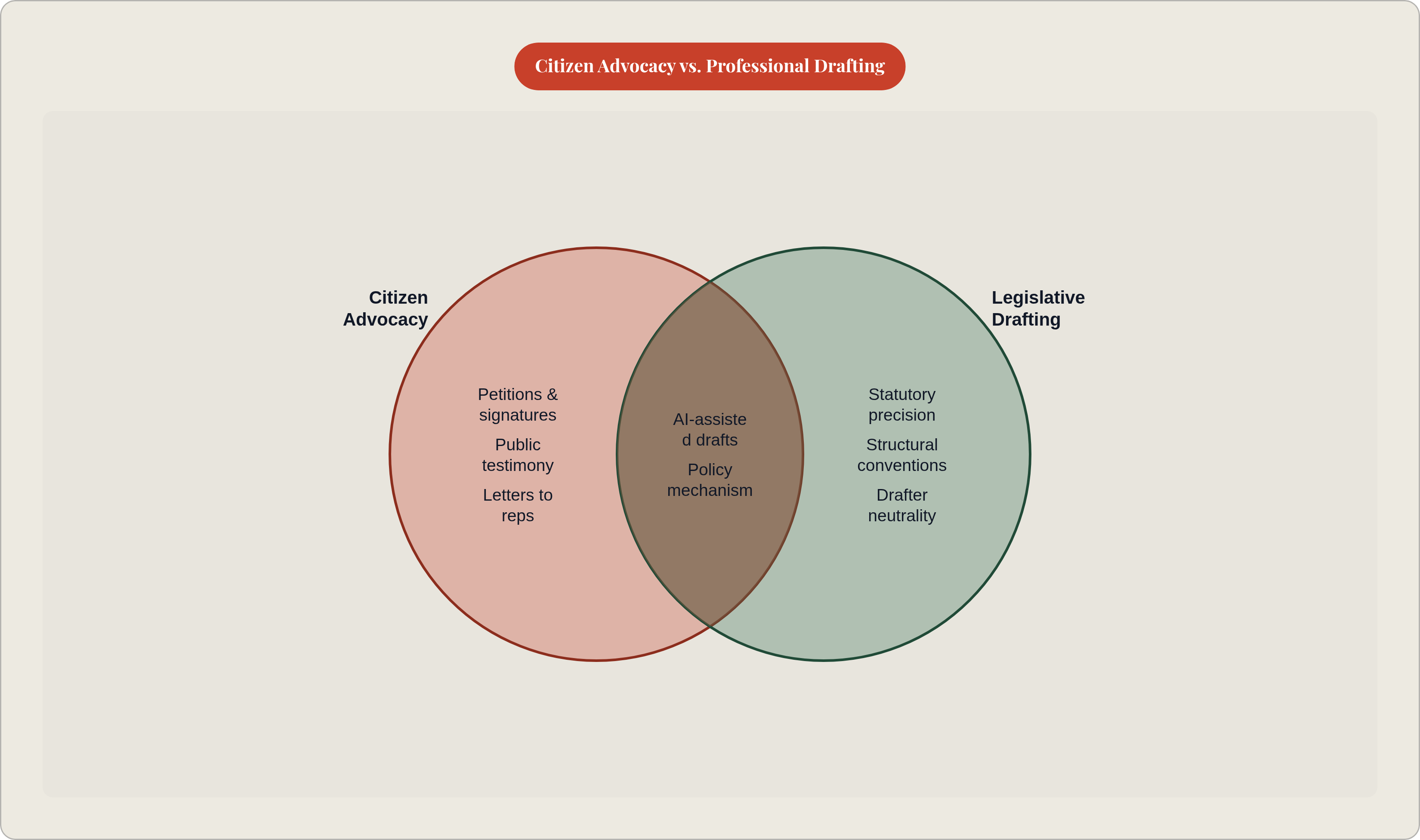
Broadly, citizen advocacy splits into two modes. Direct lobbying means meeting with a legislator or testifying at a hearing yourself. Grassroots lobbying means mobilizing other people through letter-writing campaigns, petitions, public demonstrations, that kind of organized outside pressure. Both are real. Both matter.
But here's the gap, and it's a big one. Large organizations and businesses can hire professional lobbyists who already understand drafting conventions and know how to frame a request in language legislative counsel can actually work with. Individual citizens, generally, cannot. Petitions, however many signatures they gather, demonstrate sentiment without producing anything a drafter can use. A petition tells a legislator that people care, but it doesn't hand anyone a policy mechanism or a problem statement structured the way a bill needs to be structured.
That's the real barrier, and it's really two barriers stacked on top of each other. A citizen with a genuine policy idea first has to get a legislator's attention, which is a political problem. Then, separately, that citizen has to translate the idea into language that can actually enter the formal drafting pipeline, which is a craft problem entirely. Most advocacy tools address the first barrier. Almost none touch the second.
How AI is beginning to close the drafting craft gap
This isn't hypothetical anymore. A Brazilian municipality passed what's believed to be the first AI-written law in 2023. Inside official legislative offices, the shift has already started too: the U.S. House's Office of the Clerk was using AI by 2024 to speed up cost estimates for bills and to map how new legislation connects to existing code. Ohio used an AI tool starting in 2020 for a wholesale revision of its state administrative law.
The stakes for drafting precision went up sharply in June 2024, when the Supreme Court reversed the Chevron doctrine. Agencies no longer get automatic judicial deference when they interpret gaps in statute, which means legislation itself now has to be specific on its face in ways it didn't strictly need to be before. Who catches every inconsistency across a long, complex bill when there's no fallback agency interpretation left to smooth things over? AI tools built to enforce consistency across a bill's provisions become genuinely more valuable in exactly this kind of environment.
A 2025 Lawfare analysis breaks down what large language models specifically bring to the table. They can work across several specialized policy areas at once, without needing a large team of subject-matter experts assembled for each one. They can process huge volumes of existing legislation, regulatory guidance, and legal opinions while keeping consistency across interconnected legal frameworks, the kind of cross-referencing that wears a human drafter out over a hundred-page bill. They're also well suited to the tedious, mechanical parts of the craft: enforcing the grammatical and structural rules drafting manuals lay out, sentence-level precision that's easy to state as a rule and hard to sustain by hand for hours at a stretch.
The OECD's September 2025 report counted nearly 200 examples of AI use across government functions worldwide, regulatory design and policy evaluation among them. That number is worth pausing on. AI-assisted drafting has moved well past novelty at this point; it's becoming a mainstream government practice.
Which raises the obvious next question. If AI can help professional legislative counsel draft more precise, more internally consistent bills, why would that capability stop at the office door? If it helps a trained attorney working inside a legislature, there's no craft reason it can't help a citizen produce draft language structured well enough to actually enter the formal process.
What it actually takes to turn a citizen idea into a bill that can be acted on
Formal bill drafting is a learned craft, run through professional offices, bound by structural conventions and exacting rules about word choice. That precision serves a purpose beyond difficulty for its own sake: a bill has to survive courts, survive agencies, survive months of political negotiation, sometimes years of it.
So what does a citizen idea actually need before it can enter that process? A clearly identified problem, stated with specificity rather than as a grievance or a general preference. A specific policy mechanism, the precise means by which the problem gets addressed, not just a direction to head in. Language structured the way legislative counsel and committees expect to see it. A route to the specific official or office that actually has jurisdiction over the subject matter.
Historically, citizens have had the advocacy tools: petitions, public testimony, letters to representatives. The missing piece has been the drafting infrastructure that turns an idea into something with actual legislative form. The desire to participate was rarely the obstacle, and in many cases neither was access to officials. The craft layer in between was.
Some emerging tools go directly at that gap, taking a plain-language citizen idea and turning it into a formally structured bill, built around the same conventions this whole piece has walked through. Verified community co-signatures can give a proposal the kind of credibility that separates a serious idea from background noise, and routing the finished result to the officials who actually have jurisdiction to act on it closes the loop between citizen and process.
The craft of bill drafting produces durable, precise law, full stop. The real question has always been whether ordinary citizens could reach the standard that craft demands without a law degree or a retained lobbyist standing between them and the process. Technology is starting to make that access real, helping more people meet the existing standard rather than lowering it.