Public Comment Periods in the Rulemaking Process
Citizens can shape regulations before they're finalized if they know the process exists.

Federal agencies can't just write a rule and slap it into law. They have to open a public comment period first, a legal requirement baked into the Administrative Procedure Act of 1946. I've spent enough time tracking these proceedings to know most people have no idea this window exists, let alone that it's often the single best shot a regular person gets at shaping a regulation before it's locked in.
Congress passes laws in broad strokes. It says the air should be "clean" or that a tax credit should exist, and then leaves the actual math and definitions to an agency. That agency has to publish a notice in the Federal Register, take in comments from anyone who wants to weigh in, and show, on paper, that it actually grappled with what people said. Skip that step or fumble it, and a court can throw the whole rule out. This is the plumbing underneath most federal regulation, and almost nobody outside a handful of trade groups and law firms knows how it works.
How a rule moves from agency proposal to final regulation
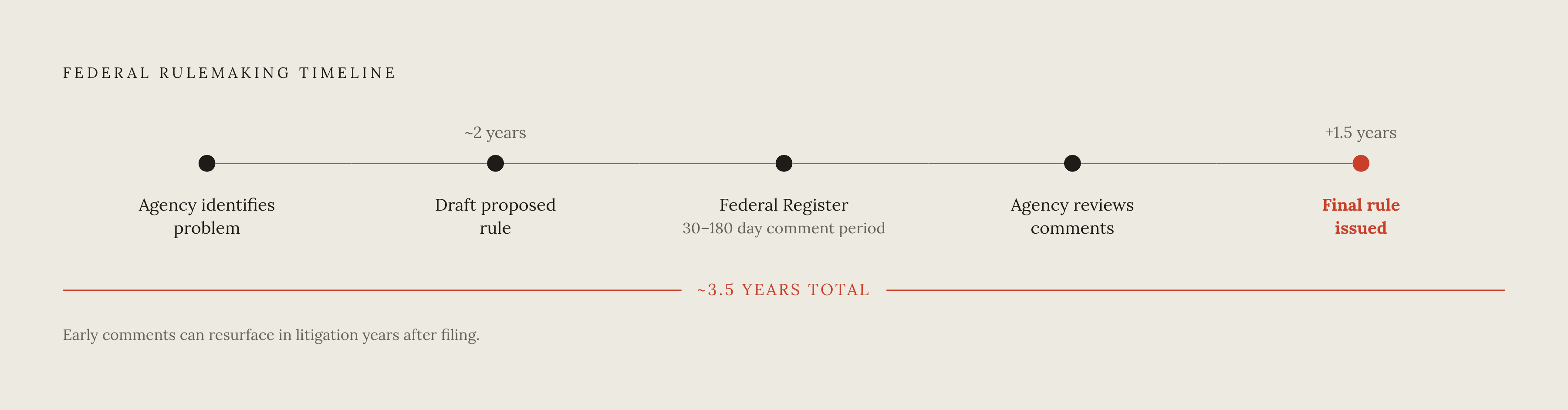
On paper, it's a clean sequence. An agency spots a problem, drafts a proposal, publishes it, opens a comment window, reads what comes back, then issues a final rule that responds to what it received. That response is the legal hinge. Leave it out, and there's no record connecting what the public said to what the agency actually decided.
Once the window shuts, an agency has three moves: revise based on what it heard, drop the idea, or push forward close to the original draft. Courts review that choice under the "arbitrary and capricious" standard, and a rule that waved off substantive comments without answering them is vulnerable. Judges have struck down rules on exactly that ground.
None of this moves fast. I went looking for a pattern across the proceedings I've followed, and the timeline holds up: historically it takes close to two years just to get from identifying a problem to publishing a proposed rule, then another year and a half to reach the final version. A comment filed early isn't a one-off gesture into the void. It becomes part of an administrative record that can resurface years later in litigation, long after everyone's forgotten they wrote it.
How long comment periods last and where to find them
Most run 30 to 60 days, though bigger, more contested rules can stretch to 180. The main venue is Regulations.gov, where proposed rules get posted and comments get filed; the Federal Register stays the official record, the place notices show up first.
States run their own version under their own administrative procedure acts. Local government adds a third layer on top of that, and its notices sometimes live nowhere but a municipal website, a legal notice buried in a newspaper, or a meeting announcement nobody outside city hall ever sees.
Plenty of people affected by a rule never even see the notice that started the clock running, and sometimes the window closes before word spreads past the professional stakeholders who already had it marked on their calendars. And the tools built to fix that gap don't always work: technical failures on government comment portals have left submission windows functionally closed even when officially open. The door meant to open can stay, for all practical purposes, locked.
What the volume of public comments actually looks like
Some rules pull in a flood. The IRA's clean hydrogen tax credit, Section 45V, drew more than 29,000 comments before its window closed on February 26, 2024, one of the most contested provisions in the whole law. That's not a freak number, since across the federal government, comment volume in any given year runs from the thousands into the millions.
Volume is its own kind of problem. Agencies are legally required to consider every comment that comes in, on a fixed timeline that doesn't stretch just because the mailbag got heavier. Throw in coordinated form-letter campaigns, the same templated message showing up thousands of times under different names, and staff have to sort duplicates from anything genuinely new before the real work even starts.
Does a bigger pile of comments actually move the needle? I used to assume volume mattered more than it does, but it's rarely decisive on its own. Agencies weigh the argument, not the headcount.
What makes a comment substantive versus what gets set aside
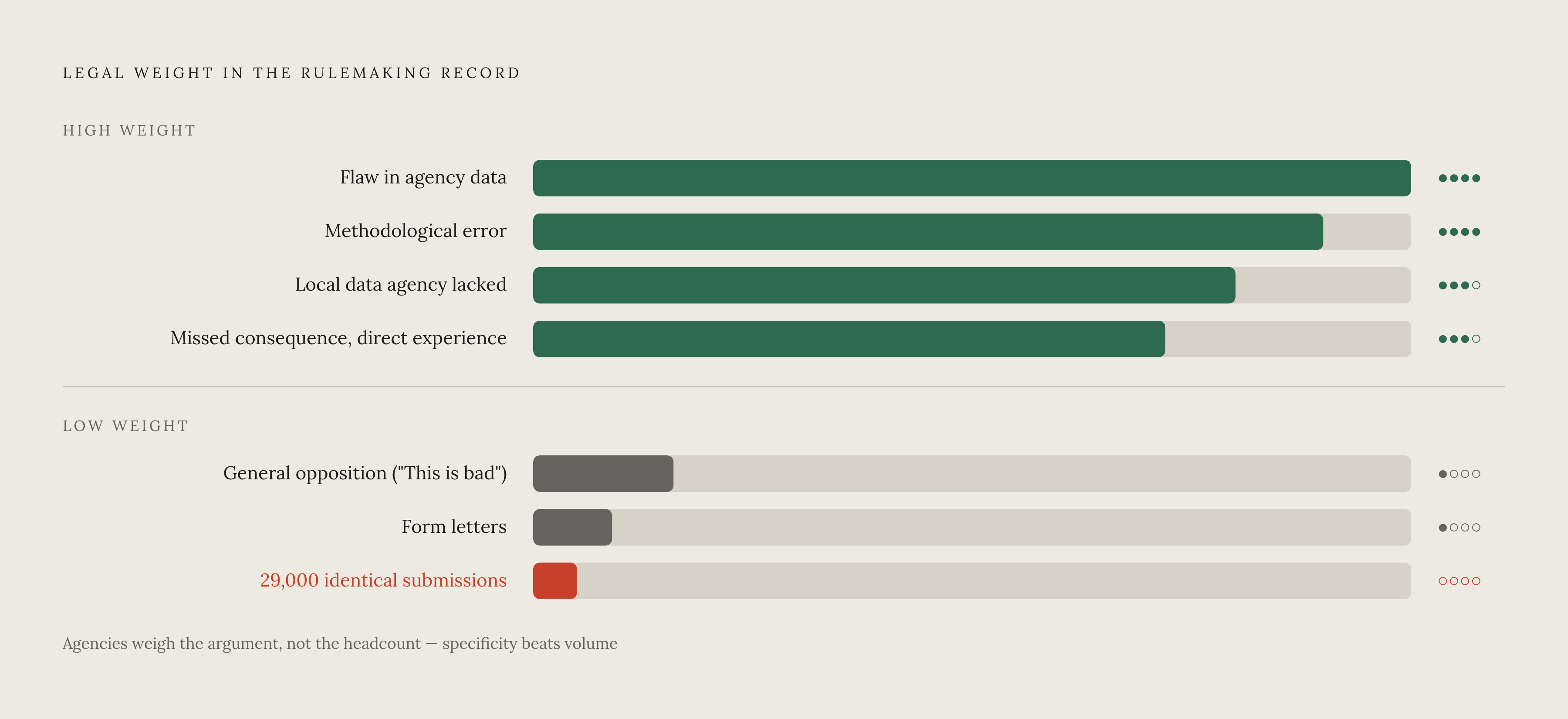
An agency doesn't have to change course because a lot of people said they didn't like something. It has to respond to comments that raise a specific factual, technical, or legal problem with what's proposed. Point to a flaw in the agency's data, question its methodology, flag a consequence it missed, and offer a fix: that carries weight, while "This is bad," on its own, doesn't.
Form letters and general opposition still land in the record, though they rarely get more than a boilerplate acknowledgment back. In practice, the comments that get treated as significant by agency staff tend to be dominated by interest groups, trade associations, and people who know the technical weeds of the subject.
So what does that mean if you're one person writing in? A single comment grounded in direct experience, one carrying local data the agency never had or naming a group its analysis skipped over, can outweigh thousands of identical form submissions. The legal standard rewards specificity over volume. That cuts hard against the instinct that more signatures automatically means more influence, and it's worth remembering the next time someone forwards you a petition instead of a comment link.
The barriers that keep most people out of the process
The barriers fall into recognizable categories: people don't know the process exists, don't know how to take part even if they do, lack the time or money to engage, or run into language and geographic barriers that shut them out before they start.
Take the first one. Civics classes spend weeks on how a bill becomes a law and almost nothing on what happens after, and most people graduate never having heard the word "rulemaking."
Then there's the writing itself. Proposed rules read in dense regulatory language, and figuring out what's actually being proposed, before you've even tried to respond, eats up time most people don't have to spare. Meanwhile, certain organized interests, trade groups, specialized law firms, show up every single time with more resources and more practice at this game than any individual will ever build up. The formal right to comment and the realistic odds of shaping an outcome are two different things, and most people fall into that gap.
Local rulemaking makes it worse. City and county notices are often less visible than federal ones, sometimes posted only at an agency office or tucked into a newspaper legal notice section nobody reads anymore.
How AI is changing what happens to comments once they're submitted
Several federal agencies already lean on AI to manage the flood. The CDC uses generative AI to classify commenter sentiment, and the Department of Transportation uses agentic AI to categorize submissions and detect sentiment, according to the agencies' own AI use plans. What's coming next goes further: AI flagging which topics need rulemaking attention, machine learning finding patterns across huge comment files, generative tools drafting preambles or first-pass responses.
Agencies are required to give reasoned responses to important comments. If an AI system is doing the sorting and staff lean on its output without fully understanding how it got there, that's a defensibility problem the moment a rule gets challenged in court. Legal scholars tracking this closely have pointed out the technology is outrunning the rules meant to govern it; agencies may not fully understand the systems they're now relying on in a process that carries real legal weight.
For someone writing a comment, this shifts the math a little. Clarity matters more, not less. A comment an AI tool misreads as neutral, or files as off-topic, can effectively disappear from the substantive record before a human staffer ever lays eyes on it.
The separate threat of AI-generated fake comments and what it does to the process
This is a different animal from AI sorting real comments, and it's already showing up in live proceedings. In Northern California, AI tools were alleged to have generated comments attributed to real residents who said they'd never submitted anything to the Bay Area Air Quality Management District on the pollution rule under review. The Sierra Club called for a state attorney general investigation.
A similar pattern surfaced in North Carolina in September 2025, where county commissioners noticed a run of suspiciously similar emails backing a gas pipeline and suspected a coordinated AI campaign behind it. Across the Atlantic, a UK service emerged that automatically files a citizen's objection to every project currently under regulatory review. Sitting with that one for a while, I keep landing on the same question: what does mass participation even mean once it no longer requires a person to sit down and write anything?
Congress has started to respond. The Comment Integrity and Management Act of 2024 passed the House without opposition. It doesn't ban AI-generated comments outright; it builds a framework for agencies to flag and manage them on Regulations.gov, sponsored by Rep. Clay Higgins of Louisiana. The stakes go past any single rule. If an agency can't tell a genuine constituent account from a fabricated one, the whole comment record loses evidentiary value, and courts lean on that record every time they review a rule.
What state and local comment processes look like compared to the federal model
Every state runs its own administrative procedure act, and the details differ, but nearly all of them build in some form of notice-and-comment for state agencies. Local government sits in its own category. City councils, county boards, zoning commissions, school boards: they all hold comment periods governed by local rules, often with shorter notice windows and an expectation you show up in person to be heard.
COVID pushed a lot of this online. Agencies that once required in-person comment moved to Zoom, and some kept a hybrid option once the emergency passed. That shift matters, because local decisions, zoning changes, school policy, municipal budgets, tend to shape daily life more directly than most federal rules ever will. Yet they draw a fraction of the civic attention federal rules get.
The accessibility gap is sharper at this level too. There's no local equivalent of Regulations.gov. A resident has to know the meeting is happening, know where the agenda lives, and often has to physically show up or dig through a specific department's website just to have any voice at all. Some cities have rolled out 311 apps and resident feedback tools, but those mostly handle service requests, potholes, broken streetlights, rather than input on a rule still being written.
What technology can and can't fix about public participation
Digital platforms have made it nearly free to submit a comment, and that's real progress. But dropping the cost of submission to almost nothing hasn't closed the gap between submitting something and actually shaping the outcome. Those are two separate problems, and only one of them has been solved.
Some governments are experimenting with civic tech tools built for deliberation, distinct from the big social platforms that reward outrage and quick emotional hits, aimed instead at surfacing tradeoffs and supporting real exchange. Open data portals have helped too, giving people a clearer window into what agencies are actually doing. A 2025 CivicPlus survey found 70% of residents believe accessible government data lets community members meaningfully affect how government operates. The UNDP, working with the Open Government Partnership, launched a Regional Civic Tech Innovation Challenge in May 2025 and pulled in 251 applications from 30 countries, covering citizen feedback tools, AI-assisted public services, and better local access systems.
None of that replaces the one ingredient that actually makes a comment count: specific knowledge of a particular community's conditions, put into words clearly enough that an agency has to engage with it. That still has to come from a person who lives the situation. Tools that help someone move from a vague worry to a structured, well-formed submission, plain-language breakdowns of what a rule actually says, guided templates, do more for the quality gap than a slicker submit button ever will. The next frontier is tools that help people shape the policy conversation before an agency has even narrowed its options, rather than just reacting once the draft is already locked in.
How citizens can use the comment period as one tool inside a broader advocacy strategy
A comment period works best as one piece of a bigger campaign, not a lone act. Direct contact with legislators, coalition organizing, media coverage: these reinforce each other, and a comment filed in isolation carries less weight than one backed by a wider push.
Constituent stories genuinely move legislators. Congressional staff have noted that many of the strongest bills introduced by a first-term member trace straight back to something a constituent brought to their attention. New members in particular are hunting for ideas rooted in real experience. Petitions don't carry that same legal standing in a rulemaking proceeding; they can show political pressure is building, but an agency isn't required to respond to a petition the way it's required to respond to a substantive comment.
And if what you want actually requires new legislation rather than a new rule, the comment period is the wrong door entirely. That's a job for Congress or a state legislature, not an agency.
So where does someone actually start? Figure out whether the issue lives inside a rule an agency controls or a statute only a legislature can change, then track down the relevant comment period on Regulations.gov or its state equivalent. Write from direct experience, naming one specific problem with the proposed approach instead of a general complaint. Knowing the difference between a law, a regulation, and agency guidance tells you which lever is actually yours to pull, and the comment period is only one lever among several.