How Local Ordinances Are Passed in City Councils
State laws set the boundaries, but citizens who know the process can push where it matters.
An ordinance is local law: a rule with teeth, fines, penalties, actual enforcement. I've spent enough time around city council chambers to know most residents don't realize how much structure sits underneath that single word, ordinance, and how much of that structure is actually usable if you know where to push.
Local law only reaches as far as the city line. Cross into the next town and a different set of rules takes over, because cities don't have some inherent right to make law out of thin air. They borrow it. A city's authority comes from the state, either baked into the state constitution or handed down through statute, and in a lot of states that borrowing works under something called Dillon's Rule: a city can only act where it's been explicitly given the power, where that power is fairly implied, or where it's essential to the city functioning at all. Practically, that means before a city attorney drafts a single sentence, they have to check whether the state has already claimed the topic. That's also why a noise ordinance in one city can read completely differently from the one twenty miles away. Different states, different ceilings.
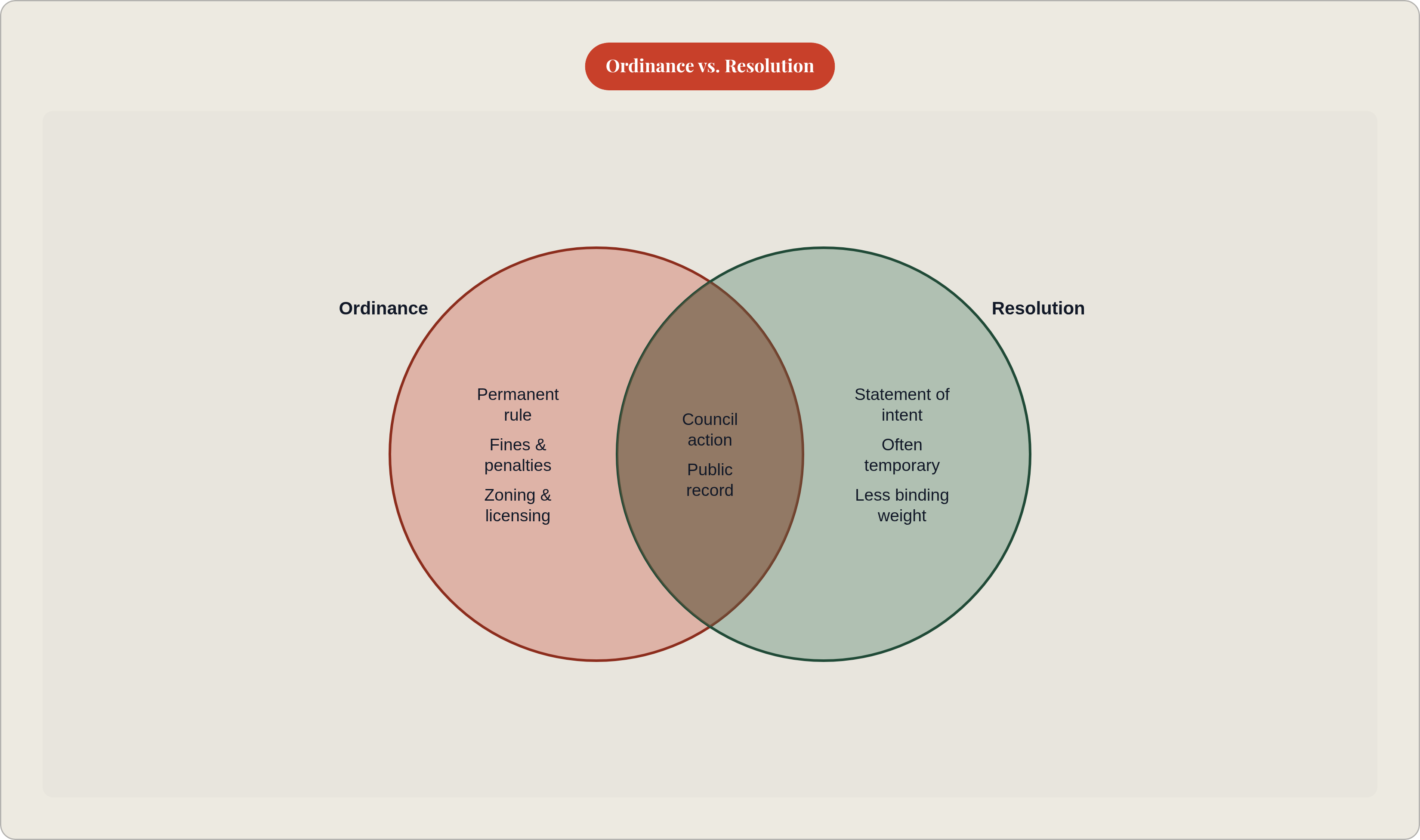
Worth pausing on one distinction here, because it trips people up constantly: ordinance versus resolution. An ordinance is a permanent rule of conduct, the kind of thing that governs speed limits, zoning, business licensing. A resolution is closer to a statement of intent, an administrative directive, often temporary, carrying less binding weight. If you're an advocate hoping for lasting change, you want an ordinance. A resolution might get you a nice line in the meeting minutes and not much else.
Ordinances cover an enormous range once you start looking: land use, traffic patterns, public health rules, business regulation, noise limits, even how big a sign on Main Street is allowed to be. Basically anything local that the state hasn't already staked a claim to.
Where ordinance ideas actually come from before anything is drafted
Ideas don't come from one place. They come from council members themselves, from the mayor's office, from state or federal mandates that force a city to update its code whether it wants to or not, and, yes, from citizens.
Citizen-driven ideas tend to show up through a handful of predictable channels: public forums, direct calls or emails to a council member, petitions, or comments during the open portion of a regular meeting. But here's the structural reality that catches a lot of people off guard: a citizen cannot introduce an ordinance. Only a council member or the mayor's office can sponsor one.
That changes what your actual job is: persuasion. Finding the right council member, the one whose district or interests line up with your idea, and getting them to champion it, is itself a strategic move, maybe the most important one in the whole process.
Sometimes cities don't have a choice at all. State or federal law changes, and suddenly the city has to pass something just to stay in compliance. That's the machinery turning because it has to, separate from any citizen energy at work.
This origin stage, though, before anything is formal, is the loosest and most open part of the whole process. It's where a plain idea still has room to become something real, before procedure closes in around it.
How a draft ordinance gets written and checked before it ever reaches the council floor
Drafting almost always falls to the city attorney, usually working alongside the sponsoring council member and whatever city staff know the subject best.
Before any language gets written, the attorney has to answer a few questions. Does state law already regulate this? Does state law flatly prohibit the city from touching it? And if the city can act, where exactly do those boundaries sit? Skip this step and you end up with an ordinance that gets challenged and struck down before it ever does anything.
Attorneys and clerks also look sideways, at what neighboring cities have already done. That's not laziness. Consistency across a region makes enforcement easier and makes the law easier for residents to understand, and it gives a new draft a kind of borrowed legitimacy. "This worked in the next town over" is a genuinely persuasive argument in a council chamber.
And the draft has to be built for codification from day one: law with section numbers, cross-references, defined terms, the whole apparatus that lets it slot cleanly into the municipal code later.
Here's the part citizens should sit with: the city attorney is the one shaping the actual text. Showing up with a vague complaint gets you sympathy. Showing up with a clearly articulated, well-researched proposal, something that already looks like it could survive legal review, gives a council member something they can actually hand to their attorney. That's the difference between an idea that dies in a hallway conversation and one that becomes a working draft.
The public notice and first reading: what happens when a proposal goes on the record
Before a council can vote on anything, public notice has to go out. Per the League of Minnesota Cities in 2024, at least 10 days' advance notice is required. That notice usually shows up in three places: the city's official bulletin board, its website, and the local paper of record.
That 10-day window is a citizen's earliest formal signal. It's the moment to start paying attention if you haven't been already.
Then comes the first reading, where the ordinance gets formally introduced at a public meeting. Some cities require the entire text read aloud; others allow a reading by title only, which sounds like a technicality but tells you something about how transparent that particular city tends to be. Most states then require a second reading on a separate day before any final vote happens, which builds in a mandatory pause. California requires two readings for basically everything except urgency ordinances, and that pattern shows up across the country, close to the norm rather than a quirk.
The gap between first and second reading is, in my experience, the single most underused window in the entire process. It's structural, built in on purpose to give people time to react. So attend the first reading if you can, note exactly when the second one is scheduled, and get your comment, written or spoken, ready before that date arrives.
Committee review and what it means when a proposal is sent "to committee"
After introduction, a council will often send the ordinance to a standing committee. A parking ordinance goes to a transportation committee. Zoning questions might go to the planning commission. Sometimes it's an ad hoc group assembled just for the issue at hand.
What does a committee actually do with it? They check the draft for technical accuracy and internal consistency, they hear from department staff, public works, planning, the city attorney, and on complicated or contested proposals they might hold their own public hearing. Eventually they issue a recommendation back to the full council: do pass, do not pass, or pass with amendments.
"Sent to committee" sounds like a polite way of saying dead, but plenty of ordinances come back from committee stronger than they went in, with better language and new supporters they didn't have before.
This is also, quietly, one of the best places for a citizen to have real influence. Committee hearings tend to be smaller, less formal, more willing to sit with a detailed argument than a packed full council session ever is. If you've got specific technical knowledge or a data-backed case, this is where it lands hardest.
There's a real risk, too: a proposal can sit in committee indefinitely if no one on the council pushes to bring it back for a vote. So track the committee's schedule. Keep asking about it. Momentum doesn't sustain itself.
The public hearing: what it is, when it's required, and how to use it
Not every ordinance requires a formal public hearing. The ones that legally must have one are mostly zoning changes and amendments to the city charter.
For everything else, comment happens through open periods at regular meetings, written submissions to the city clerk, or a hearing the council chooses, but isn't obligated, to hold.
When a hearing is mandatory, the council genuinely cannot move forward without it. That's a hard procedural protection, and citizens can invoke it directly if a city tries to skip the step.
Being effective in public comment is its own small skill. Speak to the actual language in the ordinance, not the general topic floating around it. Submit written comments too, since those become part of the official record in a way that spoken comment sometimes doesn't. If you're organizing neighbors, have them speak in sequence with distinct points instead of six people repeating the same sentence. And bring something concrete: photos, data, an ordinance from a comparable city that handled the same issue well.
One thing that's changed the credibility equation here: verified co-signature models let a council member see that a proposal has real, documented neighborhood support before the hearing even starts. That matters, because council members hear "everyone in my neighborhood wants this" constantly, and most of the time they have no way to check if it's true.
The council vote: thresholds, mayor involvement, and what can still change
The standard bar is a majority vote of all council members, not just the ones who happen to show up that night. Some ordinances need a supermajority, and it's the city attorney's job to know which threshold applies to which type of ordinance.
California adds a specific wrinkle: at least three affirmative votes are required, and if two members are absent, passage needs a unanimous vote from whoever's left in the room. Attendance, in other words, can decide the outcome all by itself.
Government structure matters too. In strong-mayor cities, the mayor can sign or veto after the council passes something. In council-manager cities, the council's vote is usually the final word, no separate executive sign-off needed.
Amendments can still happen at this stage. A vote to amend, followed by a re-vote, is entirely possible, and organized citizen pressure between readings has pushed through last-minute changes more than once. So if you've been showing up, testifying at committee, submitting written comment, you've likely already shaped the version on the table, even if you're not sitting in the room when the final tally happens.
Enactment, publication, and the waiting period before an ordinance becomes enforceable
Passing an ordinance and enforcing it are two separate moments, and most states build a deliberate gap between them.
The timelines vary quite a bit state to state. In California, ordinances generally take effect on the 31st day after adoption, urgency ordinances aside. Minnesota requires publication in the city's official newspaper within 45 days of adoption. Neither of those numbers is arbitrary; they're set by statute for a reason.
Publication itself matters more than it sounds like it should. Most states require the new ordinance to appear in an official paper or on the city's public portal, and that's the step that actually makes enforcement legitimate. Skip it, and you technically don't have an enforceable law yet, no matter what the council voted on.
Then comes codification: the ordinance gets formatted and slotted into the municipal code, with section numbers, cross-references, defined terms, the works. This step makes the law searchable and citable later, for residents, for businesses, for the officer who eventually has to enforce it.
That waiting period gives businesses and property owners time to actually comply before enforcement kicks in. And if you were one of the people pushing for this ordinance, don't check out once the vote happens. Track the publication and the codification. Confirm the final text matches what you thought was passed, because it's not unheard of for small things to shift between the vote and the code.
Where citizens have the most leverage across the full process
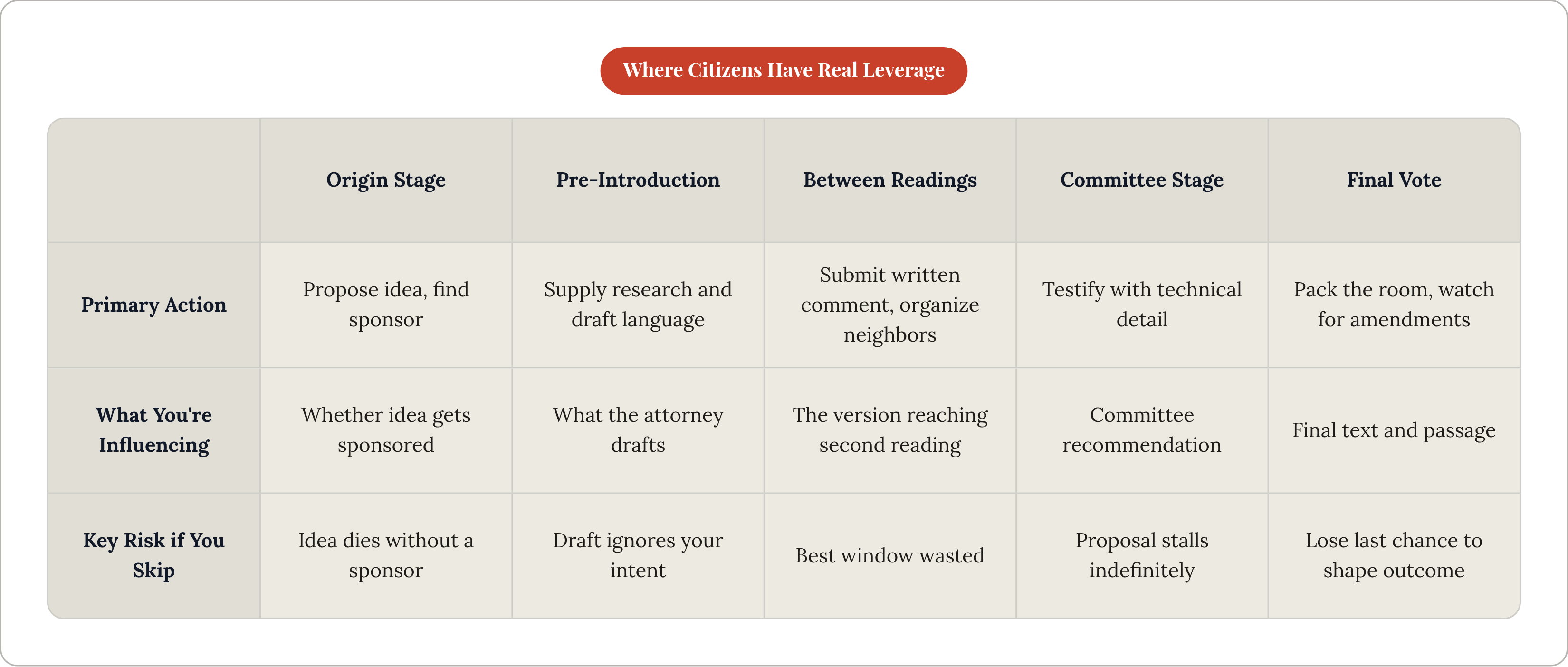
So where does all this actually leave someone with an idea and no formal power to introduce it?
There are at least five real points of entry, not just one. At the origin stage, you can propose the idea, find a council member, and document community support before drafting even starts. Pre-introduction, you can hand over research, comparable ordinances, even a structured draft that makes the city attorney's job easier. Between readings, you can submit written comment, organize neighbors, and ask directly for a meeting with the sponsor. At the committee stage, you can show up, testify with real technical detail, and track the recommendation. And at the final vote, you can pack the room, get last-minute comments in, and watch for amendments.
Numbers matter, but only when they're backed by substance. A petition with no structure behind it tends to get filed and forgotten. A verified list of co-signers attached to a specific, well-drafted proposal tends to get a response, because it looks like something the council member could actually act on without political risk.
Worth remembering, too: only 26 states have citizen initiative laws, according to New America. Everywhere else, there's no direct path to the ballot. The council process is the only route available. Which raises the real question underneath all of this: if the council is the only door, why do so many good ideas never make it through?
Mostly it comes down to the gap between having an idea and finding someone willing to sponsor it. That gap is where most citizen proposals quietly die, not because the idea was bad, but because nobody translated it into something a council member could pick up and run with. Digital tools are starting to close that gap. Platforms like PollSee let residents show up already holding AI-drafted legislative language and verified neighbor signatures, turning raw frustration or raw hope into the exact format a council actually knows how to act on. It's a way of arriving at each stage already prepared for it, which, in a system built on formal steps and short windows, might be the only real advantage a citizen has.