How Citizens Have Introduced Successful Bills Through Sympathetic Legislators
A four-step formula helps ordinary citizens pass bills through sympathetic state legislators.
Citizens who get a bill through a state legislature almost never do it by accident. They follow a sequence: define a real harm, organize the people affected by it, shape that harm into a workable proposal, and hand it to a legislator who has a reason to carry it. California's AB 951, which addressed autism insurance coverage, follows this arc. So does Washington State's Doulas For All Coalition. Different states, different issues, same four parts: a defined harm, an organized constituency, a concrete proposal, and a named legislative champion. None of it depends on party, region, or who a citizen happens to know.
State legislatures as the most productive arena for citizen bills
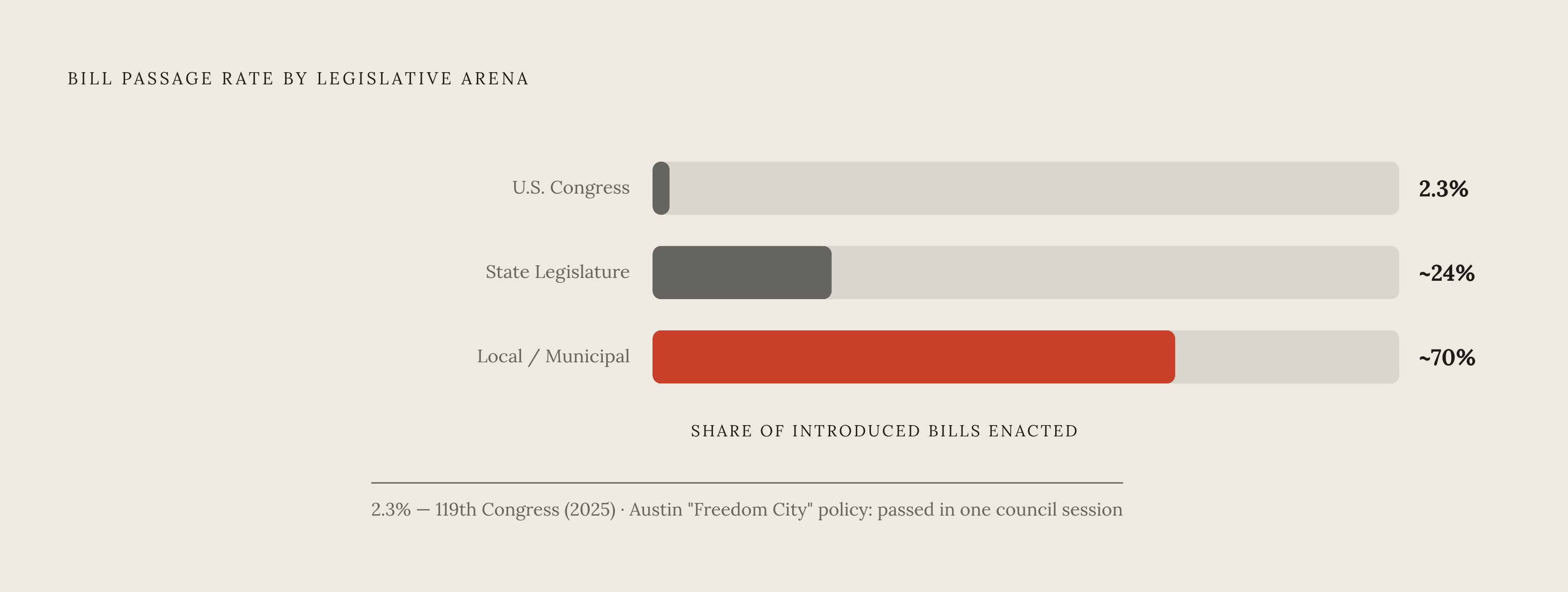
Where a citizen aims this effort matters as much as how carefully they build it. State legislatures pass a far higher share of the bills introduced in them than Congress does, and that gap in success rates is the first thing to understand before organizing anything. Analysis of the 119th Congress found that of the thousands of bills introduced in 2025, only a small fraction became law, a success rate of roughly 2.3 percent. That arithmetic should shape where a citizen group spends its time and energy.
State legislatures work differently because the scale is different. Sessions run shorter. Districts are smaller. Legislators hold office hours, show up at town halls, and answer their own phones more often than members of Congress do. A well-organized group of constituents carries more relative weight in a state capitol than in Washington, simply because there are fewer people competing for the same legislator's attention.
Local and municipal government sits even closer to the ground, though it gets studied less. Austin's "Freedom City" policy shows that a city council can move community-driven policy as fast as, or faster than, a state legislature. For most citizen efforts, though, the state legislature is the sweet spot: accessible enough for an ordinary group to reach, powerful enough for a bill passed there to matter. The steps that follow are built around that arena.
Step one: Defining the problem precisely enough that a legislator can act on it
Every successful bill starts with a problem stated so precisely that a legislator can see what to do about it. Vague frustration doesn't turn into legislation. A broad sense that "something should change" gives a legislator nothing to draft, nothing to defend, and nothing to point to when a colleague asks what the bill actually fixes.
California Assemblyman Tri Ta's account of AB 951 shows what a usable problem statement looks like in practice. A constituent came to him with a precise grievance about autism insurance coverage. Ta could see the specific gap in existing law that caused it. Because the harm was narrow and clearly bounded, the fix could be targeted, too: a correction to the specific broken provision, not a rewrite of the entire regulatory system.
That gives citizens a practical test before they ever approach a legislator's office. Try to compress the problem into one sentence: who is harmed, how are they harmed, and what missing or broken rule causes it. If that sentence doesn't come together cleanly, the idea isn't ready yet. It needs more digging, not more passion. The drafting of an actual bill comes later. At this stage, the only job is making the harm legible enough that someone with the power to act on it can see the shape of the fix.
Step two: Building community backing that gives a proposal visible credibility
A precisely defined problem gets a citizen in the door. It doesn't get a legislator to take political risk on their behalf. Before a legislator sponsors anything, they want proof that real people are affected and organized around it, because sponsoring a bill means spending political capital, and spending it on a problem nobody else seems to notice is a bad bet.
Washington State's HB 1541, known as "Nothing About Us Without Us," shows what that proof looks like when it's built over time. The bill was the product of four years of sustained advocacy, led by self-advocates from the disability rights community alongside organizations like Disability Rights Washington. By the time the bill reached the legislature, that history of organizing was part of what made it sponsorable.
Community backing does two things for a legislator weighing whether to take on a bill. It answers the question of scale: is this problem actually widespread, or is it one constituent's bad experience? And it signals political safety: if a constituency has stayed organized for years, that constituency will likely remember who sponsored the fix, and reward it. A legislator reading a single letter has to guess at both of those things. A legislator looking at four years of organized advocacy doesn't have to guess.
Step three: Shaping a proposal a legislator can sponsor
Community backing doesn't hand a legislator anything to sponsor. Legislators sponsor documents, not grievances, so the closer a citizen's proposal sits to an actual bill, the easier it becomes for a legislator to say yes to it.
Colorado's Neighborhood Development Collaborative didn't walk into a legislator's office with a complaint about housing. Alongside Housing Forward Colorado, the group anchored the policy work behind a housing reform bill and helped secure bipartisan sponsorship for it. The drafting and groundwork the coalition did in advance meant a legislator could step in and carry something largely finished.
A proposal ready for sponsorship answers three questions in plain language: what existing rule or gap it addresses, what it actually changes or creates, and who administers the change once it's law. Citizens worry, reasonably, that they lack the legal training to write anything a legislature would recognize as a bill. That worry matters less than it once did. Legislative offices routinely take constituent-drafted language and refine it into final form, and the tools available to citizens for shaping a workable proposal have improved a great deal in just the past few years.
Step four: Finding and approaching the right legislative sponsor
A sponsorable proposal still needs the right person to carry it, and picking that person is a strategic decision, not a matter of luck. The legislator most likely to say yes is rarely the most powerful one in the building. It's the one whose district, committee seat, personal history, or voting record makes the issue theirs to carry.
Tri Ta carried AB 951 because a constituent in his own district brought him a case that touched his own family directly. That geographic and personal connection, not a calculation about seniority or party leadership, is what made him the natural sponsor. Committee assignment works the same way: a housing bill belongs with a legislator who sits on a housing or development committee, and a health insurance bill belongs with someone on a health committee. A sponsor with the right committee seat can move a bill through markup that would stall for months in the hands of a sympathetic legislator sitting on the wrong committee.
Reaching that legislator doesn't require money or insider access. District office meetings, public testimony at committee hearings, and written letters all work as entry points, but direct constituent contact, especially when backed by an organized group showing up in person, tends to carry more weight than written testimony alone. Timing adds another layer: approaching a legislator at the start of a session, before the docket fills up and other priorities crowd the calendar, puts a proposal in a very different position than approaching the same legislator midway through.
What sustained advocacy looks like during the legislative process
Finding a sponsor is a beginning, not a handoff. Most guides to citizen advocacy stop at the moment a bill gets introduced, as if the work were finished, but it isn't. A bill still needs constituents paying attention and showing up through committee votes, floor votes, and executive review, because the relationship with a sponsor has to keep going for the bill to survive.
Washington State's 2026 citizen initiative process shows what happens when that attention runs into a closed door. Nearly half a million signatures were submitted to the legislature, yet the majority of those measures never got a hearing or a chance at public input. When institutional channels close like that, sustained community pressure can push a measure toward a ballot initiative instead, a form of continued advocacy.
Public testimony at committee hearings remains one of the clearest, most documented channels citizens have. The Massachusetts Platform for Legislative Engagement, known as MAPLE, was built in part because testimony submitted in that state rarely reached public view. The platform now makes that testimony visible to other citizens, which creates a feedback loop: people can see who else is engaged on a bill and organize around that visibility.
Inside a coalition, the daily work of advocacy looks less dramatic than a hearing and matters just as much. Co-signers need updates as a bill moves. Amendments need a response. Supporters need to be mobilized again at the moment of a key vote. That ongoing maintenance, not the initial introduction, is usually what separates a bill that stalls in committee from one that reaches a governor's desk.
Civic technology shortening the distance between a citizen idea and a bill
The four-step pattern hasn't changed, but the tools available to execute it have gotten considerably better in a short span of time. Civic technology is cutting the friction out of each step, turning a process that used to require insider knowledge into something an organized group can run with little outside help.
MAPLE makes legislative testimony, which otherwise rarely reaches public view, visible to citizens. It lets citizens submit testimony on pending legislation and see what others have submitted, and it now uses AI to summarize bills, tag them by topic, and transcribe legislative hearings, with AI-assisted testimony drafting planned as a future feature. In Brazil, the Mudamos platform lets citizens propose their own bills and sign onto each other's proposals using blockchain-verified signatures, a structural cousin of what verified community co-signatures do for a coalition elsewhere. Washington, D.C.'s Deliberation.io, built with the MIT Governance Lab and the Stanford Digital Economy Lab, uses algorithms meant to surface a representative range of resident perspectives. That last point matters for the kind of community backing described in step two: it suggests technology can make the input reaching officials more representative, not just louder or more voluminous.
None of this closes every gap. Broadband access isn't even across every community, so fully digital civic tools don't yet reach everyone equally. The platforms that work best pair digital access with the offline organizing described in earlier sections, door-knocking, in-person testimony, community meetings, rather than treating one as a replacement for the other.
What the successful cases have in common
AB 951, the Doulas For All coalition, the Liberian Refugee Immigration Fairness Program: these aren't strokes of luck. Each one worked through the same four moves. A harm got defined precisely enough that a legislator could see what needed fixing. A constituency organized around that harm long enough to prove it was real and widespread. A proposal took shape in a form close enough to an actual bill that a legislator could put a name on it with little friction. And a specific legislator, chosen for a district connection, a committee seat, or a personal stake rather than for rank or party, agreed to carry it.
What ties the four steps together is that none of them requires money, a law degree, or a connection to party leadership. It requires precision at the start, patience in the middle, and continued attention after the bill gets introduced. State legislatures offer the room to run that process, with far better odds than Congress and a scale that keeps the people actually making a case close to the people deciding on it. The civic tools now available make each step faster to execute than it was even a decade ago. The pattern itself has been sitting there the whole time, in case after case, waiting for the next organized group willing to work it from the first step to the last.