Minimum Wage Increases Passed Through Citizen Initiative in the Last Decade
Voters approve minimum wage increases on ballots at rates legislatures can only envy.
Missouri tells the story best. The win was erased before it could take hold. That single move pushed advocates toward the ballot box, because the legislature had just shown them how little their local victories were worth.
That pattern, legislatures blocking what voters want, is the reason the citizen initiative process has become the main engine of minimum wage policy in this country. Thirty states and Washington, D.C. now have minimum wages above the federal floor, and a substantial share of them got there through a ballot measure, not a statehouse vote.
In a country where legislatures are supposed to be the default venue for lawmaking, a meaningful chunk of wage policy has been made by voters directly, because the default venue failed to deliver. The initiative process didn't start as a workaround of last resort. For many of these campaigns, once organizers saw how much more sympathetic the public was than their own representatives, going straight to the ballot became the plan from day one.
The decade's approval record and cross-partisan support
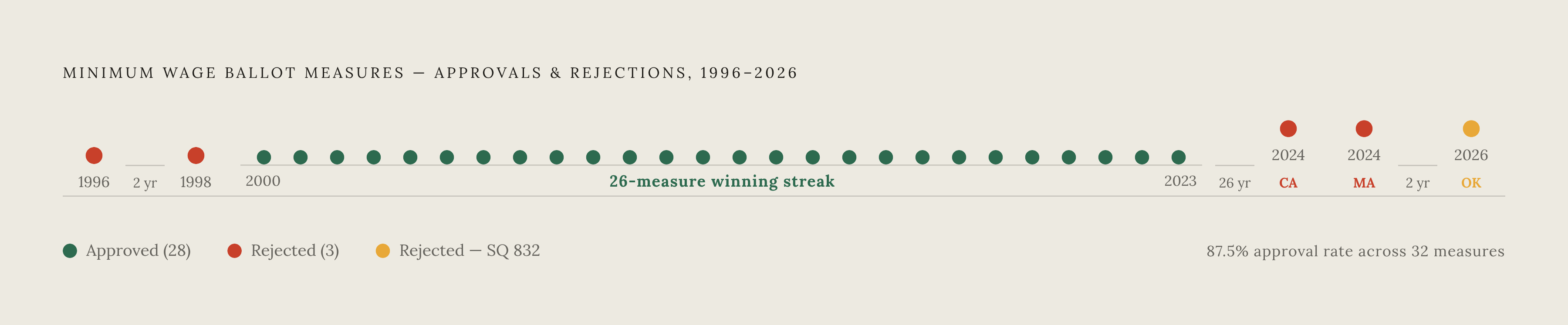
The numbers back up what Missouri's preemption fight suggests: when minimum wage increases reach a ballot, voters say yes almost every time. Ballotpedia records 32 minimum wage ballot measures between 1996 and 2025, and voters approved 28 of them. That's an 87.5% success rate, a figure that would make most legislative leaders envious of their own caucus discipline.
The four defeats deserve to be named honestly. Then came a 28-year gap with no losses at all, until California and Massachusetts both rejected minimum wage measures in 2024, the first rejections in nearly three decades. Those defeats complicate the record without breaking it. They likely reflect the specific wage levels those measures proposed, or the strength of the opposition campaigns mounted against them in those two states, rather than any broader collapse in public support for higher wages.
The more striking pattern sits elsewhere: in red states. Five Republican-leaning states, Alaska, Arizona, Florida, Missouri, and Nebraska, have all passed large minimum wage increases through the ballot, and all five are at or scheduled to reach $15 an hour by mid-2027. Voters who backed Trump at the top of the ticket turned around and backed a $15 minimum wage down the ballot. The same pattern holds beyond Missouri. Minimum wage measures, like post-Dobbs abortion rights measures, have consistently outperformed Democratic candidates running in the same states, pulling in Republican and independent voters who otherwise vote Republican in every other race on the ballot.
The 2016 wave: four states, one election cycle
If one election cycle defines the last decade of initiative-driven wage policy, it's 2016. Four states acted within the same cycle, and together they built the playbook that later campaigns would follow almost exactly.
Arizona passed Proposition 206, raising its minimum wage to $12 an hour by 2020 and indexing it to inflation starting in 2021. Maine took a slightly different route: a signature campaign there pushed the legislature to act directly, passing a law that raised the wage from $7.50 in 2016 to $12 by 2020 for 181,000 Mainers, without the measure ever needing to go before voters. The threat of the initiative did the work on its own.
What connected all four campaigns wasn't luck. The 2016 cycle also set a pattern that would recur for the next eight years: pairing a wage increase with paid sick leave, bundling two worker protections into a single vote.
The payoff from that cycle is still showing up on paychecks today. Washington's wage is now $17.13, among the highest in the country. Workers in those three states are still collecting the benefits of a campaign fought a decade ago, because the people who wrote those measures built in a mechanism that kept paying out after election day.
Arkansas in 2018, Nebraska in 2022, and Florida in 2020: the pattern holds in hostile terrain
If 2016 proved the model could work, the years that followed proved it could work almost anywhere. Arkansas, Florida, and Nebraska are not swing states. All three lean Republican in presidential elections, and all three would have been unlikely venues for a legislature-driven wage increase. Voters raised their wages anyway.
Arkansas is the clearest case. A 68-point margin in a state that hasn't gone for a Democratic presidential candidate in decades is a sign that the policy itself, not the party attached to it, is what moves voters.
Florida's 2020 Amendment 2 cleared a higher bar and still won comfortably. The coalition behind it included grassroots urban organizers, state-level advocacy groups, and national unions like SEIU, working alongside the Fight for $15 campaign.
Nebraska followed in 2022. Three different states, three different years, three comfortable wins, all in places where a legislative bill with the same substance likely never would have gotten a floor vote.
Missouri and Alaska in 2024: the most recent wins and the paid-leave pairing
The most recent full election cycle, 2024, showed the initiative model entering a new stage: wage increases bundled with earned sick leave as a matter of course, not as an occasional add-on.
Missouri's Proposition A drew nearly 1.7 million approving votes, raising the wage to $15 an hour by 2026 and adding earned paid sick days. It passed 58% to 42%, in the same state Trump carried by 18 points.
Alaska's 2024 measure, backed by the Fairness Project, opened the door to higher wages for more than half a million workers and required employers to let employees accrue up to 40 hours of paid sick leave a year at small businesses, and up to 56 hours at larger ones.
The paid-leave pairing in both states wasn't incidental. That infrastructure is part of why the win rate has held up as well as it has. It's also what Missouri's legislature targeted next.
Getting a Winning Initiative on the Ballot: Signature Mechanics and the Coalition Model
None of these wins happen on election day. They happen months earlier, in the signature-gathering phase, which is both a legal requirement and the organizing spine of the entire campaign.
Every state sets its own threshold. Oklahoma requires signatures equal to 8% of the votes cast for governor in the previous gubernatorial election, and campaigns must submit them within 90 days of being cleared to circulate petitions. For State Question 832, proponents reported submitting about 180,000 signatures. The secretary of state verified 157,287 as valid, a noticeably smaller number than submitted, showing why campaigns have to collect well beyond the legal minimum.
Missouri's 2018 Proposition B followed the same logic. Organizers have described the move from lobbying lawmakers to mobilizing voters directly as a deliberate strategic choice, made once it became clear the legislature wasn't going to act on its own.
That same structure, local worker organizations doing the ground game, state-level advocacy groups coordinating strategy, national funders like the Fairness Project providing resources, repeats across nearly every successful campaign in this decade. But the signature phase is also where campaigns are most exposed. It's the first point where opponents can challenge a measure's validity, and it's also the first target when legislatures decide to fight back, as the next section shows.
How Legislatures Fight Back: Preemption, Repeal, and Restrictions on the Signature Process
Winning a vote and keeping what you won are two different things. The citizen initiative process can put a law on the books, but it has no power to stop a legislature from repealing that law, preempting it at the local level before it's even written, or making the signature process itself harder to use next time. Legislators in several states have tried all three.
Missouri is the clearest and most recent example. Proposition A was enacted as a statute rather than a constitutional amendment, and that distinction mattered almost immediately. Republican Gov. Mike Kehoe signed a bill repealing the mandated paid sick leave benefits that voters had just approved, and he also blocked the annual inflation adjustments built into the measure. The strategy was to keep the popular part and cut the part business groups had objected to. More than 700,000 Missouri workers who had already started accruing paid sick leave lost it the moment the repeal was signed.
The 2017 law barring cities from setting wages above the state rate had already nullified the local wins in Kansas City and St. Louis before a statewide campaign ever got organized, which is part of why the ballot became the only remaining option.
Florida offers a second pillar of the same pattern, aimed not at the law but at the process that produces it. Republican legislators in Missouri have separately argued that the state's threshold for passing constitutional amendments is too low and have pushed to raise it, though legal scholars describe that effort as a hard lift, because even voters who oppose a specific measure tend to resist handing their legislature more control over the process.
The 2024 defeats in California and Massachusetts are a reminder that not every setback comes from legislative interference. But the larger lesson from Missouri and Florida stands: passing an initiative is necessary, but it isn't enough on its own.
What separates durable initiative wins from reversible ones
Not every win holds the same way: whether the measure is a constitutional amendment or a statute, whether it includes automatic inflation indexing, and whether the coalition behind it sticks around to defend it determine how durable a win is.
The constitutional-versus-statutory choice carries the most weight. Arizona's Proposition 206 and Florida's Amendment 2 are both constitutional amendments. Amendments require a public vote to change, so the legislature cannot undo them with ordinary legislation. Same decade, same basic policy goal, very different outcomes once the legislature got involved.
Inflation indexing works as a second kind of protection, though a quieter one. States that rely on periodic statutory updates instead of automatic indexing need a new campaign every few years just to keep pace with rising prices, while indexed states let the law do that work by itself.
The five Republican-leaning initiative states, Alaska, Arizona, Florida, Missouri, and Nebraska, are all at or scheduled to reach $15 an hour by mid-2027. But Missouri's experience shows that a single campaign can win on one front and lose on another: the wage floor survived, the paid sick leave did not. The difference wasn't public support. It was the legal form the policy took.
Coalition durability matters just as much, even if it's harder to measure. The organizations behind Missouri's 2018 and 2024 campaigns had been working in the state for years before either vote happened, and that continuity is what let them respond when the legislature moved to repeal parts of what they'd won. Many are not. That capacity separates a durable win from a one-year headline.
Oklahoma State Question 832 in June 2026: what a recent defeat reveals about where the process is heading
Oklahoma's State Question 832 lost on June 16, 2026, and the loss says more about timing and organizing capacity than about the policy itself. The measure would have raised the minimum wage to $12 an hour in 2027, $13.50 in 2028, and $15 in 2029, with cost-of-living adjustments starting in 2030. It also would have extended minimum wage coverage to groups often left out of existing law: part-time employees, students, minors, farm and agricultural workers, domestic service workers, newspaper vendors and carriers, and feedstore employees.
Voters rejected it by a sizable double-digit margin, 55.37% to 44.63%. Kevin Stitt then issued an executive order placing it on the June 2026 ballot instead, timed to coincide with the state's gubernatorial primary, a far lower-turnout election than a November general.
That timing decision deserves real attention, because it's one of the few variables in this entire story that has nothing to do with the policy's popularity and everything to do with the mechanics of who shows up to vote. A measure that might clear 58% in a November general, the kind of margin Missouri's Proposition A posted in 2024, can struggle in a June primary with a fraction of the turnout.
The signature phase showed the same attrition pattern seen elsewhere. Oklahoma's minimum wage has sat at the federal floor of $7.25 since 2009, one of 20 states still stuck there entering 2026. The defeat doesn't undo the broader record: it's one loss in four across 30 years of these measures nationwide. But it's a useful reminder that the process depends on election timing, coalition depth, and turnout infrastructure as much as it depends on public opinion.
The technology available to citizen campaigns, and what's still missing
Citizen campaigns today have tools their predecessors didn't, particularly around the parts of the process that used to eat the most time and money: validating signatures and reaching voters.
A Washington, D.C.-based volunteer project called Civic Tech DC is building a tool named VoteCatcher, open-source software that uses multimodal large language models to check signatures against the voter file in real time. Democracy Works's TurboVote sent more than 60 million election reminders by email and text that same year.
A separate volunteer-led group, MAPLE, has built an open-source platform that helps ordinary constituents understand how state lawmaking actually works, including AI tools that summarize bills and help draft testimony. That's a different kind of help than signature validation or turnout, it's aimed at the front end of the process, where a community idea first has to become something resembling a formal proposal.
That front end is still the weakest link. Most of the tools built so far serve the campaign phase: collecting signatures, getting out the vote. Few serve the earlier moment when a group of residents has a genuine grievance and a rough idea of a fix, but no clear path to turning that into language a state could actually put on a ballot. A Granicus survey found that a majority of government offices already use AI tools, but fewer than half have a written policy governing how. The technology is moving faster than the rules meant to guide it, in government offices and in citizen campaigns alike.
Lessons for Citizens Who Want to Use the Process Now
Ten years of evidence point to one conclusion: where citizens can use the initiative process, build real coalition infrastructure, and choose the right legal form for what they're trying to protect, they can move policy that their own legislatures have refused to touch for years.
Access to the process comes first. The process exists in only 24 states, and inside those states, success depends on things that have nothing to do with the policy's popularity: election timing, how many extra signatures a campaign collects beyond the legal minimum, and whether the coalition that wins the vote is built to stick around afterward. Oklahoma's 2026 defeat shows what happens when the timing works against a campaign even when the underlying idea has broad support.
Campaigns must choose between a constitutional amendment and a statute. Campaigns that have a choice between the two routes should weigh that trade-off early, not after the law is already under attack.
Inflation indexing deserves the same early attention. It's the mechanism that turns a single ballot win into a raise that keeps paying out year after year. Arizona and Colorado built it into their 2016 campaigns, and workers in both states are still feeling the benefit a decade later, with wages that climbed to $15.15 and $15.16 respectively without anyone having to organize a second campaign.
And the cross-partisan pattern running through this entire decade is the clearest evidence that this issue doesn't belong to one party. The tools available to make these campaigns happen are better than they were a decade ago, and they keep improving. What's still missing is help at the very beginning, turning a community's shared frustration into a proposal formal enough to survive the signature count, the courtroom challenge, and the legislature that comes after.
Sources
- Raises from Coast to Coast in 2026 - National Employment Law Project
- NELP on Minimum Wage Ballot Initiatives in 2024 - National Employment Law Project
- The battle for the ballot: How Southern legislatures are trying to block economic progress by restricting access to ballot initiatives
- A review of key 2024 ballot measures: Voters backed progressive policy measures