Coalition Building Strategies for Hyperlocal Policy Campaigns
Recruit anchor institutions first, then sequence matters more than final headcount.
Hyperlocal campaigns win or lose on three mechanics: who gets recruited first, in what order, and whether neighbor agreement turns into something an official can't wave off as noise. Nail those and a good idea becomes an ordinance. Miss them and the idea sits in a drawer until the next election buries it for good. Most organizers get the first mechanic backwards: they chase headcount when they should be chasing sequence. The order you recruit in matters more than how many people you eventually sign up, and that single mistake explains more dead campaigns than bad policy ideas ever do.
Local governments answer to state law first, and that shapes what's even winnable before anyone knocks on a door. The structure of the local government itself matters just as much, maybe more. Mayor-Council, Commission, Town Meeting, Representative Town Meeting: each one creates different pressure points and a different path to a vote. Public hearings are usually required by law whenever a governing body takes an action with real community impact, zoning changes, budget votes, and that's a structural opening most campaigns never think to use. Advisory boards, planning boards, environmental councils, recreation commissions, sit open to ordinary citizens and hand them a kind of insider standing few campaigns ever touch. Add it up, and hyperlocal campaigns have more formal entry points than most organizers realize. The catch: those mechanisms are specific to the government type involved, so knowing the structure matters from day one, not after the first meeting goes sideways.
What makes a coalition credible versus one that officials can safely ignore
A big petition used to pass for the strongest thing you could hand an official. Look at local campaigns that fizzled despite thousands of signatures, though, and the pattern is hard to miss: officials didn't act any differently. A petition captures one moment of agreement. A coalition demonstrates organized, persistent constituents who understand the process and plan to keep showing up. Most campaigns build the wrong one and never notice, because a petition feels like progress right up until the vote comes and goes without them.
A coalition-building guide from NCAN lists five traits that separate the coalitions officials take seriously from the ones they file away. A named identity, even with no website and no budget, signals the group intends to stick around. A specific, shared ask gives officials something to act on instead of something to nod at and forget. A shared communications approach keeps member organizations saying the same thing at the same time. A timeline of coordinated actions, sequenced ahead of time rather than thrown together the week before a vote, keeps the whole effort from looking improvised. And a mix of grasstops and grassroots members, institutional players alongside actual neighbors, matters more than either group alone.
That last trait deserves a second look, because most organizers get it backwards. The instinct is to chase institutional weight first: a big union, a well-known nonprofit, a name that sounds good in a press release. Wrong order. Institutional muscle without neighbor voices reads to officials as a few well-connected groups speaking for people who were never actually asked. Faith groups, housing organizations, unions signal staying power; neighbors signal legitimacy. Skip either one and the coalition looks thinner than it actually is. Faith-based and housing partnerships have become a common model in local organizing for exactly this reason: moral standing paired with direct relationships to the people the policy actually affects.
Why do officials care this much about the distinction? Officials are acutely aware that public trust in democratic participation is fragile, and they're watching for whether a coalition reflects real community sentiment or a handful of loud, well-organized voices dressed up to look bigger than they are.
Who to recruit first and why the sequencing matters more than the final headcount
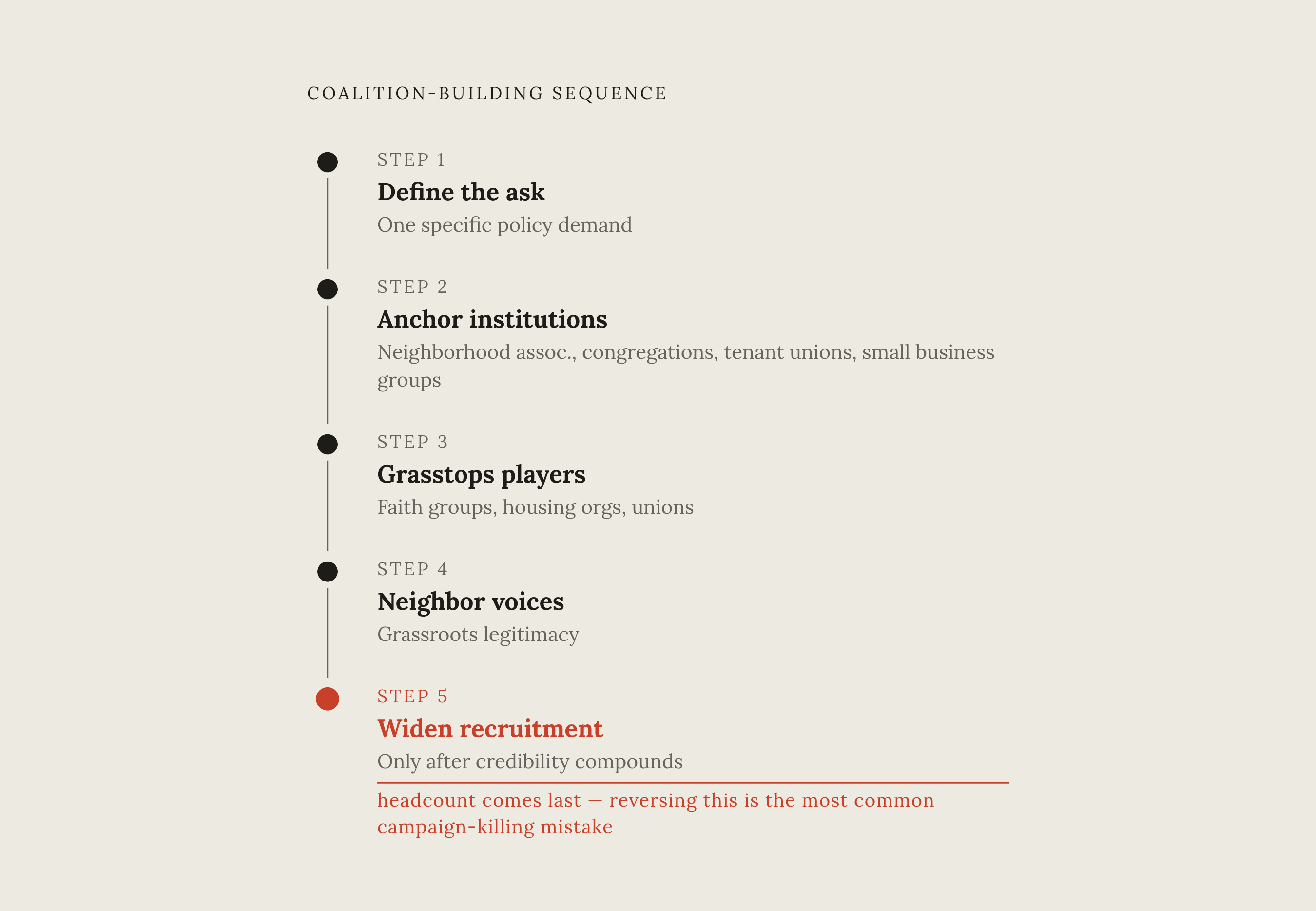
Start with anchor institutions, the groups that already have trust built in: neighborhood associations, congregations, small business groups, tenant unions. Their backing pulls in the next round of members almost on its own.
Environmental justice groups offer a useful pattern here. They've become core members of larger climate coalitions because they got recruited as people who know the terrain, not as extra names on a list. That's the model worth copying: bring people in as experts on their own streets, not as line items on a signup sheet.
Service worker unions matter too, especially on issues that cross neighborhood lines: transportation, employment, public space. They reach people a block-by-block strategy misses entirely.
The sequencing logic sounds obvious once you say it out loud, though it takes comparing a few failed and successful efforts side by side to see it clearly. Recruit the institution whose endorsement makes the next institution easier to bring on board. Credibility compounds. One solid endorsement from a respected local group often opens the second and third doors faster than a hundred individual signatures ever could.
Here's the mistake that sinks more campaigns than any other: recruiting for numbers before the policy ask is locked down. Members who sign onto a fuzzy idea get hard to manage once actual bill language shows up and doesn't match what they'd pictured. Analysis of the 2024 campaign cycle has shown that movements treating local organizers as an afterthought, brought in after strategists had already set the plan, lost the on-the-ground knowledge that makes outreach land with neighbors in the first place. The first five to ten partners should be picked for the doors they can open next, weighted far more heavily than follower counts or press mentions. Headcount can wait. Sequence can't.
How to map and sequence outreach across different local government structures
Under a Mayor-Council system, council members are the target. Find which districts overlap the campaign's footprint and put those representatives at the top of the list for direct pressure.
Commission governments blend executive and legislative power in one body. Fewer people to build relationships with, sure, but each commissioner holds broader authority and has more riding on how they vote. Smaller room, higher stakes per person in it.
Town Meeting government runs on a different mechanism entirely: attendance and floor votes. Coalition work there means turning people out to the meeting itself, well ahead of lobbying staff in a hallway beforehand. Representative Town Meeting structures split the difference: find the elected representatives from the neighborhood's precincts. They're usually far easier to reach than a state legislator, and they sit closer to the actual vote.
Advisory boards cut across all of these. Planning boards, environmental councils, recreation commissions: getting coalition members appointed to these, or just showing up to testify regularly, builds a track record before the real vote ever happens.
Public comment periods deserve more attention than most campaigns give them. Spacing written submissions, in-person speakers, and follow-up letters across the whole comment window, instead of dumping everything on one night, tells officials this is an organized, sustained effort and not a one-time flood of emails.
The practical tool here is working backward. Take the date of the required public hearing and build every recruitment and outreach milestone off that date, not off whenever the coalition happens to feel ready.
Turning neighbor agreement into a record officials treat as evidence
Agreement alone rarely moves officials. Pressure needs a visible, attributable record: named constituents, tied to a district, on paper or on tape, something an official can point to later and say, this is why action was taken.
Verified co-signatures tied to a home address carry weight anonymous online support just doesn't, because they prove the support is concentrated inside the official's own district and not scattered across the internet. Testimony at a public hearing is the gold standard: it enters the legal record, often gets transcribed, and forces an official to respond to it in public.
Written comments arriving in coordinated waves, rather than crammed into one day, read as an organized constituency instead of a single email blast that fizzles by Thursday. Door-to-door contact still converts better than almost anything else. Ohio Citizen Action's 2024 field program knocked on over 344,000 doors across 70 Ohio counties, and there, the medium is the message: face-to-face contact says a group is serious in a way a mass email never manages.
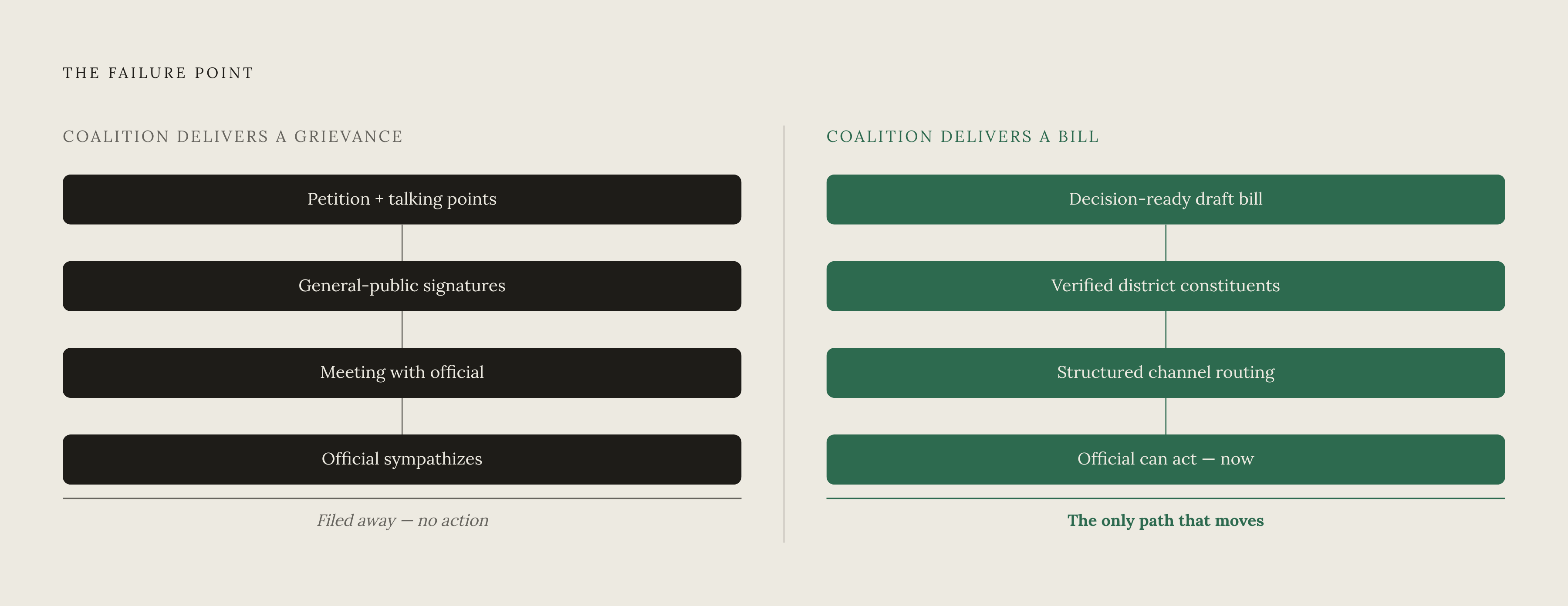
Framing counts too, maybe more than campaigns want to admit. Input packaged as a properly drafted legislative ask gives an official something to act on. Input packaged as a grievance gives them something to sympathize with and file away, and filing away is the more common outcome by a wide margin.
Civic tech has started closing part of this gap. Online deliberation tools, digital co-signature systems, 311-style apps, pull scattered neighbor input into one exportable, attributable format that moves cleanly into official channels. Per GovTech's 2025 Local Government Digital Trends report, over 70% of city governments have already adopted some form of digital engagement tool. Officials are used to seeing structured digital input land on their desks, and that familiarity works in a coalition's favor.
Using hyperlocal data to make the case specific enough to act on
General concern is easy to defer. An official can nod along to "the neighborhood is worried about flooding" and do nothing for another year. Block-level data tied to an exact geographic boundary is a lot harder to shelve, because it removes the easiest excuse an official has: not knowing the scope of the problem.
Geospatial mapping tools, tracking pollution, code violations, infrastructure gaps, service deserts, produce evidence that lines up exactly with an official's own district lines. That's not a small thing.
Local governments are already primed to hear this kind of argument. Deloitte's 2024 U.S. Public Sector CxO Sustainability survey found 40% of local government sustainability executives want more private-sector collaboration on data. A coalition that shows up with numbers alongside its complaints is speaking a language officials already use inside their own departments.
Participatory budgeting shows what this looks like when it works. The NYC Civic Engagement Commission's "The People's Money" process allocated millions of dollars based on resident votes, funding 20 winning projects in 2024. Structured citizen input led directly to government output, with little ambiguity in between.
A workable data strategy has a shape to it, one that only becomes obvious after watching a few campaigns drown in raw numbers nobody could use. Start with public records already sitting on a government website: 311 complaint logs, property records, environmental monitoring data, mapped to the specific neighborhood in question. Layer in what the community collects itself: surveys, photos, resident testimony, the texture raw data can't carry on its own. Compress the whole picture into a one-page brief an official's staff can read between meetings.
AI-assisted drafting tools are starting to show up at the local level for exactly this kind of synthesis, turning community-collected information into structured policy language. Local governments themselves are increasingly using AI for geospatial mapping of neighborhood-level concerns, which means a citizen coalition doing the same thing is speaking a language city hall already recognizes.
Keeping the coalition functional as the campaign hits resistance
Delays happen. Committee reviews stretch on longer than anyone planned, and state preemption questions surface out of nowhere and stall a bill that looked close to done. None of that is personal. It's just how the process works, and a coalition that treats ordinary friction as betrayal tends to fall apart right when it needs to hold together most.
NCAN's guide makes a related point: the coalitions that last are the ones checking in regularly, re-evaluating goals, swapping tactics, bringing in new members as needed. Agile, adaptive, built to bend without breaking. That bending is what most campaigns get wrong when they treat the original plan as sacred. Treating the first draft of a strategy as fixed is the surer way to lose it entirely.
A few fracture points show up again and again, the same handful each time once you've watched enough of these campaigns run their course. A business group backs the goal but balks at the specific mechanism chosen to get there. Scope creep sets in, the ask growing past what early members actually signed up for. A timeline drags long enough to burn through volunteer energy before the final vote ever happens. Or a win on some adjacent issue satisfies a few members enough to make them drift off, even though the original ask never got resolved.
Holding onto a named coalition identity through all of this is itself a signal. Officials notice if the coalition falls apart, and that's exactly the outcome nobody wants at the moment pressure needs to hold steady. Housing and homelessness organizations offer a decent model for durability: they build civic engagement as a year-round habit rather than something that spikes during election season and vanishes after.
Staying agile means adjusting tactics, a different sponsor, a narrower ordinance scope, a fresh round of data, while keeping the coalition's name and its core demand intact the whole way through.
What the full pipeline looks like from neighbor idea to decision-ready bill
Laid out start to finish, the sequence looks like this. Identify the exact policy change wanted and which government body actually has jurisdiction over it. Recruit anchor institutions in order, locking down the policy ask before opening recruitment wider. Map the decision timeline backward from the required hearing or vote. Collect and package hyperlocal data so no official can hide behind "we don't have enough information." Convert scattered neighbor agreement into something attributable, verified, on the record. Deliver it in a form an official can act on directly, a draft bill or structured ordinance proposal, alongside the credibility a large petition alone can't provide. Hold the coalition's identity and flexibility together through the delays that are coming.
Here's where most citizen campaigns actually stall, and it took looking across a lot of them to see where the failure crept in. They do nearly everything on that list, and then hand over a grievance where a legislative instrument was needed. An official who genuinely wants to act has little concrete to move forward with. That gap, between a well-organized complaint and an actual bill, is where a lot of good campaigns quietly die: from having nothing decision-ready to hand over at the moment someone was finally willing to listen.
This is the real failure point, and it ranks above recruitment, above data, above even coalition discipline. Civic tech platforms that pair AI-assisted bill drafting with verified neighbor co-signatures are starting to close that exact gap, turning a neighborhood's plain-language idea into a formal proposal routed to the right official in a format they can act on right away. The 2025 Gallup/Kettering study found that a large majority of Americans report facing multiple barriers to civic participation, which points to a distance between having an idea and producing a credible legislative proposal, a distance that has historically required money, legal knowledge, and time most people simply don't have.
A coalition that shows up with a properly drafted bill, backed by verified constituents inside the official's own district, delivered through a structured channel, carries a different category of pressure entirely: the kind an official can actually act on, not just sympathize with.