State-by-State Rules for Citizen Direct Initiative Ballot Measures
Half the states don't allow citizen initiatives, and the other half have vastly different rules.
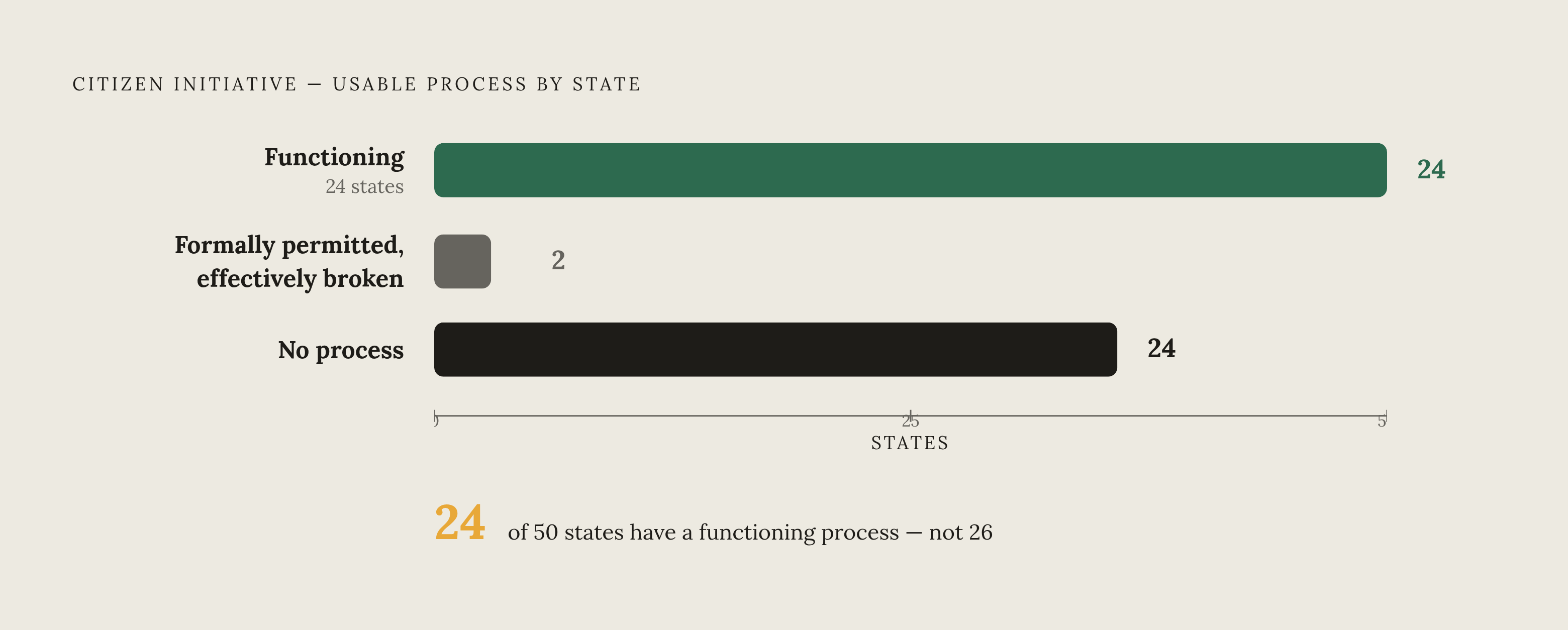
Whether a citizen can write a law and put it directly to voters depends less on how good the idea is than on which state that citizen happens to live in. Roughly half the country, twenty-four states, has no statewide initiative process. The other twenty-six vary so widely in their rules that "having" the tool and being able to actually use it are two different claims.
Why only twenty-six states give citizens the initiative tool
Start with the map, because it settles the question before any of the finer rules matter. Texas, New York, Georgia, Alabama, Connecticut, Delaware, Hawaii, Indiana, Iowa, Kansas, Kentucky, Louisiana, Minnesota, New Hampshire, New Jersey, North Carolina, Pennsylvania, Rhode Island, South Carolina, Tennessee, Vermont, Virginia, West Virginia, and Wisconsin have no statewide citizen initiative process, the Ballot Initiative Strategy Center reports. A citizen in any of those states can gather a million signatures and it changes nothing at the ballot box, because there's no statewide mechanism built to receive them. Some of these states allow local-level initiatives, like city charter amendments or county ballot questions. But the statewide lawmaking channel, the one that lets citizens write a law or a constitutional amendment and send it to every voter in the state, simply doesn't exist there.
So the first question anyone needs to ask isn't "how many signatures do I need?" It's "does my state even have this tool?" That's a smaller, more sobering question than the headline number of twenty-six suggests.
A state can formally permit citizen initiatives, but that doesn't mean the process actually works. Mississippi's constitution guarantees the right to ballot initiative, but the state Supreme Court nullified the process in 2021, because the constitutional language referred to Mississippi's old number of congressional districts, and nobody fixed that defect when the state lost a seat. As of February 2026, the legislature's attempt to restore the process had failed again. Illinois tells a similar story from a different angle: the state permits initiatives, but its thresholds and constitutional restrictions are narrow enough that the process hasn't produced a qualifying initiative in decades. Both states count toward the "twenty-six," and both illustrate why that number overstates how many states actually offer a working tool. Having the right on paper and having a process that functions are not the same thing, and the gap between them is the subject of most of what follows.
The three-way fork in the road: direct initiatives, indirect initiatives, and veto referendums
Once a citizen confirms the tool exists in their state, the next question is which version of it they're holding. Not every initiative process works the same way, and the differences change who gets a chance to intervene before voters ever see the measure.
A direct initiative is the version most people picture when they hear the term: a citizen collects the required signatures, and the measure goes straight to the ballot. The legislature has no role in the middle. Voters decide, period.
An indirect initiative adds a step. After signatures are verified, the proposal goes to the state legislature first. If lawmakers approve it, the measure becomes law without going to a popular vote, bypassing the governor. If lawmakers reject it or simply ignore it, only then does it proceed to the ballot. Ballotpedia identifies nine states using this indirect model: Alaska, Maine, Massachusetts, Michigan, Nevada, Ohio, Utah, Washington, and Wyoming. Two of those states, Massachusetts and Ohio, require a second round of signature collection if the legislature fails to act, so they add a sequential structure that a direct-initiative state doesn't impose.
Why would a citizen prefer one over the other? An indirect process gives the legislature a formal window to co-opt or defuse a popular measure before it reaches the ballot, and lawmakers can pass a watered-down version that technically satisfies the demand without the political cost of a public vote. A direct process denies lawmakers that opening. Neither is objectively better, but a campaign strategist needs to know which fork they're standing on.
A third category works differently from both. Citizens can't propose new law this way. They can only push back against something lawmakers already did. Nevada carries a further variation: a statute affirmation mechanism that lets citizens ask voters to affirm an existing law, which shields that law from future legislative modification without another public vote. It's a defensive tool, not available elsewhere, built for citizens who want to lock a policy in place rather than change one.
Layered on top of all this is a separate distinction: whether the initiative creates a constitutional amendment or an ordinary statute. Ballotpedia lists eighteen states permitting initiated constitutional amendments: Arizona, Arkansas, California, Colorado, Florida, Illinois, Massachusetts, Michigan, Mississippi, Missouri, Montana, Nebraska, Nevada, North Dakota, Ohio, Oklahoma, Oregon, and South Dakota. A constitutional amendment is harder for a legislature to undo later, which makes it the more durable vehicle. An initiated statute, by contrast, can usually be amended or repealed by the legislature after it passes, the same way any other law can. Nevada adds its own wrinkle here too: a constitutional amendment must pass at two successive general elections before it takes effect, a hurdle no other state imposes. California and Colorado allow citizens to combine a constitutional amendment and a related statute into a single initiative, letting one campaign do the work of two.
Signature Thresholds: Easy or Nearly Impossible Depending on the State
Once the structural type is settled, the first concrete barrier a campaign hits is the signature count. States calculate that number in two fundamentally different ways: as a percentage of total registered voters, or as a percentage of votes cast in the preceding general election. So the choice of denominator alone can make the raw number required swing dramatically, even between two states of similar population.
Geography adds a second layer. Many states require signatures to come from a minimum number of counties or legislative districts rather than a single statewide pool. The stated purpose is to keep a campaign from qualifying by camping out in one dense city and ignoring the rest of the state. So a group collecting signatures now needs field infrastructure spread across multiple counties instead of volunteers working a handful of busy sidewalks, and that raises the cost of running a campaign substantially.
Where can a citizen actually find these numbers? Colorado's Secretary of State publishes the exact signature requirement for statewide initiative petitions (124,238 for the 2023-2026 cycle), calculated as 5% of the votes cast for Secretary of State in the prior general election. That's a model of what good state-level documentation looks like: a specific number, a clear formula, updated for the cycle. South Dakota's Secretary of State does the same: it publishes separate thresholds for initiated measures, constitutional amendments, and referendums on its official site. Anyone researching their own state should expect to find, and should insist on finding, that level of specificity before investing time in a campaign.
The variation these formulas produce is not a modest rounding difference. A signature count that a well-organized neighborhood coalition could realistically hit in one state might sit wildly out of reach in another state with a comparable population, simply because the formula or the geographic spread requirement is harsher. Florida adds a second barrier after the signature stage: the state requires a supermajority of voters to approve a constitutional amendment. A campaign can clear every signature hurdle in Florida and still lose at the ballot box on a vote margin that would have won in almost any other state. Illinois and Mississippi sit at the far end of this spectrum, formal permission paired with thresholds or constitutional defects so restrictive that neither state has produced a qualifying initiative in decades.
What does achievable access actually produce? Where thresholds are within reach, citizens have used the initiative process to pass Medicaid expansion, minimum wage increases, term limits on lawmakers, and abortion rights protections, all in states where the legislature had declined to act, because the signature threshold is the gate that decides whether any of that becomes possible.
How filing deadlines structure the calendar of a citizen initiative campaign
Signatures measure how big the task is. Deadlines measure how much time a campaign gets to do it, and that second variable can sink a well-supported measure just as easily as a brutal signature count.
States set these deadlines two different ways. Some tie the cutoff to the start of the next regular legislative session: Ohio, Washington, Alaska, Maine, Wyoming, and Mississippi all use this benchmark. Others tie it to a fixed calendar date or a set number of days before the general election. Florida, Maine, and Wyoming all land in the first week of February (Florida on February 1, Maine on February 2, Wyoming on February 6), while most other initiative states set their deadlines sometime in summer.
The states using indirect initiatives complicate the calendar further. Massachusetts and Ohio, which require a second round of signatures if the legislature doesn't act on the first petition, effectively run two deadlines in sequence. Only after that window closes does the second signature deadline become operative, so a campaign in those states needs to plan for a process that could stretch well beyond a single filing date. Nevada and Utah both set their deadlines for indirect initiated state statutes in November, ahead of the legislative session, so campaigns there have to finish signature collection before lawmakers even convene.
Why does any of this matter beyond logistics? A short runway between a filing deadline and the campaign's launch rewards organizations that already have paid canvassers, donor lists, and legal teams on retainer. But a longer window gives volunteer-driven efforts a real chance to build momentum through grassroots canvassing, instead of paying professionals to compress the timeline, since deadline structure is a variable that tilts the field toward funded campaigns or toward grassroots ones depending on how much time it leaves. And the deadline is absolute: miss it, and the measure doesn't appear on that cycle's ballot. There's no grace period. The clock simply resets for the next election.
Citizen Initiatives as a Legislative Backstop
All these rules, who gets the tool, which fork it takes, how many signatures, how much time, exist to answer one practical question: can citizens actually make law when their elected officials won't? Where the thresholds are achievable, the answer has repeatedly been yes.
Medicaid expansion has passed through citizen initiative in states where the legislature declined to expand it through ordinary legislation. Abortion rights have been protected by initiative in states where lawmakers moved to restrict them. Minimum wage increases have passed at the ballot box in states where the legislature left the wage untouched. North Dakota voters imposed term limits on their own state lawmakers through the initiative process, and state legislators, for obvious reasons, rarely want to pass that on themselves.
Look at what these examples have in common. In each case, a majority of voters wanted a policy that the people they elected would not deliver, whether for structural reasons, political incentives, or outright disagreement with the public. The initiative process became the release valve. And this pattern doesn't track cleanly along partisan lines. Groups out of power, regardless of which direction "out of power" points in a given state, have used this tool to get policies past legislatures that wouldn't move. It functions less as a weapon for one side and more as a pressure valve for whichever side currently lacks the votes in the statehouse.
That's precisely what makes the initiative process more than a symbolic right. It's a working alternative lawmaking channel, one that operates in parallel to the legislature and, in the states where it works, can override legislative inaction. And a tool that can override a legislature's preferences is a tool legislatures have reason to want under control.
The legislative counterattack: how states have tightened the rules to make the process harder
If the initiative process functions as a backstop against legislative inaction, it stands to reason that legislatures would eventually respond to being backstopped. Several states have done exactly that: they tightened signature rules, restricted who can collect signatures, and raised the bar for passage.
The mechanisms vary by state. Some raise the raw signature threshold outright or change the calculation formula to demand more signatures for the same measure. Some add or tighten geographic distribution requirements, so the burden now spreads across more counties than before. Florida requires a supermajority, not a simple majority, for voters to approve a constitutional amendment, raising the bar after a measure has already cleared every earlier hurdle. North Dakota's legislature referred a constitutional amendment to its own ballot that would impose a single-subject rule on all constitutional amendments, including citizen-initiated ones, restricting how much a single measure is allowed to combine. Florida has also narrowed who is allowed to collect signatures at all: state law excludes anyone with a felony conviction who hasn't had voting rights restored, anyone who isn't a U.S. citizen, and anyone who isn't a Florida resident, and a 2025 law requires every petition circulator to register with the state's Division of Elections.
The argument legislators make for these changes deserves to be taken seriously rather than dismissed. Signature collection was designed to show that a measure has genuine community support before it reaches the ballot. Paid signature gatherers funded by outside interests can turn that threshold into a test of campaign funding rather than a test of local public sentiment, and that's a real distortion of what the requirement was built to measure. Whether the fix matches the problem is a separate question. Restricting who can gather signatures, or requiring circulators to register with the state, raises the cost and logistical difficulty of qualifying any initiative, which tends to advantage the same well-funded campaigns the restriction was supposed to check. A rule meant to protect grassroots legitimacy can end up squeezing grassroots campaigns hardest.
Courts have pushed back on some of these efforts. A U.S. District judge blocked enforcement of six new Arkansas laws that would have made the ballot initiative process nearly impossible to use, citing free speech concerns, so the restriction trend isn't unchecked. Mississippi's situation shows the same outcome can arrive without any legislative act at all: the state Supreme Court's 2021 ruling made the initiative process mathematically inoperative over a constitutional drafting defect, not a deliberate legislative restriction, but a citizen trying to use the process in Mississippi today faces the same wall either way.
The lesson that falls out of all this is that the rulebook is not fixed. A citizen who researches their state's initiative rules today may find a different set of rules than existed two election cycles ago, tighter signatures, new circulator restrictions, a higher passage threshold, or in Mississippi's case, no functioning process. Anyone serious about using this tool needs to treat the research itself as ongoing work.