Generative AI Applications in Federal and State Public Services
Agencies are running generative AI at scale, not testing it.
A constituent files an unemployment claim and gets a decision in a fraction of the time it used to take. Neither interaction feels experimental. Both are running now.
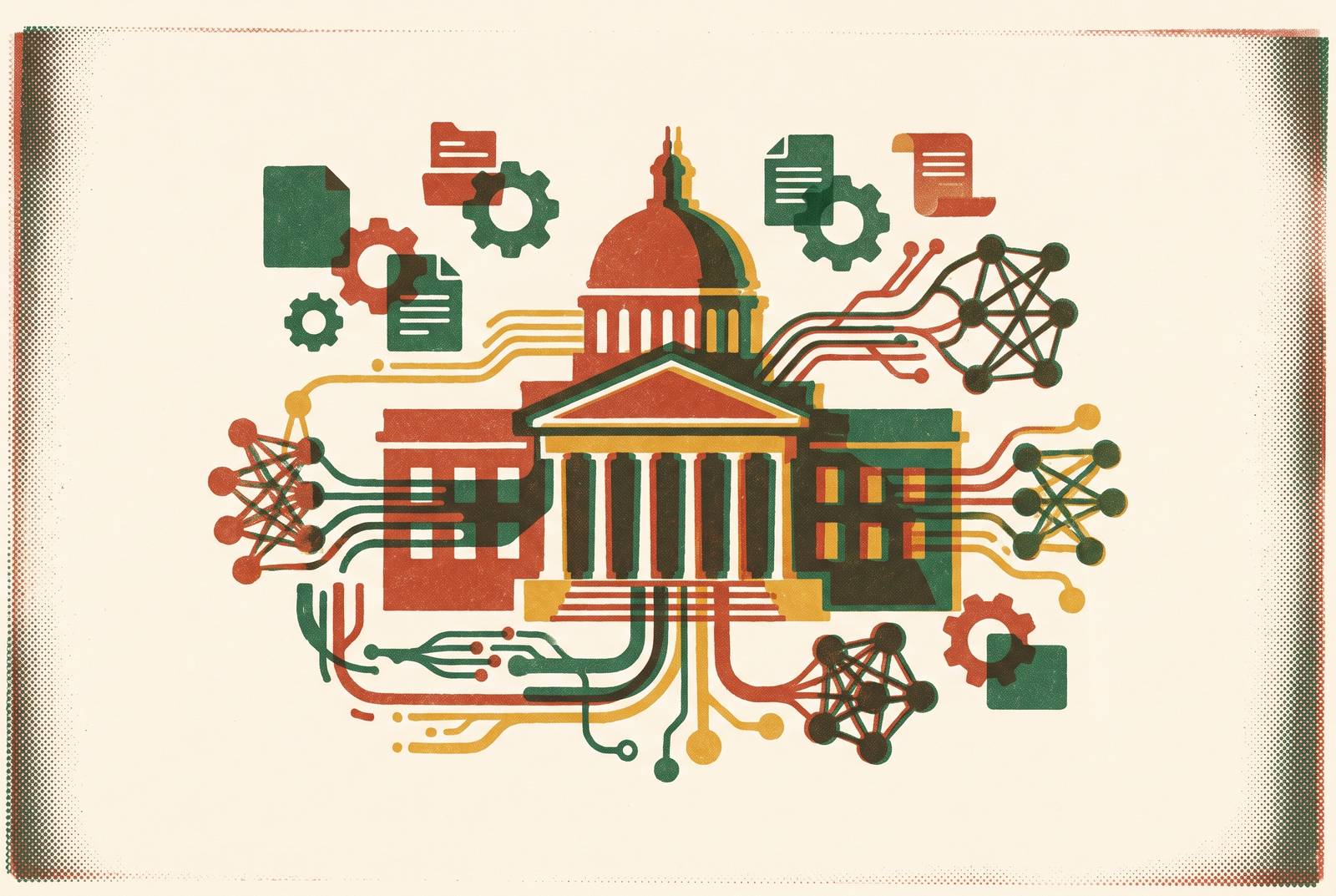
The pattern that defines 2026 is this: agencies are not testing whether generative AI is useful. They are managing adoption, governance, and scale of tools already in production. The 2026 Digital States Survey makes the shift explicit. AI has moved from experiment to infrastructure in state government, appearing in application development, cybersecurity operations, benefits administration, procurement, and data management.
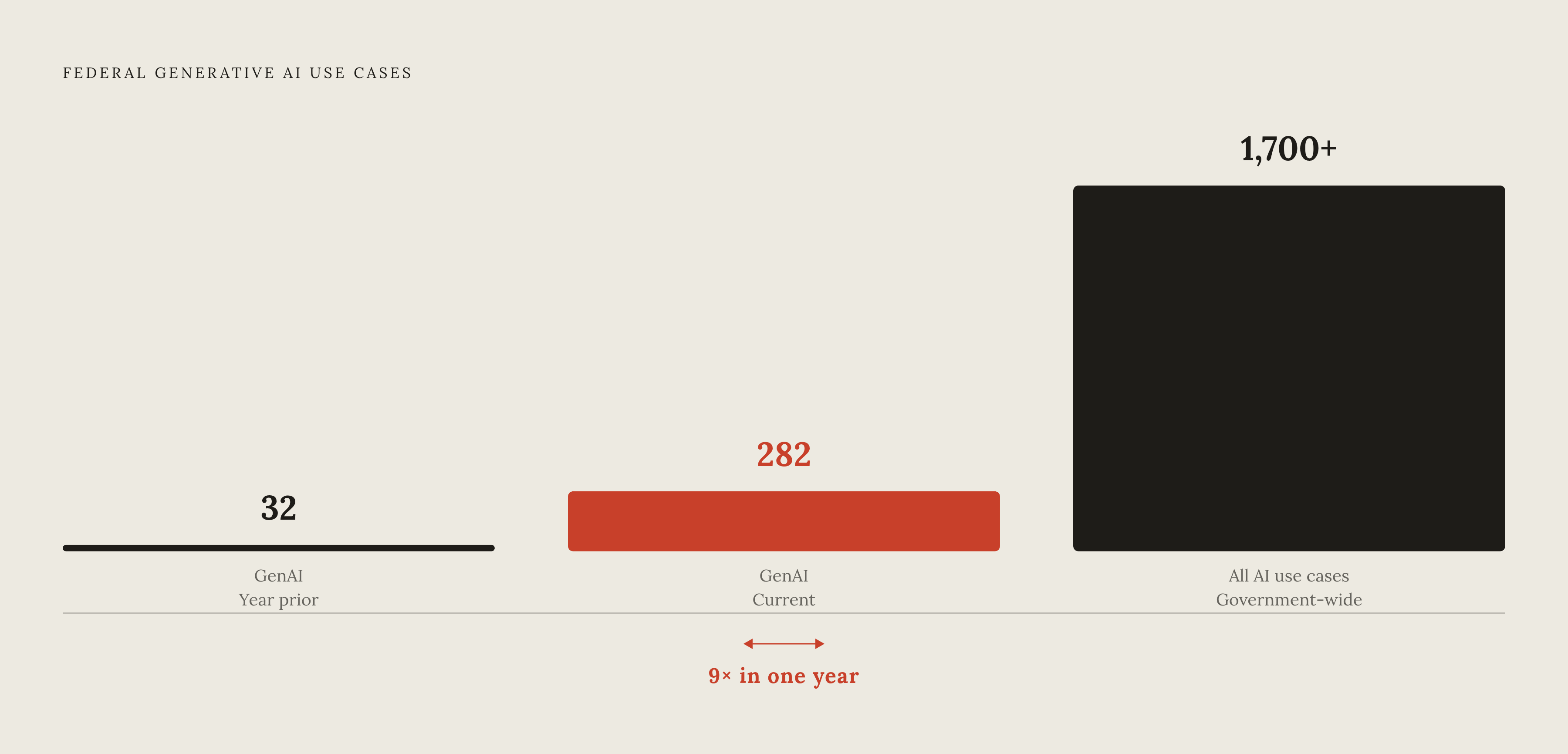
At the federal level, the driver has been executive rather than legislative. A series of executive orders and policy frameworks beginning in January 2025 removed the deregulatory friction that had slowed agency adoption. Federal agencies reported over a thousand active AI use cases across mission areas among a selected group of 11 agencies reviewed by GAO, with the full government-wide tally exceeding 1,700. Generative AI use cases specifically jumped ninefold in a single year, from 32 to 282. That magnitude signals structural embedding, not piloting.
One objection deserves attention. But a lot of use cases could still mean shallow or low-stakes experiments. The rest of this piece answers that objection by walking through what those use cases actually are and what governance has formed around them.
What agencies are actually using GenAI for — benefits, services, and internal operations
The use cases now running in production span three distinct layers: constituent-facing service delivery, internal agency operations, and mission-critical functions. Each layer shows a different dimension of the shift.
Constituent-facing services
Mississippi deployed a generative AI-driven virtual assistant on the state's central web portal, giving residents a single conversational interface across multiple agencies. It helped cut unemployment application processing times substantially. That is AI touching a high-stakes moment in someone's life, not a back-office convenience.
Arizona's myPHX311 platform uses AI-enabled translation to reach one key language population. Residents in those places can now access payment portals, water services, and violation reporting in their own language. The shift here is from translation as an afterthought to translation as a standard interface layer.
Internal agency operations
The Department of State's Generative AI Playbook, published in July 2026, documents how StateChat reached over 62,000 users and adoption across 98 percent of U.S. diplomatic posts worldwide as of June 2026. StateChat is the department's first Sensitive But Unclassified-enabled enterprise GenAI chatbot, built with support from GSA's Technology Modernization Fund. It happened because people found the tool useful fast.
GSA launched USAi, a shared platform for AI experimentation, in August 2025. Employees use it for chat-based AI, code generation, and document summarization. The platform matters because it gives agencies a sanctioned place to try things without building their own secure infrastructure from scratch.
App Maisters Government notes that agencies are integrating AI into fraud-prevention workflows for unemployment insurance. The pattern is consistent: AI augments human judgment rather than replacing it. A fraud analyst gets a flagged case with context attached, not a machine-made final decision.
Mission-critical and specialized functions
The Department of War deployed GenAI.mil, a secure generative AI platform on the desktops of all military personnel, civilians, and contractors on the non-classified network. It runs on Gemini for Government. The scale of that rollout, across an entire department, is its own evidence of infrastructure status.
The Department of Veterans Affairs used GenAI to automate medical imaging processes and enhance veterans' diagnostic services. FEMA and NOAA have used GenAI for weather and disaster prediction and response, with some models outperforming traditional deterministic models. The Department of Health and Human Services used GenAI to extract information from publications and identify polio outbreaks in areas previously thought to be polio-free.
Ohio now operates an agentic security operations center powered by Google SecOps and Gemini. The system automates triage, correlation, and enrichment so analysts make decisions in minutes rather than days. When AI handles security alerts, the argument that these are low-stakes experiments gets harder to sustain.
How the federal government cleared the procurement bottleneck that had blocked adoption
The jump from pilot to infrastructure required removing two concrete blockers. One was the authorization timeline that made cloud AI tools impractical to procure. The other was the cost barrier that prevented agencies from experimenting at all.
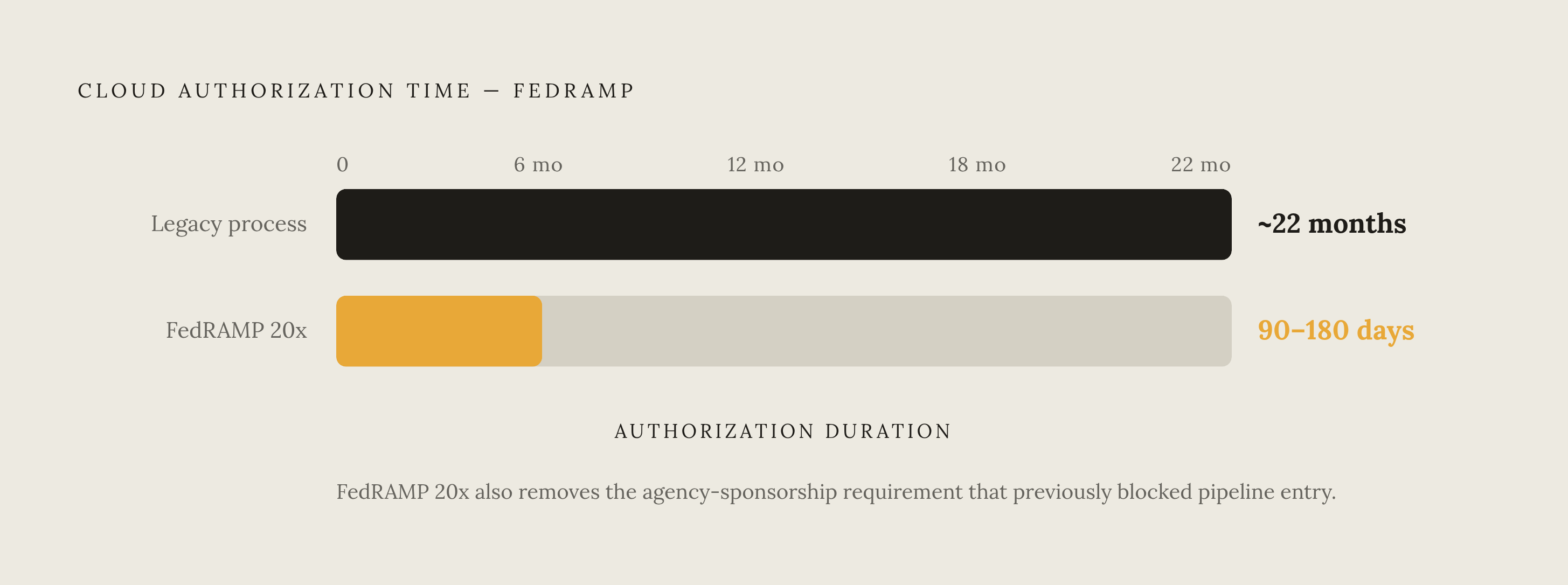
FedRAMP 20x, announced by GSA in 2025, was designed to cut cloud authorization timelines drastically. It targets roughly 90 to 180 days, down from approximately 22 months. Just as important, FedRAMP 20x eliminates the existing requirement for agency sponsorship of cloud provider offerings before entering the authorization pipeline. Policies expected from the program are designed to streamline AI procurement across federal agencies and allow widespread access to critical AI services.
On the cost side, GSA's OneGov cost strategy aligns directly with the AI Action Plan's goal of allowing agencies to test AI models before purchasing, at no cost and with no security risk. If trying a model requires a procurement action, nobody tries anything. If trying is free and safe, adoption can be led by actual usefulness.
The policy stack behind all this is layered. The January 2025 executive order "Removing Barriers to American Leadership in Artificial Intelligence," the July 2025 AI Action Plan, the December 2025 National Policy Framework for Artificial Intelligence, and the Genesis Mission from November 2025 form the foundation. The December 2025 framework specifically addresses the risk that state-by-state regulatory variation would create a patchwork slowing federal adoption. That tension gets full treatment in the governance section.
The State Department's playbook offers a concrete illustration of what this enabling environment produced. Once the infrastructure was in place, meaning secure APIs, sandbox environments, and training programs, StateChat moved from concept to 62,000 users and near-universal diplomatic-post adoption. Infrastructure first, adoption follows. That is the causal order, and the playbook documents it explicitly.
The governance frameworks states are building where federal law is absent
The U.S. still has no comprehensive federal AI legislation. States have become the primary governance laboratory, producing a patchwork of accountability requirements that reflects genuine disagreement about where risk lies. New York enacted a law requiring state agencies to publish detailed information about their automated employment decision-making tools on each covered entity's public website. SB 8831 actually repealed the central inventory previously maintained by the Office of Information Technology. The model is transparency-first: put the information where each agency operates, not in a single state-maintained database.
Other states took different approaches in their 2025 governance laws. Kentucky SB 4 established an AI governance committee and required risk management for high-risk AI systems. Montana HB 178 required agencies to disclose AI uses and mandated human review of AI-driven decisions. Texas SB 1964 directed the Department of Information Resources to develop risk management and governance standards for "heightened scrutiny" AI systems, which state agencies and local governments must then adopt.
Ohio's agentic cybersecurity operations center and Mississippi's virtual assistant both run within this governance vacuum. That is not a criticism of those programs. It is a description of the regulatory environment they operate in.
The strongest objection to this state-by-state approach is that it creates compliance complexity for vendors and agencies operating across jurisdictions. That is exactly the argument the White House's National Policy Framework uses to call for federal preemption. The variation itself has become evidence in the debate.
The federal-vs.-state preemption fight and what it means for how AI gets governed long-term
The most consequential unresolved question in public-sector AI is not technical but jurisdictional. Whether federal frameworks will supersede state governance laws, and what that means for accountability when AI makes decisions that affect constituents. States pushing back have already passed their own governance laws. Kentucky, Montana, Texas, and New York are treating human review requirements and transparency mandates as non-negotiable floors, not optional extras. Federal preemption would not prevent them. It would override them.
Mississippi CIO Craig Orgeron frames the stance from a practitioner's position: "Federal priorities will continue to shift. Our job is to build capabilities across our state that can adapt and outlast any single funding cycle." That implies states are building governance resilience precisely because they cannot rely on federal consistency. It is a statement about institutional memory, not ideology.
The practical consequence for citizens is concrete. The argument is not between governance and no governance. It is between a floor set now and a floor set later, after more evidence accumulates.
Where AI is changing how citizens engage with lawmaking, not just how government processes claims
Beyond automating government workflows, GenAI is being applied to the participation problem itself. The tools now help ordinary people understand legislation, submit testimony, and engage with public consultation at a scale and accessibility level that was previously impossible. MAPLE, the Massachusetts Platform for Legislative Engagement, is a volunteer-led, open-source platform using large language models to summarize and tag bills. The technology does not eliminate that gap. But it narrows it.
Fort Collins, Colorado used AI-enabled analysis to engage with more than 4,000 long-form responses on a contested land-use issue. Washington, D.C.'s Office of the Chief Technology Officer piloted Deliberation.io, built by the MIT Governance Lab and Stanford's Digital Economy Lab in partnership with those institutions. Residents shared perspectives, voted on comments, and answered follow-up questions anonymously on how much the D.C. government should support AI innovation.
AI-assisted policy drafting is also emerging from civic rather than government initiative. Policy Synth, from the Citizens Foundation, is helping New Jersey review public job descriptions and remove unnecessary degree requirements, with expansion to more states underway. The pattern here matters: ordinary policy changes that took years of expert review can now be drafted from a plain-language starting point.
As AI tools become production-ready across federal and state agencies, they are also enabling new forms of constituent participation. PollSee, for instance, combines AI-drafted legislation with verified neighbor co-signatures, turning a plain-language idea from any citizen into a structured bill routed to elected officials. The platform applies the same logic as MAPLE and Policy Synth but as a direct pipeline from constituent to legislator, available to people who have never engaged with a statehouse.
The participation gap that technology alone does not close
The assumption that digital access is the main barrier to civic participation has been challenged empirically. Institutional and algorithmic distrust, not technical access, is the primary obstacle for many citizens. That includes people who are digitally competent and already engaged in civic life.
As governments rely more heavily on AI-mediated services and engagement, the risk of exclusion rises for people with limited device access, unreliable internet, or low digital literacy. The elderly and people in isolated areas are disproportionately affected. The tools that make participation easier for some can make it harder for those already at the margins.
Three countermeasures are being developed in practice. Meaningful participation requires citizens to have digital and data literacy skills. Civic empowerment through AI has institutional, functional, and democratic dimensions, all of which face barriers in cultures that privilege expertise and are risk-averse.
The answer is not to slow GenAI adoption. That is why verification mechanisms like co-signatures and structured pipelines matter more than open-ended AI tools for civic input. A verified co-signature scales signal.
What citizens can do now, given how much of this infrastructure is already running
GenAI is now embedded in government operations. It processes benefits, handles queries, drafts regulatory text, and sorts public input. Citizens who understand the landscape are better positioned to engage with it deliberately rather than be processed by it passively.
The practical map starts with knowing what AI tools your agencies use. Platforms like MAPLE in Massachusetts allow constituents to read AI-generated bill summaries and submit testimony, an entry point that requires no legal expertise. The third step is proposing legislation directly.
That third step is where the legislative proposal pipeline becomes visible. Unlike public comment systems or petition platforms, it creates a direct legislative pipeline for citizens who have never engaged with a statehouse. The tool does not guarantee a bill becomes law. It does make the first mile of the journey legible.
The shift to AI-mediated government is not a reason for citizens to disengage. The tools that make government more efficient are the same tools that can make participation more accessible, if citizens know they exist and how to use them. The remaining gap is awareness. Most of the infrastructure described here, from StateChat to MAPLE to PollSee, is running now. The citizens most affected by government decisions are often the least likely to know these tools exist.
Sources
- The Department of State Generative AI Playbook A practical guide for U.S.
- AI in Action: How GSA is Transforming Federal Services
- 2026 State and Federal AI Legislation Updates - Center for Democracy and Technology
- Assessing the state of AI adoption across the federal government
- Summary of Artificial Intelligence 2025 Legislation