Trust Deficits in Government and Their Effect on Civic Engagement
Perceived unresponsiveness, not practical barriers, drives citizens away from civic participation.
Ask most policymakers why people don't vote, testify at hearings, or show up to town halls, and the answer usually comes back to friction. Registration is confusing. Meetings happen at inconvenient times. Ballots aren't translated. Portals are clunky. This diagnosis makes intuitive sense, and it isn't wrong on its own terms: easier registration, online comment portals, more accessible meeting times, and translated materials all remove real obstacles.
But friction removal solves a different problem than the one actually driving disengagement. Making it easier to participate doesn't address whether participating actually changes anything. The OECD's 2025 Trust Survey, covering dozens of countries across OECD members and accession candidates, found that barriers to political influence are driven more often by perceptions that officials are unresponsive than by practical constraints like time, money, networks, or information access. Those practical barriers matter, but they're secondary.
That distinction has consequences for how governments spend money and attention. Build more access infrastructure without addressing the credibility gap, and the result is more ways to participate that produce the same outcome as before: nothing changes, and disillusionment deepens because now there's less excuse for the system's unresponsiveness. Solve the wrong problem well enough, and it can still make the real problem worse.
Low trust comes from the belief that officials don't care
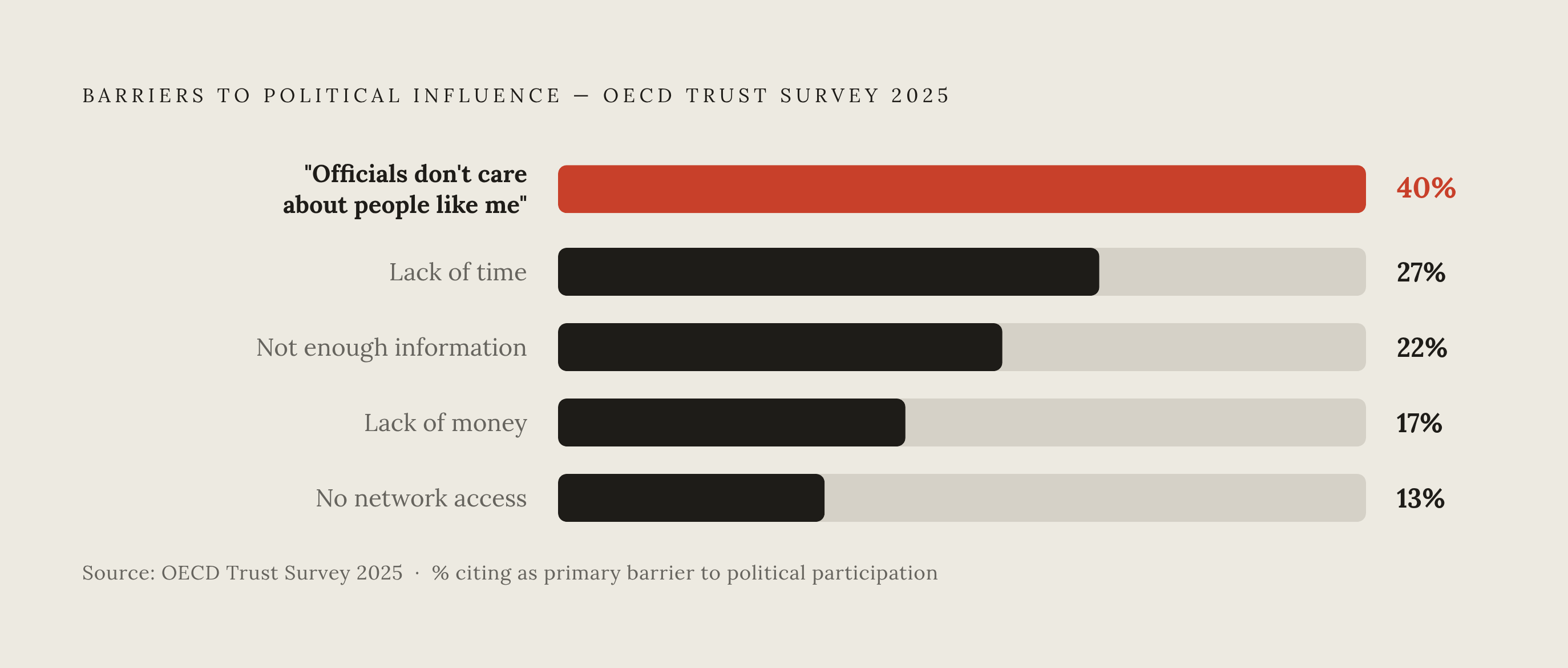
The 2025 OECD Trust Survey put a number on the thing most people suspect but rarely see confirmed at scale. Across OECD countries, 40% of people believe elected officials "do not care about people like me," and that single belief ranks as the most cited barrier to political influence. Not lack of time. Not lack of information. A conviction that the people in charge aren't listening.
That conviction isn't new, and it isn't a pandemic hangover. Most people across OECD countries report feeling they lack meaningful influence over what government does, and this sense has held steady since 2021 rather than spiking and fading. It's a baseline, not a blip.
The uncomfortable part is that this holds even for the channel democracies treat as most legitimate. Voting is still the participatory act most people trust, yet it no longer feels sufficient on its own to make citizens believe they've been heard, and formats like public consultations and town halls are seen by most respondents as having only modest sway over actual decisions. Faced with that math, disengaging starts to look less like apathy and more like a rational response: why spend time on a process widely believed to be designed for the appearance of inclusion rather than the substance of it?
The Harvard Ash Center's research shows that belief is grounded in actual government operations, not just perception. Public comment processes generate a volume of submissions no human staff can realistically read. Constituent input arrives in formats agencies aren't built to process. Legal and regulatory text is often written in language ordinary citizens can't parse without specialized training. None of this requires malice. A system can be structurally unresponsive even when every official inside it wants to listen, simply because the pipes carrying citizen voice into government were never built to carry that volume or that format.
How trust has fractured along partisan and generational lines in the U.S.
In the United States, the trust deficit doesn't sit still. It swings with who holds power, which makes it a much harder thing to fix with any single policy lever.
The Partnership for Public Service's State of Public Trust in Government 2026 report found that trust among Democrats in civil servants dropped significantly between 2025 and 2026, while trust among Republicans rose substantially over that same stretch. The lines crossed, tracking almost exactly with which party controls the federal executive branch. A large majority of Democrats now say the government is corrupt, a higher share than the one reported by Republicans, which is close to a full reversal of where each group stood just two years prior.
Independents tell a different story, and arguably a more revealing one. Their trust has stayed near-static and low, largely unchanged from the prior administration, suggesting this group isn't reacting to which party just won an election. Their disillusionment looks like a settled baseline rather than a partisan mood swing. That distinction matters: trust that rises and falls with electoral outcomes was never really trust in the institution. It was trust in whoever currently runs it, which evaporates the moment power changes hands again.
Layered on top of the partisan split is a generational and demographic one. Trust is not evenly distributed across communities: BIPOC communities, low-income communities, immigrants, and younger citizens face compounding barriers rooted in systemic inequality and a history of disenfranchisement. For these groups, the question is whether the system was ever built to listen to them at all.
Why existing participation channels fail to close the credibility gap
Town halls, public comment periods, advisory committees, resident surveys: these are the standard tools governments reach for when they want to demonstrate they're listening. The OECD's 2025 survey found that only a minority of respondents believe that participating in a consultation or town hall carries moderate or significant weight in actual government decisions. If the format itself isn't seen as credible, no amount of promotion or accessibility fixes that.
ICMA's research on local government adds a practical wrinkle: city and county managers may say the right things about citizen involvement, but the incentive structures inside most local governments don't actually reward staff for doing the harder work of real engagement. Endorsing participation in a mission statement is cheap. Building the operational muscle to act on it consistently is not, and that gap appears as wildly uneven engagement quality from one municipality to the next.
The residents who actually show up to comment periods and town halls tend to be the most engaged, most informed, and often the most advantaged people in the community to begin with, a self-selection pattern Harvard's City Leadership program has documented despite what many local officials already sense anecdotally. The format doesn't just fail to reach the most alienated residents. It structurally filters them out, because showing up requires exactly the kind of institutional trust and free time that alienated residents are least likely to have.
Communication style compounds the damage. Gravity Global's analysis of citizen engagement trends found that top-down, one-and-done messaging actively erodes trust in an era of real-time interaction. Residents want to take part in shaping a decision, not receive a press release about one already made.
Put those pieces together and a loop forms. Low-credibility channels draw thin, self-selected participation. Thin participation produces input that officials reasonably discount as unrepresentative. Discounted input confirms, for the citizens watching, that the whole exercise was theater. Each round reinforces the last.
What rebuilding perceived responsiveness requires
Making participation easier and making it credible are two different design problems, and most reform efforts have only worked on the first one. The OECD's 2026 findings frame the priority clearly: rebuild responsiveness, strengthen civic space, and reduce barriers to engagement, with the emphasis on creating opportunities that are genuinely meaningful rather than merely available.
Gravity Global's analysis of what's working inside forward-thinking agencies points to a few consistent traits. Engagement that invites real co-creation, through live Q&As, collaborative workshops, and digital feedback tools, tends to land better than passive comment collection. So does communication that arrives through trusted local voices instead of institutional channels, paired with storytelling that feels authentic rather than scripted.
Allegheny County's "Proud for a Reason" campaign, run by Gravity Global in 2023, offers a compact example of the principle at work. Research going into the campaign found that residents held genuine pride in their local heritage even where broader public conversation stayed fixated on the county's past setbacks. Rather than push a top-down message correcting that narrative, the campaign built a participatory platform where residents shared their own reasons for civic pride in their own words. The result was reconnection between residents and their local institutions, beyond wider reach for a slogan.
The OECD's framing sharpens the underlying test. Governments need engagement mechanisms that exist beyond the traditional channels of representative process, and those mechanisms need to actually drive results on policy decisions. Whether input visibly shapes an outcome is the entire question.
A fair objection asks whether more participation just generates more noise that's harder to act on. The volume itself isn't the obstacle. Format is. Structured, actionable input, submissions that arrive in a form an official can actually route, evaluate, and respond to, can be acted on regardless of how much of it comes in. Unstructured volume, the kind the Ash Center points to in public comment floods, can't be, no matter how few submissions there are.
Local government's place in the trust picture, and why it's both the most promising and most fragile layer
Local government has long been the layer of American democracy people trust most, on the theory that decisions made closer to home feel more accountable. That advantage is thinning. ICMA's research shows trust in local government now tracking a declining curve that increasingly resembles the trajectory of trust in federal and state institutions. The insulation that "closer to home" used to provide is wearing off.
Local government is where citizen input most plausibly changes something real, which makes that erosion worth taking seriously. Zoning decisions, municipal budgets, school policy, local services: these touch daily life more directly than most federal policy ever will, and the distance between an idea and a decision is far shorter.
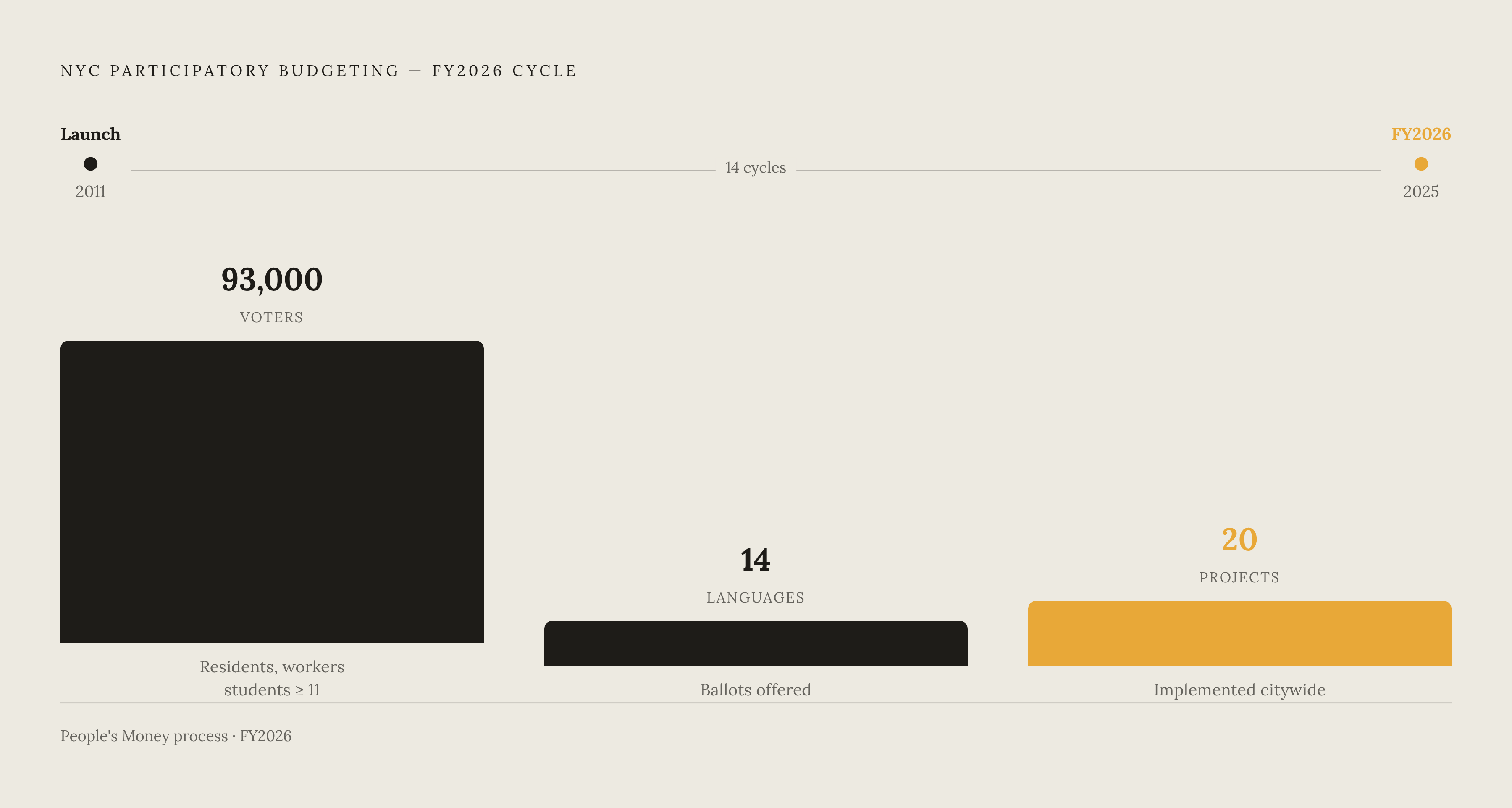
New York City's participatory budgeting program shows what that shorter distance can produce at real scale. In its FY2026 cycle, the 14th since the City Council launched the program in 2011, more than 93,000 New Yorkers voted to allocate capital funding toward local improvement projects. Ballots were available in English and 13 additional languages, and voting was open to residents as well as people with a work or school connection to the district, starting at age 11 in participating districts. The city's Civic Engagement Commission reported that the fourth cycle of "The People's Money," one of the largest citywide participatory budgeting processes in the world, launched 20 implemented projects that reached thousands of residents and generated hundreds of community events and workshops.
What ties these programs together is a visible, traceable line running from a resident's vote to an actual dollar spent on an actual project. That's the mechanism missing from most public comment periods: participation that demonstrably changes an outcome, not one that simply gets logged and filed.
Programs at that scale remain rare. Most local governments don't have equivalent infrastructure in place, and the decline in local trust that ICMA is tracking is outpacing the rate at which cities are building the tools to reverse it.
How civic technology and AI can address the structural responsiveness gap
Technology can narrow the distance between a citizen's voice and an official's desk, but only if it's built to produce input governments can actually verify and act on rather than input that merely looks orderly. A 2026 article in Frontiers in Political Science frames AI-enabled systems as a strategic tool for strengthening participatory democracy, with the potential to improve efficiency, transparency, and security while opening new channels for civic engagement.
Governments are already building capacity on their end. The OECD's Digital Government Outlook found that 56% of OECD countries report using AI for drafting assistance, search and knowledge retrieval, and conversational support, and the institutional capacity to process and respond to constituent input is expanding on the government side as well. Harvard's Ash Center, through its Allen Lab for Democracy Renovation, convened a workshop on October 16, 2025, bringing civic technologists, researchers, and municipal and state leaders together to examine digital civic infrastructure for Massachusetts. Out of related work, Partners in Democracy adapted New_Public's framework into a "Connect, Learn, Act" model for evaluating that infrastructure.
None of this is automatic or risk-free. South Africa's Draft National AI Policy, published for public comment on April 10, 2026, was withdrawn by Minister Solly Malatsi on April 26, 2026, following a scandal involving AI-hallucinated citations in its reference list. The episode is a clean illustration of the failure mode: deploy AI in policy work without human verification, and it can widen the credibility gap it was meant to close rather than narrow it. Citizens already suspicious that officials don't read their input have every reason to grow more suspicious when they learn officials didn't even write their own.
The constructive version of this technology looks different in structure. Platforms that use AI to convert plain-language citizen ideas into properly formatted legislative drafts lower the barrier to formal participation while producing something officials can actually process and act on, addressing the structural responsiveness problem directly rather than papering over it. Verified co-signatures from actual neighbors, rather than anonymous form-letter volume, give officials a credibility signal worth responding to, separating serious proposals from noise. This approach, citizen-drafted legislation, AI-assisted structure, neighbor verification, and direct routing to elected officials, structurally addresses the uneven participation formats described throughout this piece.
What the trust deficit means for citizens who want their ideas to become law
Everything in this analysis points toward one structural fact: citizens disengage when they believe participation changes nothing, and they re-engage when they see evidence that it can. The barriers standing in the way are mostly about belief, not time, money, or access. They're about belief: people don't think the system is listening, and the formats on offer rarely give them proof otherwise.
A petition with no structure behind it reaches no one who actually holds the authority to act on it. A public comment vanishes into a stack too large for any staff to read in full. A town hall produces conversation with no binding link to a decision. None of these failure modes are new, and naming them shows why the fix has to be structural too.
The design requirements follow directly from the diagnosis laid out across this piece. An idea needs to arrive in a form officials can actually act on. Community backing behind it needs to be verifiable. The path to the specific official empowered to act needs to be direct rather than routed through a general inbox. And the citizen who submitted it needs some way to see whether it was received and actually considered.
Local and neighborhood government remains the layer where the distance between an idea and a binding decision is shortest. It's also the layer where structured citizen proposals stand the best chance of landing on the desk of someone with the power to say yes.
The infrastructure to make that path the default, rather than the exception, is still being built. But the direction is clear enough: the trust deficit closes not through more invitations to watch, but through a working path from a citizen's idea to a decision-maker's desk, one where showing up is met with something more than silence.
Sources
- Citizen Engagement in 2026: trends driving public trust
- Citizen Engagement and Building Trust in Government
- Political voice, barriers to participation and implications for trust in government: OECD Survey on Drivers of Trust in Public Institutions 2026 Results | OECD
- The State of Public Trust in Government 2026 - Partnership for Public Service
- OECD Survey on Drivers of Trust in Public Institutions 2026 Results | OECD
- Frontiers | AI multilingual tools for social innovation: new perspectives on civic technologies, digital empowerment and inclusive governance
- Digital Civic Infrastructure – Ash Center