Civic Education Gaps in U.S. Public Schools and Their Participation Effects
Students taught to memorize government instead of engage it end up as adults who don't participate.
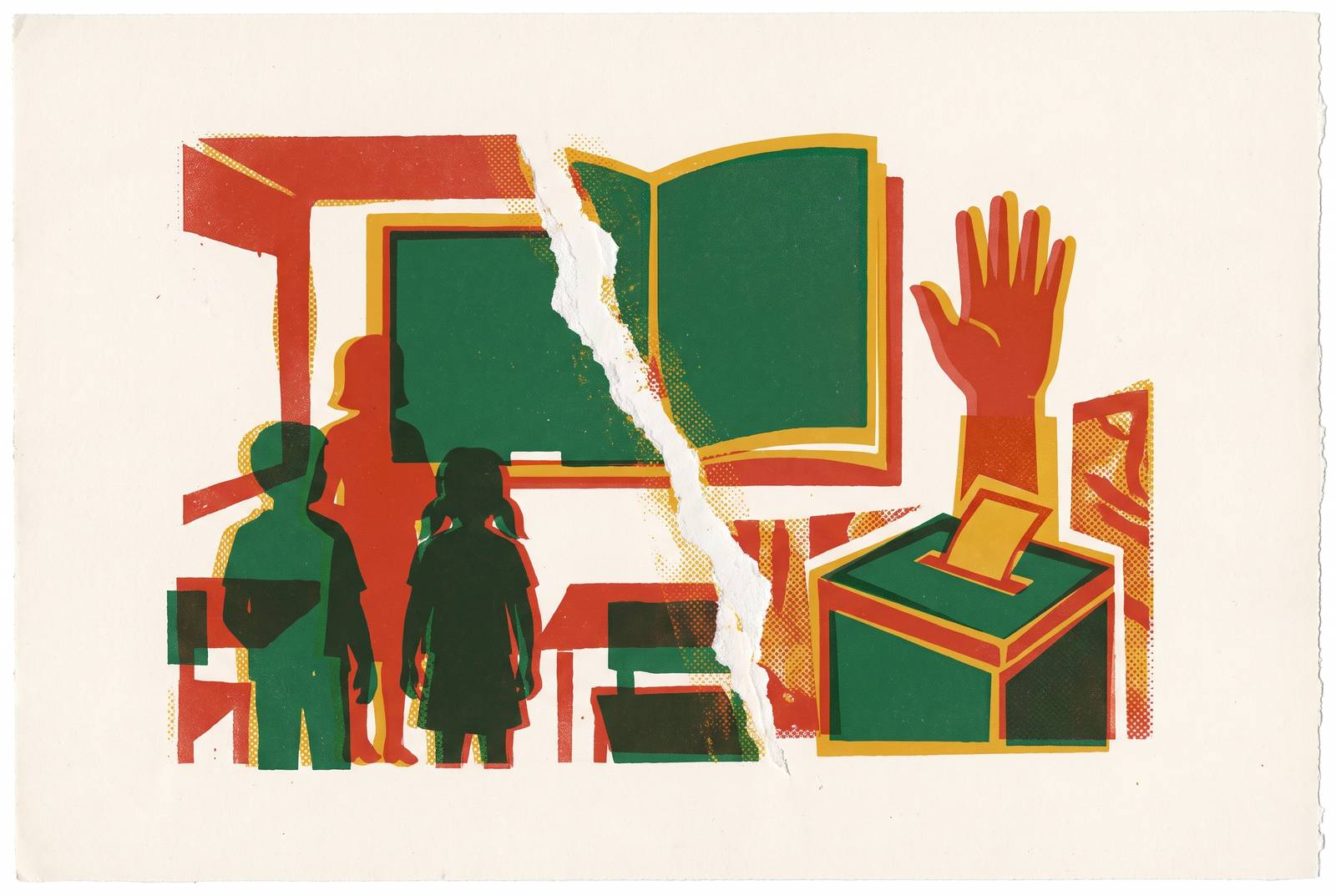
Fewer than one in four high school seniors scores at or above proficient in civics, and that number has been sliding, not climbing. The instinct is to read that as a knowledge problem: kids don't know enough about how government works. The more useful way to read it is as a pipeline problem: kids are never taught what to do with the knowledge they do get, and that gap follows them straight into adulthood as non-participation.
Most public debate treats the test scores as the thing to fix. Raising the number is the dominant strategy, on the theory that civic health follows. But Ballard Brief's analysis of textbook-based, memorization-focused civic education found it moves voter turnout by less than 1 percent, a sign that the dominant way schools teach civics barely touches what people actually do once they're old enough to vote, testify, or show up to a school board meeting. Fixing a knowledge gap means better content. Fixing a pipeline means something else entirely: procedural instruction, real practice, and a structured path from classroom to civic action. The rest of this piece follows that second path.
The curriculum is designed to produce passive observers, not active participants
Civic education in most K-12 schools answers the question "what is the government?" and almost never touches "how do I engage it?" The split is a design choice built into how courses are structured, tested, and taught, not an accident of underfunding or bad luck.
The dominant format is memorization: read the chapter on the three branches, take the test, move on. CRPE's "Mile Wide, Inch Deep" report found that most district leaders say they embed civics into a required academic class, but structured ways for students to apply what they learn are rare. Only 13 percent of districts require experiential civics opportunities, and just 23 percent mandate community service or volunteer work. So the floor is wide (nearly everyone gets some civics content) and the depth is shallow (almost no one gets to practice with it).
Electoral topics suffer the same thinning. Elections, gerrymandering, campaign finance, and voter access get mentioned, but rarely in a way that connects to what a student might actually see on the news or in their own neighborhood. The procedural skills that make a citizen functional, how to testify at a hearing, how to submit a public comment, how to track a bill as it moves through committee, are close to absent from standard instruction.
A graduating senior can usually name the three branches of government, but ask that same student how a citizen's idea becomes a law, or how to speak up at a school board meeting, or where a public comment even goes once it's submitted, and the answer is usually silence. The curriculum built the map but never taught anyone how to walk the route.
The course requirement gap that makes weak curriculum even weaker
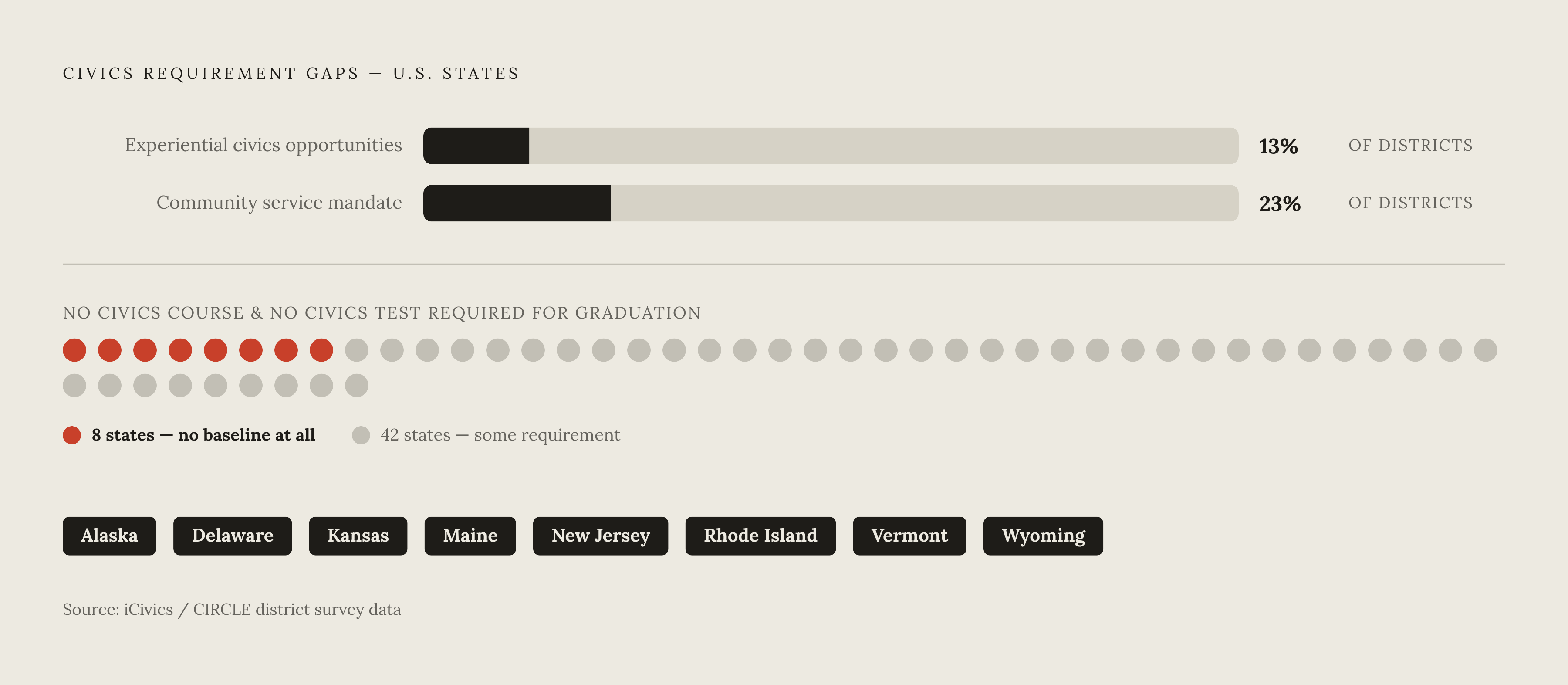
Weak content is one problem. The deeper problem: in a meaningful number of states, students aren't even required to take a civics course to graduate. When that's true, the thin curriculum described above isn't just weak, it's optional, and for plenty of students it's simply absent.
A 2024 Hoover Institution report identified eight states, Alaska, Delaware, Kansas, Maine, New Jersey, Rhode Island, Vermont, and Wyoming, that required neither a civics course nor a civics test for high school graduation, which is no small gap in a 50-state system. It means a student's exposure to even the diluted version of civic education described above depends heavily on which state line they happen to live behind.
The students most affected by this gap tend to be the ones least likely to pick up civic knowledge anywhere else, whether through family conversation, community organizations, or informal political exposure. So the requirement gap doesn't just create inconsistency. It stacks directly on top of the weak curriculum design, concentrating the weakest version of an already weak system on the students with the fewest other ways to fill it in.
Teacher capacity and the chilling effect on discussion close off what little pipeline remains
Even where a civics course exists and even where it's required, the classroom itself often shuts down the part of civic learning that matters most: practicing disagreement out loud. Deliberation and civil discourse are skills, and skills need repetition. Fewer places are as naturally built for that repetition, before adulthood, as a classroom full of teenagers with different views.
But that repetition often doesn't happen. Ballard Brief's synthesis of teacher behavior research found that when current-events discussions start to feel contentious, 92 percent of teachers shut the conversation down. It's a rational response to real pressure: parents who don't feel comfortable with their kids discussing elections in class, a definition of "controversial" that keeps expanding (in some districts, even voter registration instruction has drawn pushback), and a professional environment with little support for navigating any of it. RAND's national survey of teachers on civic and citizenship education found that pressure to cover other required subjects and a lack of professional development leave many teachers under-equipped to run the kind of open discussion that builds these habits, even when they want to.
Practicing disagreement out loud builds real participatory skill, but it's also the piece of civic education most likely to get shut down the moment it starts. And the students who lose that practice aren't spread evenly. They cluster in exactly the schools and communities already shortest on resources. That is where the inequality dimension of this problem comes into full view.
Funding inequity and the race and class dimension of the participation gap
None of the three problems already described, thin curriculum, inconsistent requirements, chilled classroom discussion, land evenly across the country. They concentrate hardest on Black, Latino, and lower-income students. The participation gap these problems produce is a race and class gap, not just a generic national one.
Ballard Brief's analysis found that civic knowledge scores for Black and Latino students typically lag behind their white peers, and that these same students generally have less access to the resources that would close that gap: qualified civics teachers, experiential programming, community partnerships that bring real civic work into the classroom. Marginalized students are less likely to attend districts that require experiential civic learning and less likely to have teachers trained in civic pedagogy. None of that is random. It traces directly back to funding.
The effects don't stay contained to test scores. Lower-income people of all races voted at lower rates in 2024 than they did in 2020, and both the racial and class turnout gaps widened. That pattern lines up with a pipeline that starts failing students years before they're old enough to vote.
One objection deserves a fair hearing: some underfunded districts still produce civically engaged students, thanks to a strong individual teacher or tight community ties that make up for what the system doesn't provide. That's true, and it sharpens the point. When civic engagement survives in a poorly resourced district, it survives because of who a student happened to have as a teacher or neighbor, not because the system was built to produce that outcome. A pipeline that only works when you get lucky is a gamble, not a pipeline.
The adult participation data as the pipeline's predictable output
Following the pipeline all the way through, the adult civic participation data looks less like a surprise and more like an outcome arriving on schedule. Large majorities of adults lack basic government knowledge. Most feel shut out of the processes that govern their lives. A substantial share say they want to take part but don't know how to start.
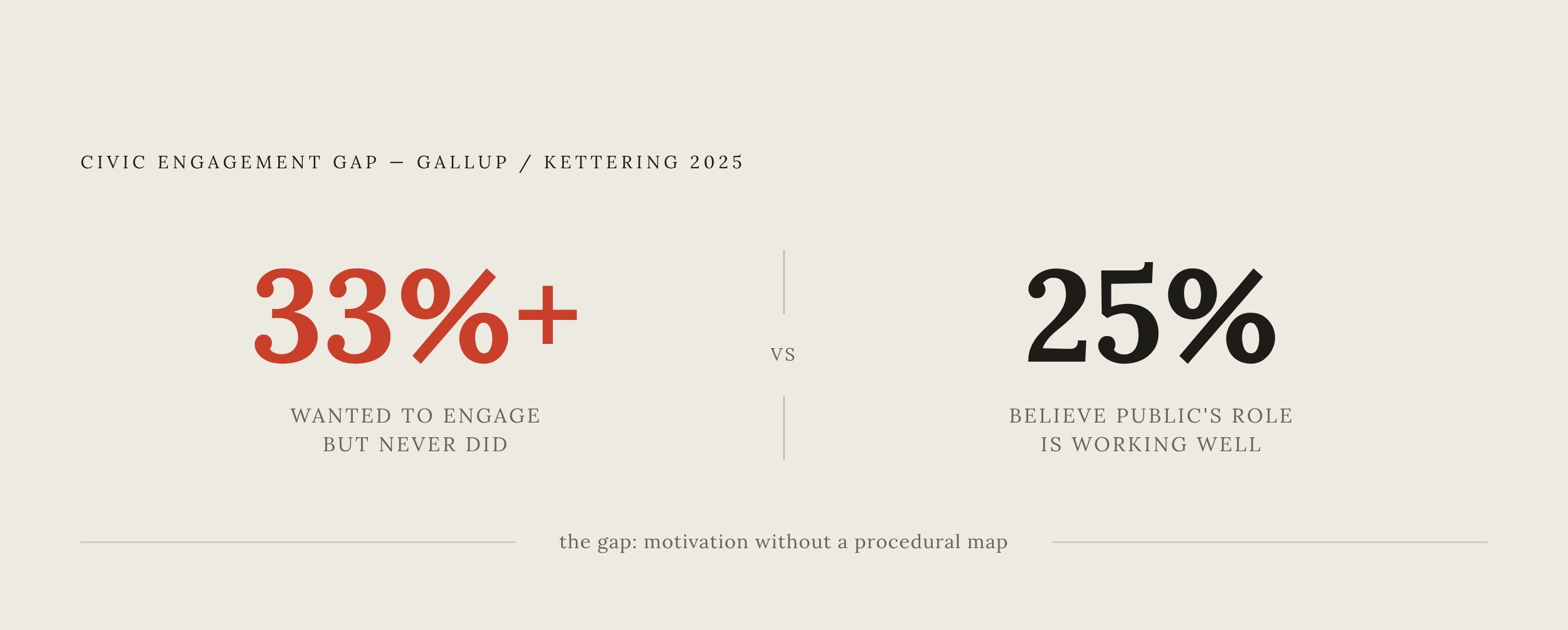
Adults who fail basic civics tests make up a majority of the adult population because the procedural and participatory side of civic life, how to actually do something with concern or interest, was never taught in a way built to last. The 2025 Gallup/Kettering Foundation national study found that only a quarter of Americans believe the public's role in the democratic process is working well, and more than a third say they've wanted to get involved in civic or community efforts but never did. That's the gap between wanting to participate and knowing how, and it maps almost exactly onto the procedural knowledge the pipeline never delivered.
Jung and Gopalan's 2024 quasi-experimental study on state-mandated civics tests adds a sharper point: the tested-content model, the approach most states actually use, does not produce reliable increases in youth voter turnout. Testing students on civics facts doesn't translate into more of them showing up to vote later. That's not apathy. Apathy would mean people don't care. The data instead describes something closer to a missing map: people have the motivation but never learned the route from personal concern to government action.
CivicPulse's survey of local government leaders shows the same gap from the other side. Large majorities of those leaders see real, positive value in youth civic participation. But structured ways for young people to actually take part, seats on local boards, youth-run forums, roles in election volunteering, remain far rarer than the appetite for them. The demand exists on both ends. The pipeline connecting them doesn't.
What effective civic education does differently
The research on what actually works keeps pointing to the same variable: practice. Students who get to practice civic participation in a real, structured, connected-to-the-world format build habits that carry into adulthood. Students who only study civic content as material to be tested generally don't.
Civic studies courses built around discussing current political events, rather than memorizing chapters, have been shown to raise how often students talk about current events with their peers, and to raise the odds they vote as adults by a meaningful margin. The near-zero turnout effect tied to standard textbook instruction, by contrast, shows that content without practice barely moves behavior, but practice does.
Action civics frameworks make this concrete. Students pick a real problem in their community, research it, and then actually engage the people who can do something about it: a city council member, a school board, a state representative's office. That's the whole mechanism in miniature. Instead of studying how the pipeline works, the student walks through it.
Mock elections and similar simulations can build the same muscles, deliberation, collaboration, weighing competing arguments, but only under certain conditions. They have to reach the whole classroom, not just the students already inclined to run for student council. A simulation designed as a competition for a few standout students teaches those few something valuable and teaches everyone else that civic life is a spectator sport. Designed for full participation, the same exercise becomes something closer to what action civics does: practice, not performance.
Existing models that close the pipeline gap, from classroom to statehouse
The programs actually closing this gap share one trait: they don't describe civic engagement, they build an open road from a citizen's concern straight to a point of contact with government.
The Massachusetts Platform for Legislative Engagement, built by volunteer developers from Code for Boston and incubated at Northeastern University's NuLawLab, tackles this at the infrastructure level. Submitting testimony to the Massachusetts legislature used to mean navigating a process with no legal requirement that written testimony even be disclosed, and in practice it rarely was. MAPLE simplifies the submission process and builds a searchable public archive of testimony, turning a closed, opaque system into one an ordinary resident can actually use and see the results of. That's the same pipeline civic education should be teaching in the first place: a concern, a clear process for voicing it, and a visible path to the people who can act on it.
The Digital Democracy Project works a different angle on the same problem, policy by policy. Verified voters can weigh in directly on pending legislation, and the platform compares what the public says it wants against how elected representatives actually vote, using voter verification, mobile voting tools, AI-generated summaries, and legislative tracking. The gap between public preference and legislative behavior, usually invisible unless someone is paying very close attention, becomes something a person can actually see and act on.
Seattle's Language Access Programs for public meetings close the gap at a more basic layer: access itself. Translation services and multilingual outreach mean the structural route into civic participation stays open to households that speak a language other than English, a substantial share of the country's population. A pipeline only works if everyone can actually get on it. These three models, one rebuilding legislative access, one tying public opinion to legislative action, one removing a language barrier at the door, show what the pipeline looks like when it gets built with intention.
Sources
- Lack of Quality Civic Education in Public Schools in the United States - Ballard Brief
- How Are U.S. Public School Teachers Approaching Civic and Citizenship Education?
- A Mile Wide, an Inch Deep: The State of Civic Learning in U.S. School Districts
- The Stubborn Unresponsiveness of Youth Voter Turnout to Civic Education: Quasi-Experimental Evidence From State-Mandated Civics Tests - Jilli Jung, Maithreyi Gopalan, 2024