Disability Accessibility Barriers in Traditional Civic Participation Processes
Four compounding barriers lock disabled citizens out of voting and civic participation.
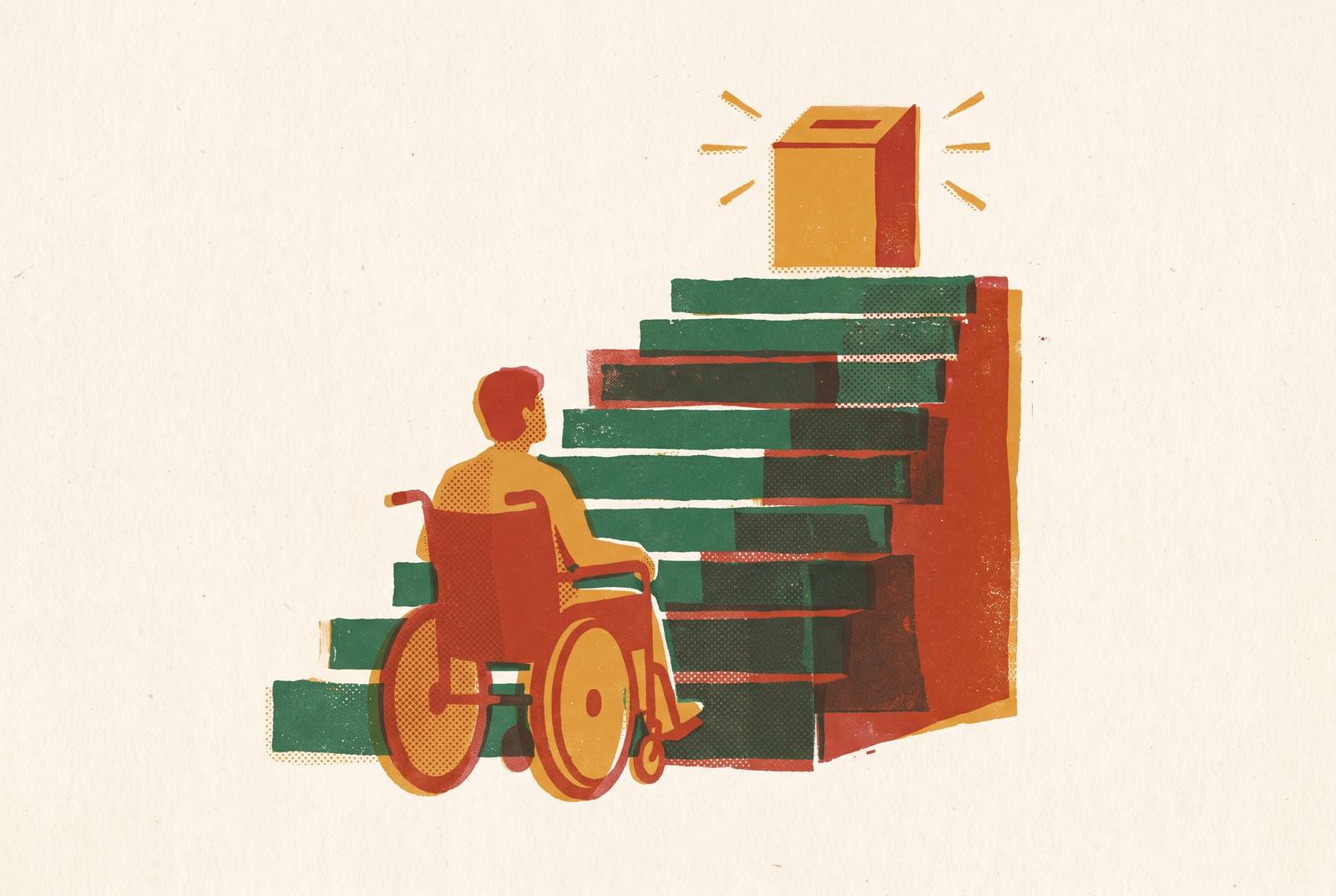
Voting, attending a public hearing, and reaching out to an elected official were all built around a default citizen: someone who can walk into a building, read a printed form, sit through a long meeting, and speak up without a second thought. That default never matched tens of millions of Americans. This is not a new problem that technology failed to catch up to. Polling places, government offices, and public comment processes have excluded disabled citizens for as long as those systems have existed, long before anyone started talking about digital access or online portals. People with disabilities make up over 40 million eligible voters, a scale large enough to shape election outcomes, the Center for Civic Design finds. A group that size does not sit at the margins of democracy. When a system this big fails a constituency this large, the result is a pattern built into the architecture itself, one that assumes everyone can show up in person and read the fine print and treats anyone who can't as an exception to work around.
The four categories of barrier that compound into near-total exclusion
The exclusion described above does not come from one broken piece of the system. It comes from four separate categories of barrier that stack on top of each other: physical, communication, procedural, and attitudinal. Each one blocks participation in a different way, and fixing one does nothing to fix the others.
Physical barriers appear in the buildings themselves: polling places without ramps, government offices with no accessible parking, meeting rooms with nowhere to sit during a long wait, and rules that restrict service animals. Communication barriers live in the materials: government websites and ballots written in dense, technical language, with no Braille, large-print, or plain-language versions available, and no captioning or ASL interpreters at public hearings. Procedural barriers run through the process itself: confusing registration steps, poll workers without training to assist disabled voters, and accommodations that vary wildly from one state to the next. Attitudinal barriers are the hardest to see and the hardest to fix: misconceptions about whether disabled people are capable of forming political judgments, documented by Disability Community for Democracy, discourage disabled citizens from showing up and shape how institutions build (or neglect to build) accessible systems.
None of these four categories cancels out on its own. A voter who clears the physical hurdle of a ramp can still be stopped by a ballot written above a plain-language reading level. A citizen who manages to read every page of a government website can still be turned away by a poll worker who has never been trained to help. The four categories compound, and that compounding is what turns a single fixable problem into something closer to a wall.
What disabled voters encounter at the polling place
The clearest evidence of how these barriers stack comes from Washington, D.C. Disability Rights DC surveyed 73 vote centers in November 2024 and found nine locations that were structurally inaccessible and 40 more with operational problems: broken elevators, ramps that didn't meet code, doorways too narrow for a wheelchair, and pathways blocked by furniture or equipment. The D.C. Board of Elections planned to keep using at least nine of those structurally inaccessible sites for the 2026 primary unless changes were made. It is a documented plan to send disabled voters to buildings known to fail them, in one of the most closely watched jurisdictions in the country.
Even where a building passes every physical test, the experience of voting while disabled carries a cost that voters without disabilities never have to pay. Getting to the polls can mean weeks of advance planning: calling ahead to confirm a location is accessible, arranging transportation that can accommodate a wheelchair or a mobility aid, and building in extra time for every step that would take a non-disabled voter minutes.
That planning burden is only part of the story. Many disabled voters also describe real anxiety walking into a polling place: sensory overload from crowded, loud rooms, and a fear of hostile or dismissive treatment from poll workers or other voters, a fear that the Center for Civic Design notes grows sharper in a polarized political climate. Fixing the ramp outside the building does nothing to address what happens to a voter's nervous system once they're inside it. Any solution that stops at physical access is treating a fraction of the problem as if it were the whole thing.
Why going digital did not solve the problem
Moving civic life online looked like an obvious fix. If a building was inaccessible, a website should have been able to reach the same voter from home, on their own schedule, without needing a ramp or a ride. That promise has not held up. Government dashboards are a clear example of the gap between intention and result. A 2025 arXiv study on U.S. government dashboards made a simple point: if dashboards are how residents track risk, request services, check on backlogs, and hold agencies accountable, then blind and low-vision residents locked out of those dashboards are locked out of accountability itself. Accessibility there makes someone either a citizen with a voice in the system or a name the system ignores.
The scale of the problem is visible in the numbers. A scan of more than 600 of the most-visited public-sector websites found that the large majority have accessibility problems right on their homepages, the front door, before a visitor even gets to the content they came for. A 2026 systematic review of civic technology platforms found that most platforms are built to maximize efficiency, speed, and scale, not to maximize inclusion or real participation, and that design priority is the deeper flaw behind the failure. That design priority runs directly against the needs of the people who need the most accommodation. When speed and scale win over usability, the citizens who need extra time, extra formats, or extra support get pushed out first.
Volume is not the same thing as influence, either. Online comment tools and portals can generate thousands of submissions, but a flood of comments means little if many of the people affected never got the chance to submit one: limited disability access, low confidence in the platform, or unreliable internet connections keep plenty of people out before they start, and others have learned from past experience that submitting a comment changes nothing. The barrier simply moves from the building to the browser. And the deeper issue is not just about who has a connection. Frontiers in Political Science found in 2025 that the digital divide is really about whether someone has the skill and confidence to use digital tools for civic action, not just whether they have an internet connection, and that gap in capacity falls hardest on marginalized groups, disabled citizens very much included.
AI in government creates invisible barriers alongside its benefits
Artificial intelligence is now showing up across government services: chatbots answering benefits questions, automated systems screening applications, AI tools drafting plain-language summaries of policy. Much of this gets built on datasets and assumptions that never accounted for how disabled people actually use technology, screen readers, voice navigation, captioning, alternative input devices, and that gap turns into a barrier few people notice until it's too late.
A June 2026 workshop held by the Center for Democracy and Technology put a name to this problem: invisible barriers. The word "invisible" carries real weight here. A broken elevator is obvious the moment someone rolls up to it. An AI system that can't parse a screen reader's output, or a voice interface that fails on non-standard speech patterns, fails quietly, often without the person on the other end ever learning why the system didn't work for them. That makes these barriers harder to document, harder to complain about, and harder to fix than a physical obstacle sitting in plain sight.
None of this means AI is a net negative for disabled citizens. AI-assisted drafting tools, plain-language translation, and voice interfaces can genuinely lower barriers when accessibility gets built in from the start. The technology is not the villain. The design process that leaves disabled users out of the room while the tool gets built is.
Where the law requires access
None of the barriers described so far exist because the law allows them. The Americans with Disabilities Act has required accessible polling places, government buildings, and public communications for decades. Disability Community for Democracy frames this as a legal obligation, not a courtesy, and treating it as optional misreads the statute. The gap lies in how slowly the law gets enforced.
The ADA's Title II web accessibility rule shows the pattern clearly. On April 20, 2026, the Department of Justice pushed back the compliance deadline, to April 26, 2027 for larger public entities and April 26, 2028 for smaller ones, citing limited compliance resources and the limits of current technology, including generative AI, to automate accessibility fixes at scale. The DOJ admitted in the Federal Register in April 2026 that it had "overestimated the capabilities (whether staffing or technology) of covered entities to comply with the Title II Rule in the time frames provided. That is a regulator stating, on the record, that the rule it wrote moves slower than the problem it was meant to solve.
The same gap appears in who gets a seat at the table when accessibility decisions get made. A peer-reviewed scoping review on PubMed found that public agencies often leave disabled people out of the decisions that shape community accessibility, and that even where formal advisory committees exist, little evidence shows whether those committee roles are themselves accessible to the people meant to fill them. California's own State Council on Developmental Disabilities ran into this directly in January 2026, when a public commenter pointed out that many regional centers don't offer Zoom access or post their meeting packets online. A body built specifically to advise on disability policy failed the basic participation test it exists to uphold. If the agencies charged with protecting access can't meet that standard themselves, the law on the books is only as strong as the will to follow it.
Legislation recently introduced to close the gaps Congress has identified
Congress has started to respond to these documented gaps with specific bills, though none of them have become law yet. On October 1, 2026, Representatives Madeleine Dean and Mary Gay Scanlon introduced a package of three bills addressing separate failure points across the voting and civic participation system. The Removing Access Barriers to Running for Elected Office for People with Disabilities Act would fix a financial penalty built into current policy, clarifying that campaigning for elected office does not disqualify a person from receiving federal disability benefits, a rule that right now discourages disabled people from running. The AID (Accessibility and Inclusion to Diversify) Local Government Leadership Act would set up an ongoing accommodations fund for local governments, aimed specifically at rural communities, smaller communities, and mid-sized communities with higher poverty rates, so that elected officials with disabilities can actually do the job once they've won it. The Accessible Voting Act, co-led by Representative Jamie Raskin, would build new infrastructure for voting access itself: a national resource center on accessible voting and more options for casting a ballot in federal elections.
Taken together, these three bills remain introduced legislation, not enacted law, and their eventual impact depends on whether they move through Congress. What makes the package worth watching is where it points its attention. Two of the three bills focus on the disabled candidate trying to reach office. That is an upstream fix. A system that keeps disabled people out of the rooms where policy gets written will keep producing policy that overlooks disabled citizens, no matter how accessible any single polling place becomes.
Citizen-led organizing moving disability access from advocacy to enacted law
Legislation does not write itself, and in several recent cases, it took organized, persistent pressure from disabled citizens and their allies to get a bill moving. In New York in 2025, YAI's "Rally in the Valley" brought thousands of advocates to the state capitol, including Congressmembers and state legislators showing up for the first time. Staff, family members, and people with disabilities turned out together to push for stronger access to policymakers and to defend critical budget support.
In Missouri, the path ran through one coordinator and a lot of patient relationship-building. Delta Center advocacy coordinator Lisa Ezeamii built a campaign to raise the Medicaid income eligibility limit for people with disabilities, pulling together a coalition through the Missouri Centers for Independent Living Advocacy Committee and the Missouri Silver Haired Legislature's annual convention. That coalition work moved Representative Travis Wilson to sponsor the legislation himself. No app, no online portal did that work. Constituent contact, sustained over time, did.
At the federal level, AAPD's Disability Power on the Hill 2026 produced at least four new cosponsors on AAPD's priority legislation, concrete proof that direct, organized contact with members of Congress still moves bills forward. Across New York, Missouri, and the federal level, the pattern repeats: disabled citizens found or built a structured way to reach the people who write the laws, not a petition that could sit unread, but a format a legislator could actually act on.
What a genuinely accessible civic participation pipeline would require
Closing this gap for good will take more than patching individual barriers as they get discovered. It calls for rebuilding the pipeline from the ground up, starting with universal design. Disability Community for Democracy frames the standard clearly: accessibility should not be something bolted onto a system after the fact. Physical spaces and digital tools need to work for every citizen from the start, without requiring special adaptation after the fact.
A single channel will never reach everyone. The Center for Civic Design points to the need for in-person, mail, and curbside voting options together, and that same logic carries over to public comment periods, legislative input, and community organizing. No one format, whether a building, a website, or a meeting, can serve the full range of disability experience on its own.
Training matters just as much as design. Public officials need real, ongoing education on what the disability community actually needs, and disabled citizens need a seat at the table while systems are being built, not a survey sent out after the system has already launched. The 2026 PubMed scoping review on advisory committee inclusion makes that same point: co-design beats after-the-fact consultation every time.
The organizing wins in New York and Missouri point to the structural piece still missing. What worked in those cases was a clear, structured path from citizen to decision-maker, built through coalitions and persistent contact. Most disabled citizens do not have that kind of path available to them without serious effort and organizational backing, and building that kind of structured access for everyone is the real work still ahead. The legal framework already requires access. The organizing record shows that change is achievable. The bills introduced in Congress in October 2026 show that political will exists. What is still missing is a civic system that treats every citizen's ability to propose an idea, back a bill, and get it in front of a lawmaker as something built into the design, not a special accommodation handed out case by case.
Sources
- Mapping Disabled Americans’ Access to Democracy - Center for American Progress
- Invisible Barriers: Disability Rights and Public Sector AI - Center for Democracy and Technology
- Reps. Dean and Scanlon Introduce Bills to Make American Democracy More Accessible to People with Disabilities
- Accessibility Gaps in U.S. Government Dashboards for Blind and Low-Vision Residents
- Practical steps towards full accessibility for voters with disabilities
- Disability, participation, and accessibility governance: a scoping review of advisory committee experiences - PubMed
- Frontiersin