How Work Schedules and Childcare Access Limit Local Political Participation
Scheduling conflicts and childcare scarcity quietly exclude working parents from local democracy.
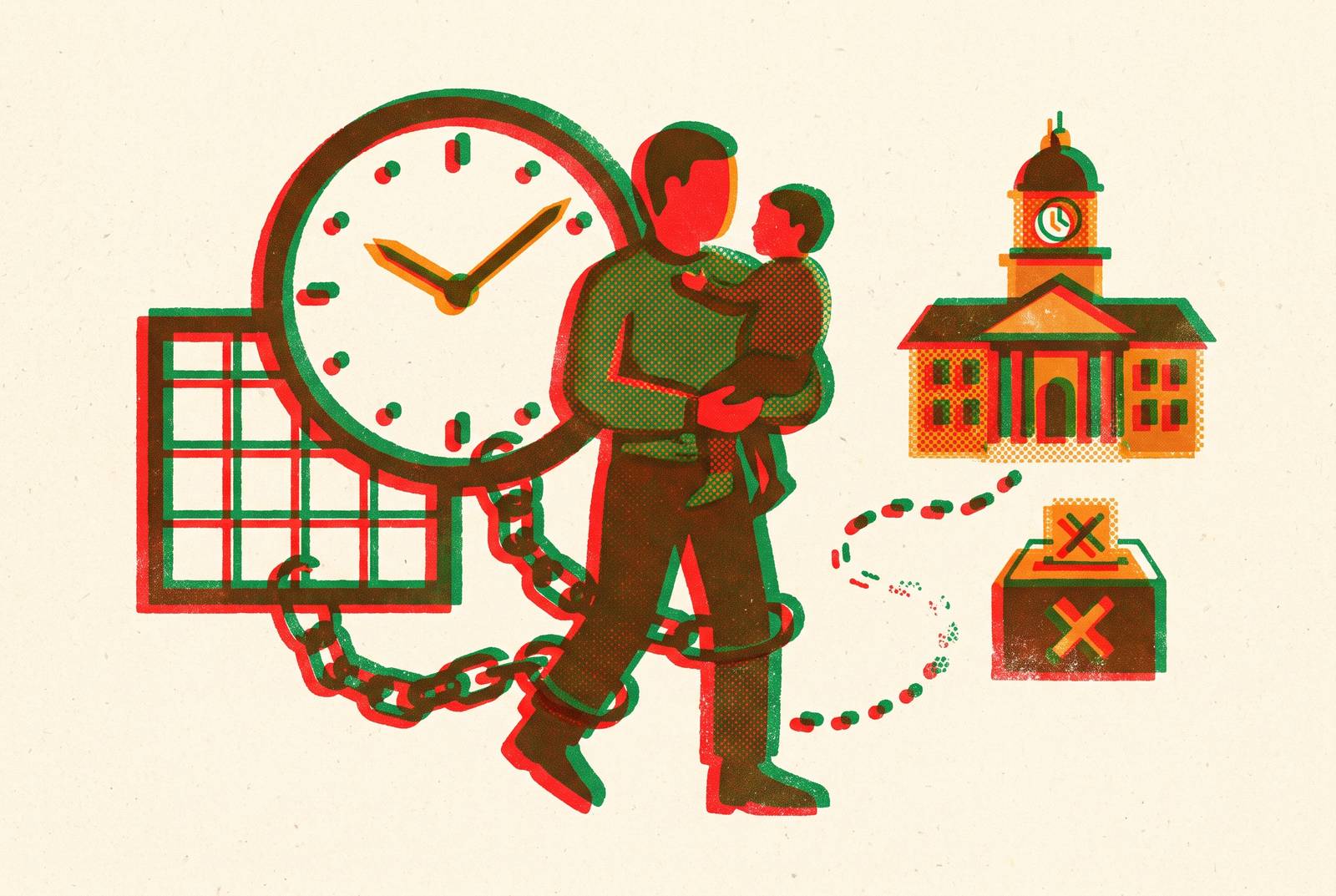
Local decisions about zoning, budgets, and neighborhood ordinances get made in city council chambers, and the people who show up to shape those decisions skew heavily toward whoever has a free weekday evening. Work schedules and childcare scarcity don't just strain family budgets: they quietly filter out a specific class of citizen from the meetings where local government actually happens. This piece walks through how that filtering works, who it hits hardest, and what's being built to fix it.
Where local decisions get made, and who gets to show up
City councils carry real legislative weight. They write and pass the laws that govern zoning, city budgets, and local ordinances, the rules that shape day-to-day life for anyone living in, working in, or visiting a city. Neither of those came from nowhere. They came out of the same channels available to any resident: public hearings, council meetings, public comment periods, town halls, and surveys.
Raleigh's city council offers a useful, concrete look at how public comment actually functions in practice. The second Tuesday session caps speakers at 108. The third Tuesday session caps at 50. Both require signing up in advance. That's not red tape for its own sake. Certain council actions are legally required to include a public hearing before they can move forward, which makes public comment the formal, structured on-ramp citizens have into the process, not a courtesy add-on.
These mechanisms are the actual machinery of local democracy, not decoration. Understanding what's on offer here matters before getting into who's locked out of it. That's the next question. Examples of citizen-influenced local laws that came from this process include Paid Sick Leave, covering all workers, both full-time and part-time, at companies with 5+ employees, and IDNYC, a municipal photo ID for New Yorkers.
The timing problem built into local government meetings
Daytime meetings remain the default in a lot of jurisdictions, and that default has a history. It traces back to an era when electricity and transportation were unreliable and when public input wasn't designed around. Council seats were often filled under a "citizen-legislator" model built for retirees and financially comfortable business owners who preferred to handle civic business early in the day, before their own schedules filled up.
Evening meetings sound like the obvious fix. So the "fix" recreates the same problem in a different time slot. A meeting scheduled at 5:15 p.m. collides with residents trying to get home from work.
None of this reflects bad intentions on the part of city staff. It reflects a scheduling structure inherited from a different set of assumptions about who shows up. Who actually gets boxed out by that structure, and how many people is that? The data answers that.
How widespread the time-and-family barrier is
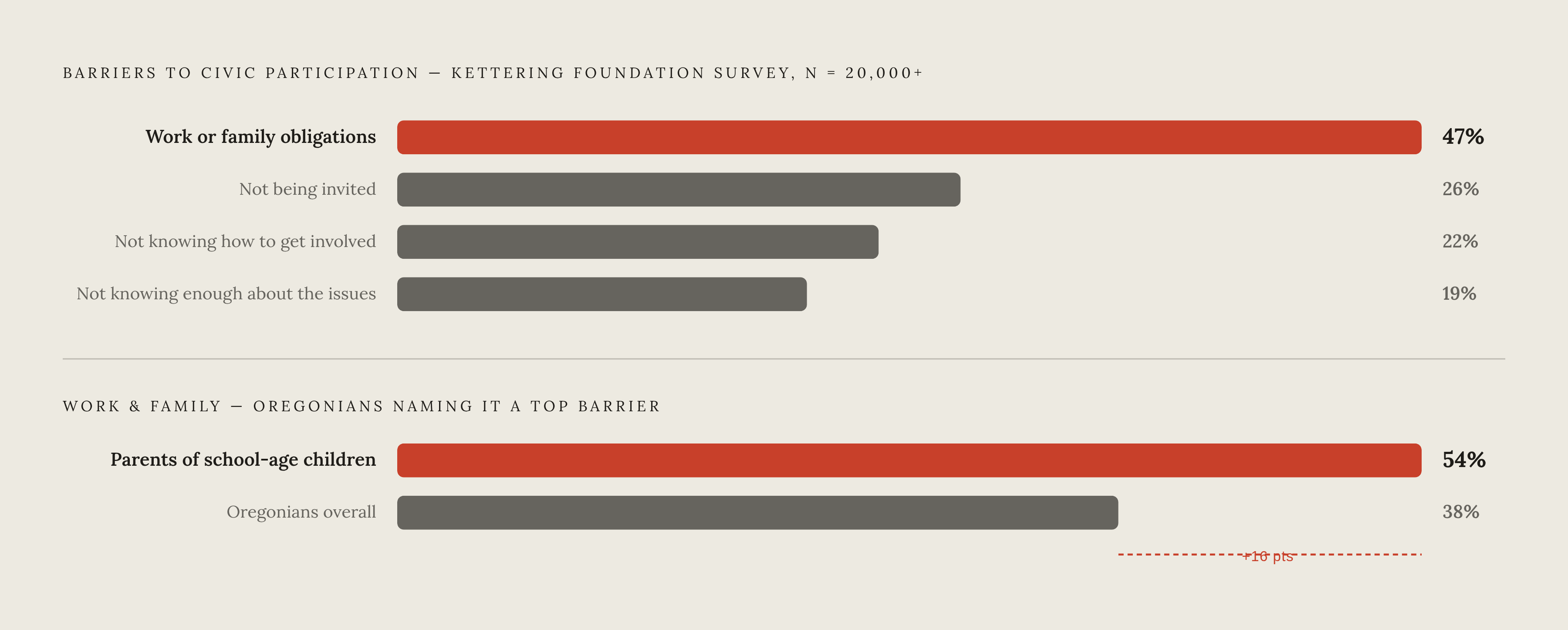
Kettering Foundation, surveying more than 20,000 adults, found that only 25% of Americans think the public's role in the democratic process is working well. That's a lot of people looking at the system and concluding it isn't functioning the way it should.
Ask them why, and the answer isn't apathy. Work or family obligations came back as the single most common barrier to civic participation, at 47%, ahead of not being invited, not knowing how to get involved, or not knowing enough about the issues. But it maps directly onto a structural conflict: participation happens at times when working people are, by definition, unavailable.
Among adults who hadn't engaged in the past two years, the most common reasons were not having time, or not believing their input would change anything. That second reason matters as much as the first. Disengagement doesn't stay flat once someone concludes their effort is futile; it compounds. Miss enough meetings, watch enough decisions get made without you, and the incentive to try again keeps shrinking.
This is the general shape of the problem. Now narrow the lens to parents, because the general barrier gets sharper, fast, once kids are in the picture.
Why parents of young children face a sharper version of this barrier
Oregon data draws the clearest line here. That gap isn't noise. It reflects a real difference in the shape of daily life, not a difference in how much parents care about their communities.
Childcare is the precondition for all of this: without it, the rest doesn't function. Per the Bipartisan Policy Center, 4.2 million children lack access to formal care in their community, with the worst shortages hitting infants and toddlers, families working nontraditional schedules, and rural households. Even where care exists, it's expensive: national average cost now runs $13,128 a year Bipartisan Policy Center. Catalyst data cited by the Bipartisan Policy Center found that 42% of women who left the workforce voluntarily pointed to caregiving responsibilities, including the cost of childcare, as the main reason.
The chain matters because of what follows. A parent who leaves a job to manage childcare hasn't gained free evenings. They've lost income, added pressure at home, and remain exactly as time-constrained as before, maybe more so. Attending a 7 p.m. council meeting doesn't get easier once someone's out of the workforce; if anything, the math gets worse.
A New America survey of 5,472 parents with children under six put a number on the underlying tension: 72% of parents wanted more quality time with their kids, more than wanted personal time (63%) or sleep (56%). More than half said they didn't have enough money for the childcare arrangement that would free that time up. Read that carefully: this isn't parents undervaluing civic life or family time. It's a resource constraint, not a values gap. Oregon data offers the clearest single illustration of the gap: 54% of Oregonians with school-age children name work and family life as one of the top four barriers to civic engagement, versus 38% of Oregonians overall, a 16-point gap, according to Our Children Oregon.
The childcare desert problem for parents who want to participate
A Michigan State University study published in Social Sciences found that more than half the U.S. population lives in a childcare desert, and the effect lands hardest on rural, low-income, and minority communities. That's not a niche problem confined to a few counties. It's the majority experience.
Michigan's own numbers sharpen the picture. Childcare disruption there hurts employment for nearly a third of parents, and 14% of parents studied left their job outright because they couldn't access childcare. 44% of lower-income households report childcare issues impairing labor participation, versus 27% of higher-income households. Money buys flexibility here, and its absence closes doors.
None of the studies behind these numbers set out to measure civic participation. But follow the logic one step further. If a parent is fighting to keep a job because childcare fell through, an evening meeting about a zoning variance isn't several inconvenient steps away, it's several impossible ones. The federal safety net meant to catch some of this isn't catching much: only 15% of eligible children receive CCDF subsidy support, and the Child Care and Development Block Grant hasn't been reauthorized since 2014 Bipartisan Policy Center. A childcare desert isn't only a workforce problem or a household budget problem. It's a democracy infrastructure problem, because it decides, quietly and structurally, who gets to show up.
How the gendered dimension of caregiving compounds the participation gap
A peer-reviewed study in the Journal of European Public Policy looked at gender balance in local government in England and landed on a familiar explanation: structural barriers, including working practices that don't fit around caregiving responsibilities, choke off the supply of women candidates before they ever run. Women's representation in local governments across a broad region has sat at roughly one-third of councillors for a while now, which points to something more stubborn than a leaky pipeline. If it were only about ambition or interest, that number would have moved by now.
Becoming a gender-sensitive local government takes real reform to work hours and work-life balance practices. The barrier sits in how the institution is built.
Virginia Governor Abigail Spanberger made a similar point in May 2026, signing legislation to create the state's Employee Child Care Assistance program: "when a family cannot afford child care, oftentimes a parent, and the numbers bear it out, oftentimes a mom, drops out of the workforce altogether". This barrier touches every parent, regardless of gender, but the evidence shows it doesn't fall evenly. Naming that pattern isn't the same as reducing the whole story to one demographic. It's one layer among several, and it compounds with the rest.
What the participation gap looks like at the local meeting level specifically
Walk into a daytime or early-evening council meeting, and the people actually in the room tend to be retirees, landowners, professional advocates, and organized interest groups, people whose schedules bend easily or whose job description includes showing up.
The consequence is straightforward and a little uncomfortable. The residents most affected by a given local decision, young families, renters, shift workers, tend to be the least represented in the room where that decision takes shape. Officials aren't ignoring these residents on purpose. They're hearing, consistently, from whoever can attend, and over years that pattern shapes what gets treated as a priority. A meeting schedule built around one kind of availability ends up training the whole system to listen to that availability and nothing else.
None of this is an argument that any group has bad values or that officials are acting in bad faith. It's a structural feedback loop: schedule filters attendance, attendance shapes priorities, priorities reinforce the schedule. So what breaks the loop?
What local governments and civic advocates are doing to lower these barriers
The standard toolkit includes varying meeting times, offering online or hybrid attendance, and providing childcare on-site during meetings. Each one chips away at a piece of the problem.
Hybrid options aren't a full fix, though. Oregon's survey findings show virtual attendance solving real barriers, childcare and transportation among them, while opening up new ones for residents facing technology gaps or other access needs. Solving one constraint produces another in its place.
Paid family leave helps at the margins. A National Partnership for Women & Families analysis found the District of Columbia and 13 states have passed paid-leave laws, covering close to a third of private-sector workers, with six more states working on laws that would push that closer to 44%. But paid leave is built around the weeks surrounding a birth. Paid leave covers time around birth, not the years of ongoing caregiving that shape whether someone can make it to a meeting.
Money keeps emerging as the deeper ask. The New America survey found two-thirds of parents, across income levels, said what they really wanted was higher wages, not just cheaper childcare. Tara Dawson McGuinness, who runs New America's New Practice Lab, put it directly in May 2026: the country isn't having a real conversation about time and wages, which is what parents are actually asking for.
On the measurement side, Go Vocal's 2026 trends report shows local governments increasingly checking participation data against census data, to figure out concretely who's missing and why. That's pushed a preference toward hybrid approaches, since online-only participation rarely produces a representative sample on its own. The same report flags a 300% increase since 2020 in the share of governments enabling SSO/eID for participation, folding civic engagement into enterprise-grade identity standards, with real consequences for who can easily verify and engage, and who doesn't Go Vocal trends report.
How civic technology can extend participation to parents who can't be in the room
Technology's value here isn't about efficiency for its own sake. It matters because it can separate participation from a fixed time and a physical chair.
A 2024 academic study reviewed 116 digital tools for citizen participation, pulled from three public repositories. Its finding: these tools move information from citizens to government reasonably well, but a real gap occurs on the other side, in "disseminating accountability information to citizens regarding how policy decisions are made, realised, and assessed". Input goes in. What happens to it afterward often disappears into a black box. It's the difference between participating and just shouting into a form.
Taiwan's vTaiwan platform points to what closing that gap can look like. It pairs online discussion with offline consultation, bringing citizens, officials, and subject experts into the same deliberative process, and shows that digital participation can carry real weight rather than functioning as a box-checking exercise. Harvard Kennedy School's Digital Civic Infrastructure Initiative, launching in 2026, is building toward something similar: research, case studies, and civic tech tools for local governments, alongside a resource hub of policy briefs, all aimed at strengthening constituent interaction. That kind of institutional backing signals this isn't a fringe concern anymore.
Generative AI is entering the picture too. Local governments are testing it for drafting documents, summarizing meetings, and handling constituent communication, per StateTech Magazine's coverage. For residents, that same technology can help someone turn an opinion into a formal comment when they have no idea how to do so.
The more interesting shift sits one layer past that. Tools that let residents draft structured proposals, not just leave comments, and route them to officials along with verified community co-signatures, turn participation from something reactive (show up to a meeting) into something proactive (start a proposal whenever there's actually time for it). That's the exact place where civic technology meets the working parent's real constraint. AI-assisted legislative drafting platforms that verify community support and deliver structured proposals straight to elected officials cut out the need to be physically present at any fixed hour, letting participation happen when a parent actually has a free moment, not when the council calendar says so.
What it would take to treat working parents as full participants in local democracy
Go back to that 47% figure. Americans aren't citing lack of interest or lack of knowledge as their reason for staying out of civic life, they're citing time and family obligations. The system in its current form was built around people who don't carry those constraints, and it shows.
Closing that gap takes movement on three fronts at once. Institutional reform means varied meeting times, childcare provided at meetings, and hybrid options built for genuine access rather than as a checkbox. Economic policy means childcare infrastructure sturdy enough that keeping a job stops being a daily fight. The 14% of Michigan parents who left jobs over childcare access aren't yet a civic participation statistic; they're an employment stability problem first, and that has to get solved before civic participation is even on the table Center for American Progress. Civic technology means giving a parent a way to draft a proposal, gather co-signatures, and submit it formally on a Tuesday night after the kids are finally asleep, not as a replacement for the town hall, but as an equally legitimate path to the same officials.
That last piece carries more weight than it might seem to at first. A petition that lands in some general inbox and a structured proposal backed by verified community support are not the same document in an official's eyes; one is far easier to act on than the other. Genuine inclusion means recognizing that the barrier here is structural and looking for the tools and policies that let participation happen on a schedule that actually fits a working parent's life. Neighborhood-level democracy needs those voices precisely because the people most affected by local decisions are so often the hardest to get into the room.
Sources
- The Other Critical Childcare Issue That Politicians Overlook | The New Republic
- Full article: How can we improve gender balance in local government? Family-friendly policies and static ambition in England
- Modernizing Child Care to Support a National Talent Strategy • Bipartisan Policy Center
- America's Licensed Child Care Deserts - Center for American Progress
- Next Article in Journal
- Public Participation Trends 2026: The Era of AI & Hybrid Democracy | Go Vocal
- What Parents of Young Kids Want: Insights from the 2026 National Parent Survey - New America
- Michigan’s Child Care Deserts (Updated March 2026)