Digital Divide Effects on Online Civic Engagement Tools
Unequal access, skills, and trust stack to block the same communities three times over.
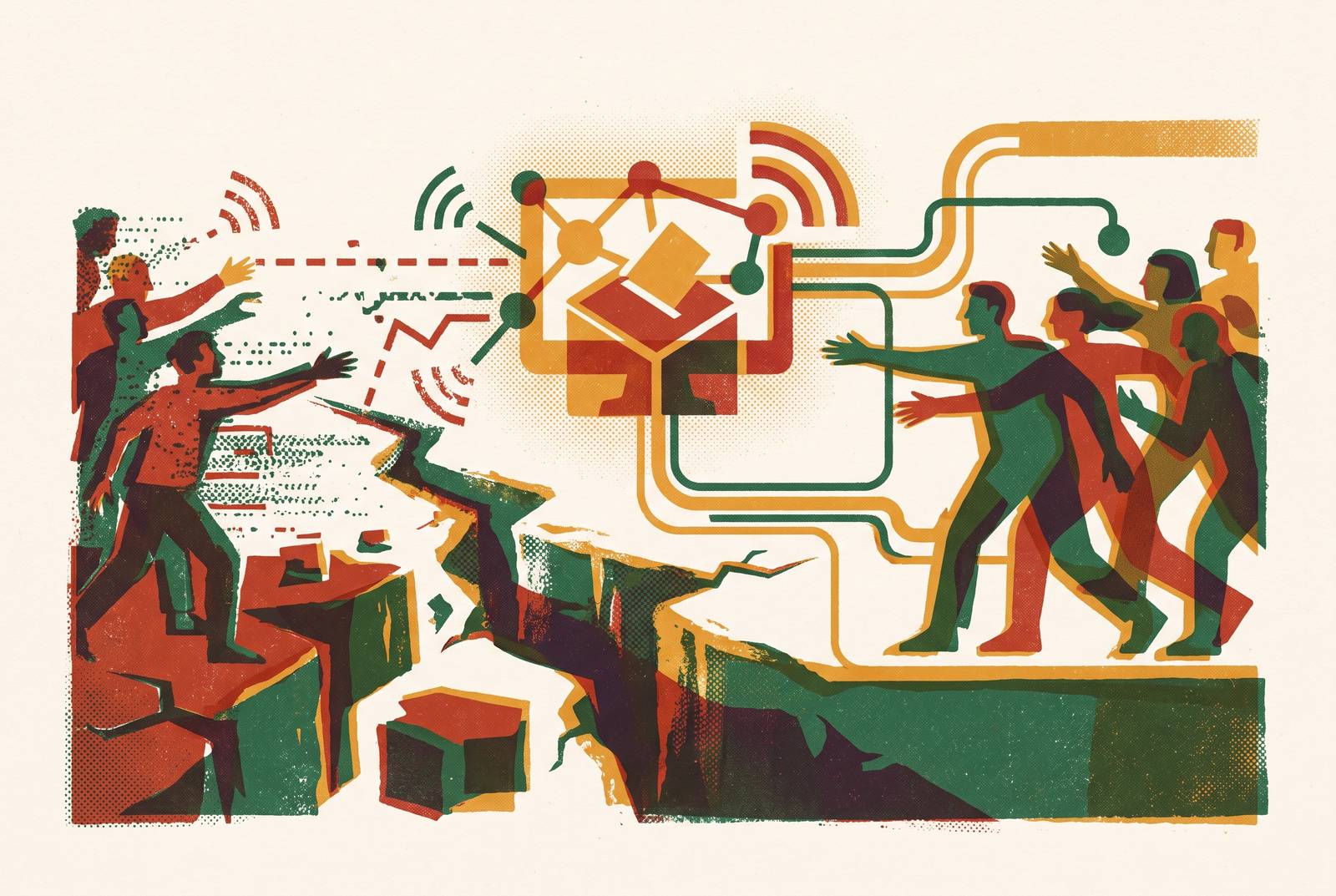
Call it "the digital divide" and most people picture one thing: someone without internet access. That's only a third of the problem. Treat those three as one problem and the fixes only ever reach the top layer, leaving the other two untouched and the tool wondering why adoption stalled. What follows walks through each layer in order, shows how they stack on top of each other in the same communities, and ends with what that means for anyone trying to build a civic tool that actually gets used.
The infrastructure gap: who cannot get online at all
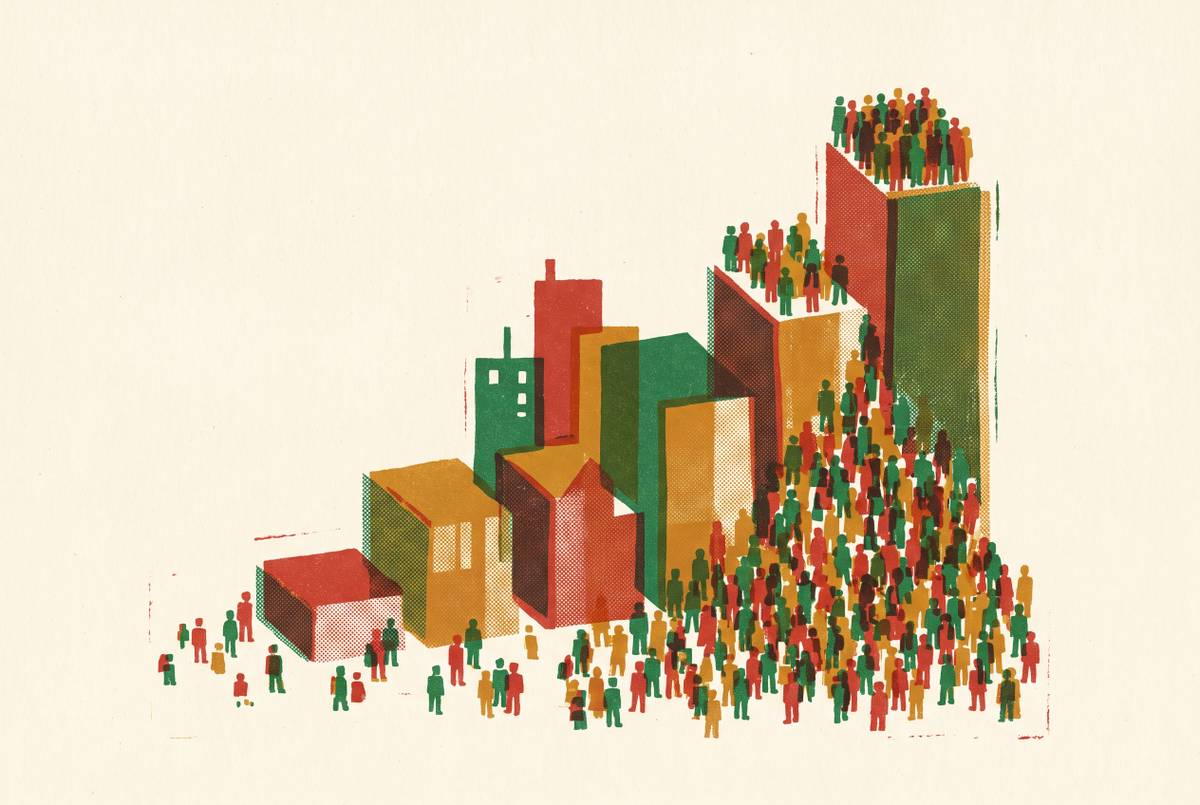
Start with the most visible layer, because it's the easiest to point to and the hardest to argue with. Tens of millions of Americans still lack access to high-speed broadband, according to U.S. Census Bureau data. That's not spread evenly across the map or across income brackets. Black households lack home broadband at nearly double the national rate, per figures cited by the Community Action Association of Alabama.
And the trend line isn't moving the direction you'd hope. The Affordable Connectivity Program, which had been covering broadband subscription costs for millions of low-income households, ended on June 1, 2024, after Congress declined to fund it further. That's not an abstraction. That's a program that was closing the gap, and then it stopped. Policy can widen this divide just as easily as it can narrow it, and lately it's been doing the former.
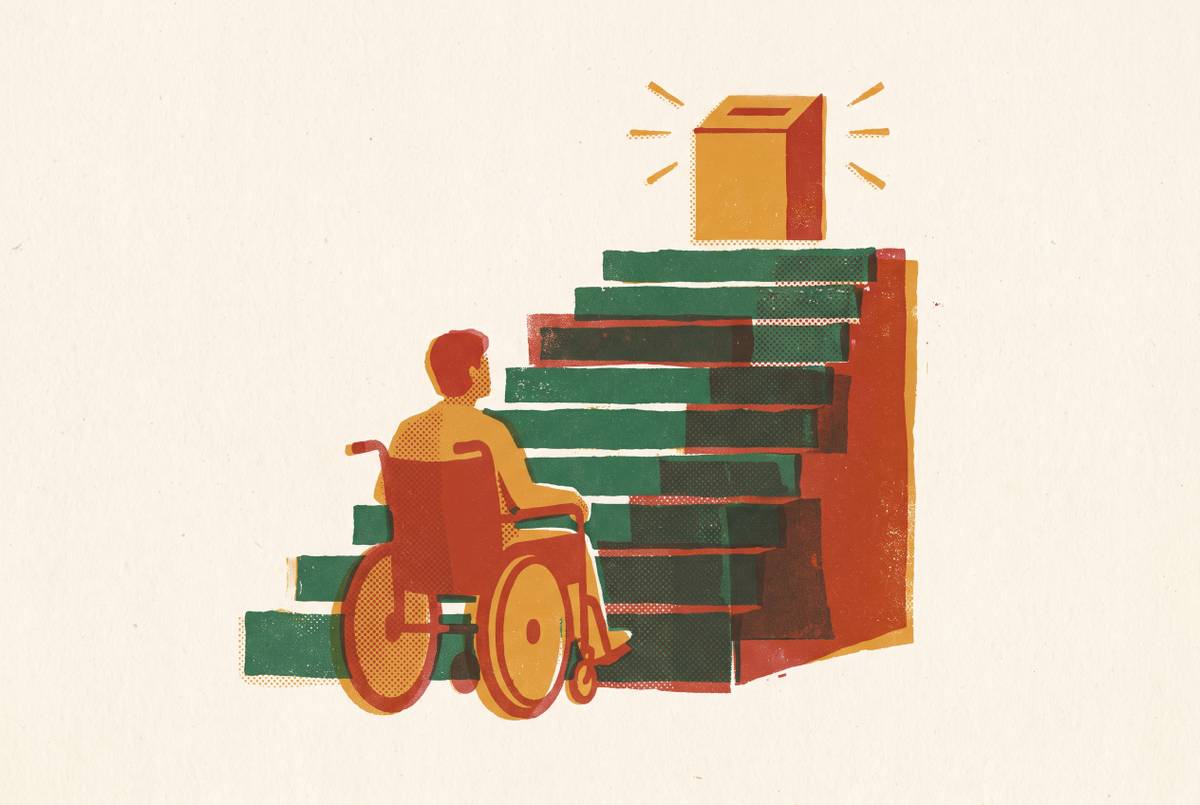
Someone will say smartphones fix this. They don't, not for the tasks that matter here. These aren't smartphone-native tasks. Mobile-only access gets someone a phone call and a text message. It doesn't get them into the civic process the way a laptop and a stable connection does. An estimated 2.2 billion people worldwide remain offline, with billions more "under-connected" (lacking reliable broadband, adequate devices, or the skills to use them effectively), according to DevelopmentAid.
The social divide: who struggles to use what they can access
Now assume broadband access is solved. Everyone's online. Job done?
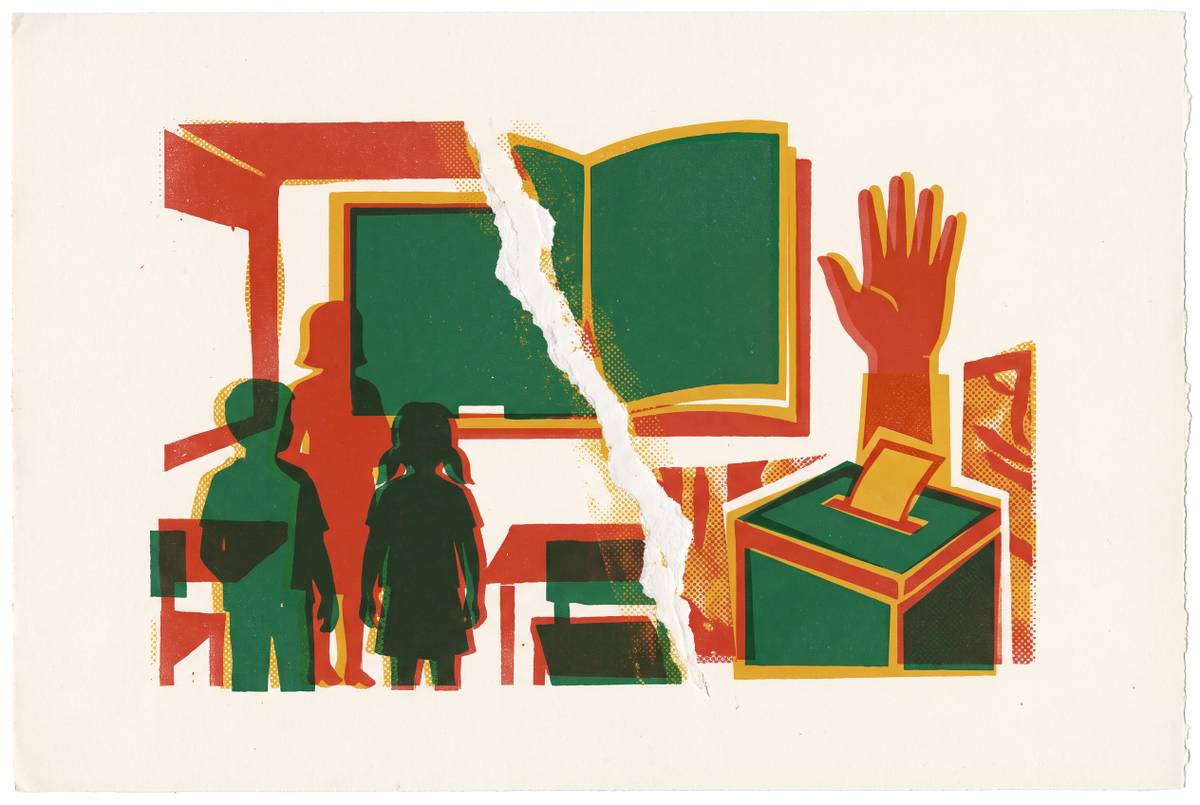
Not close. Internet Society research points to what it calls a "new digital divide," one that shows up in how people use the technology they already have, not whether they have itc9. Two households with identical internet plans can have wildly different capacities to navigate a government website, fill out a benefits form, or understand what a public comment period even is. That gap doesn't show up in a broadband map. It appears in outcomes: research cited by Artemia finds low-income families missing benefits application deadlines, losing support they qualified for, and failing to register to vote, all because the process moved online and the interface assumed a level of comfort with digital bureaucracy that not everyone has.
Language adds another layer on top. A 2025 study in Frontiers in Political Science found that multilingual civic platforms have to grapple with more than translation. A 2025 Frontiers in Political Science study adds that multilingual civic platforms must address not only technological efficiency but also how AI intersects with inclusion and linguistic diversity, since language barriers compound digital literacy barriers. Syracuse University's iSchool frames this as bigger than politics: digital inequality touches education, employment, healthcare, and general social participation, and civic disengagement is just one visible symptom of a much wider exclusion.
The households shut out by the infrastructure gap are, overwhelmingly, the same households with the fewest resources to build digital skills once they do get connected. Low income, rural, elderly, some racial and ethnic minority communities. The two layers don't operate side by side. They reinforce each other.
The democratic divide: who chooses not to engage even when they can
Most civic tech ignores this layer entirely, and it decides whether a tool actually works.
Picture someone with a reliable fiber connection, a laptop, strong digital literacy, fluent in the platform's language. Does that person engage with a public comment portal or a legislative tracking tool? Often, no. Norris's framework treats access and literacy as necessary conditions, not sufficient ones: motivation, trust in institutions, and a sense that participation actually changes anything are solved by none of that, and none of them come from better broadband.
The Harvard Ash Center laid out the mechanics of this in an October 2025 framework on digital civic infrastructure. Citizens can't find, read, or make sense of the legal and regulatory text that governs their lives. Public comment periods generate more volume than any human staffer can actually read. Constituent input arrives in formats government systems can't process. Add it up and the result is alienation, from institutions that can't hear people even when people show up.
The sharpest data point in the whole picture is this. A 2024 study that looked at 116 different digital tools for citizen participation found a consistent, major gap: these tools tell people how to participate, but almost none of them show people what happened afterward. Someone submits a comment, signs a petition, or fills out a form, and then, silence. No update, no outcome, no sense that any of it mattered. Why would that person come back a second time? The tools aren't lacking features. They're lacking a feedback loop, and without one, trust has nothing to accumulate on.
That's also why the democratic divide tends to widen existing political inequality rather than close it. People already civically active are the ones who adopt new digital civic tools first, while the people most alienated from institutions, the ones these tools are ostensibly built for, are the least likely to try. Norris's framework makes a related, uncomfortable point: internet-based political engagement tends to reflect and reinforce the structural features already built into a political system, rather than transform them. A digital tool dropped into a broken trust relationship just digitizes the distance. It just digitizes the distance.
The three divides: the populations left out at every layer
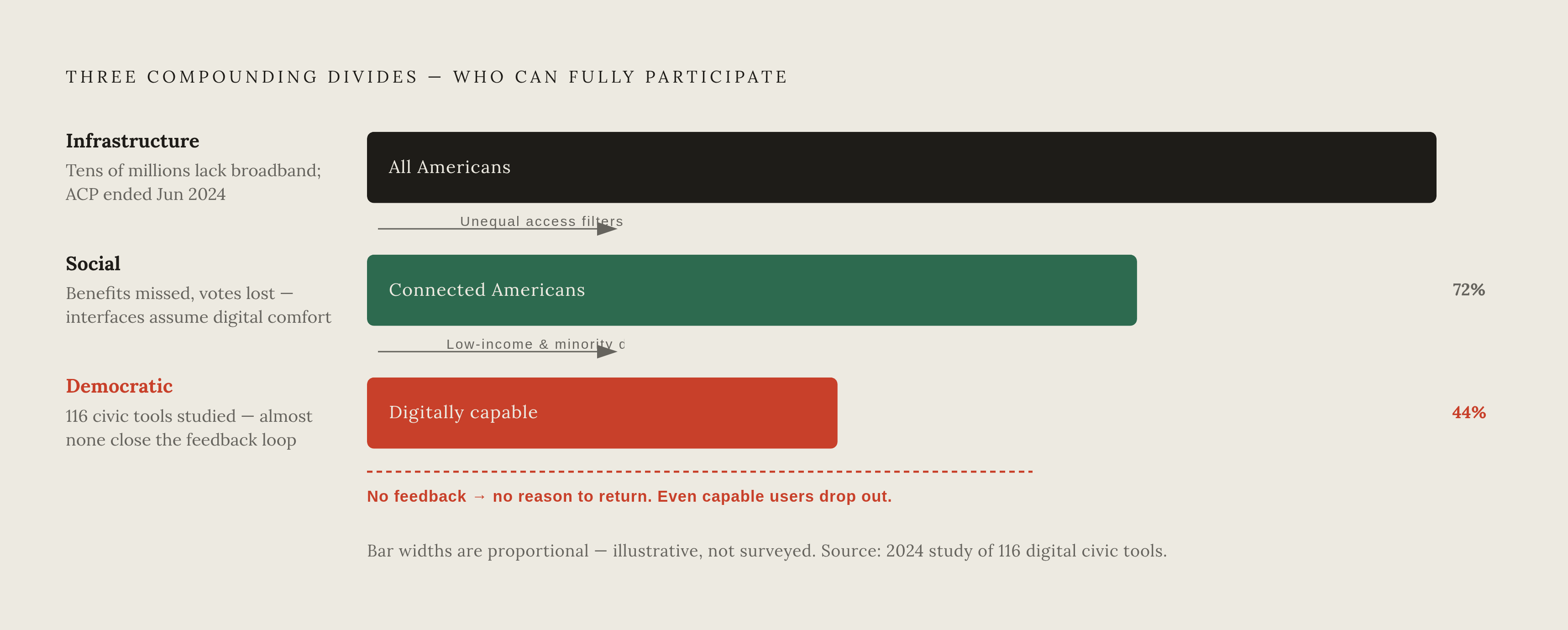
Line the three divides up next to each other and a pattern falls out immediately: they're not hitting three different groups of people. They're hitting the same one, three separate times.
Rural, low-income, and minority communities face the infrastructure gap first. Those same communities have the fewest resources, in money and in time, to build digital skills once they're connected. And those same communities, often with decades of reason behind it, carry the deepest distrust of the institutions a civic tool is asking them to engage with. So the democratic divide doesn't land evenly. It lands hardest exactly where the first two layers have already done their damage.
The Trust for Civic Life's Spring 2026 learning brief puts a number on how rare it is to get this right. In their first round of grants back in June 2024, they could only find two grantees using a genuinely community-led digital approach in rural and underserved areas. One was an online platform reaching over 90% of Vermont residents around hyper-local issues. The other was an app helping farmworkers in central California verify identification, clearing a basic barrier that had kept many of them out of community life entirely. That scarcity is the compounding effect made visible.
It gets worse from the funder side too. The same brief flags a pattern where funders project their own priorities onto local groups, particularly in underfunded rural areas, handing communities tools that don't actually fit their conditions. And as more essential services, voter registration, benefits, public comment, keep moving online, the democratic deficit doesn't shrink with each new digitized service. It grows because of the digitization. Research from ScienceDirect identifies a promising cause producing this shift: citizens are increasingly organizing themselves as co-creators of governance, not passive recipients of it. But that shift only works if the capacities the three divides erode are actually intact. Right now, for a lot of communities, they aren't.
What civic tech gets wrong about the divides
Most civic tech gets built by people who cleared all three divides years ago, and it shows. The tools reach the audience that was already reachable.
Take the digital-first assumption baked into most platforms: online interaction as a stand-in for in-person connection. The Trust for Civic Life's Spring brief found the opposite pattern among the local groups actually getting results. They used digital tools as a bridge to in-person interaction, not a replacement for it, and digital-only approaches consistently fell flat in underserved communities. A platform that assumes the internet can do the whole job is solving a problem that doesn't match how trust actually gets built.
Then there's the accountability gap again, the clearest design failure in the whole field. That 2024 study of 116 tools found most of them simply don't tell citizens how a decision was reached, or what became of their input. No feedback, no reason to return. By the time someone's motivation to participate would even come into play, they've already been shut out by the login screen.
The Trust for Civic Life brief calls this the Build vs. Buy problem: new technology succeeds at strengthening civic life when it's shaped around existing community conditions, and it creates friction, not participation, when it's imposed from outside without local input. South Africa offers a government-scale version of this failure, and it isn't a startup cutting corners, it's a national policy process. South Africa's Draft National AI Policy 2026 was published for public comment on April 10, 2026, and was withdrawn by Minister Solly Malatsi on April 26, 2026, after AI-hallucinated citations were found in its reference list. A civic AI project failed on the exact axis, accountability and verification, that determines whether communities trust the tool at all. A Frontiers in Political Science study found that AI-assisted civic platforms must address linguistic diversity, noting that tools built for English-speaking, educated users exclude multilingual communities at the interface level, before the democratic divide even comes into play.
Design principles that address all three divides, not just the visible one
None of this points toward a faster platform. It points toward a differently conceived design, one that treats infrastructure, literacy, and motivation as equally real constraints, rather than just a faster platform.
Start with relationships before reach. The Trust for Civic Life's Spring 2026 findings show that what actually drives impact is not a specific piece of software but an approach, relationships first, decisions led locally rather than handed down, connections built through real participation that no platform replicates on its own. Digital tools work as bridges to in-person connection. They don't work as substitutes for it.
Next, structured pathways instead of open access. The Harvard Ash Center's October 2025 "Connect, Learn, Act" framework, adapted by Partners in Democracy from New_Public's work on healthy digital public spaces, lays out a scaffold: connect with the community, build civic knowledge, then take direct action. That's a sequence, not a login page. An open platform that assumes people arrive ready to participate is skipping straight to step three.
Close the feedback loop, because the 2024 study's central finding demands a specific fix, not a general one: show people what happened as a result of what they did. Without a visible outcome, the democratic divide doesn't stay flat. It widens, because trust never gets a chance to accumulate.
Build linguistic and accessibility inclusion in from the start, not bolted on after launch. The 2025 Frontiers in Political Science finding on AI and linguistic diversity makes multilingual design a prerequisite, not a feature request, for any tool that claims to serve a broad community.
Hybrid deliberation is a model worth studying. Go Vocal's approach pairs tech-assisted assemblies with the depth of in-person deliberation, extending "mini publics into maxi publics" without losing the offline relationships that make deliberation legitimate in the first place. It's one demonstration that reach and depth don't have to trade off against each other.
The field is starting to notice, too. The UNDP's May 2025 Regional Civic Tech Innovation Challenge, run with the Open Government Partnership, Accountability Lab, and CurveUp, went looking specifically for youth-led civic tech in Asia and the Pacific, a sign that design is starting to center the communities affected, not just the deployment metrics. People Powered's 2025 roundup of participation tools judges platforms on cost, capacity requirements, features, accessibility, ethics, transparency, and track record, a rubric that quietly covers all three divides instead of just measuring reach. State Voices' 2025-2026 Tools and Tech Guide does something similar, weighing tools on API integration, open-source availability, data privacy, mission alignment, accessibility, security, and adaptability, criteria that speak directly to the social and democratic layers rather than infrastructure alone.
Addressing all three divides in practice for citizen-led legislation
Put the three-divide framework to work on a single concrete case: a citizen who has an idea for a law and no idea how to turn it into one. The most promising civic tools reduce the cognitive, linguistic, and motivational friction at every step of that process, not just at the entry point.
The infrastructure divide asks for entry points that don't require broadband-quality access at all: SMS-based submission, co-signing organized through a trusted local organization instead of a login system, mobile-first design that doesn't assume a fast connection.
The social divide asks for something more specific: a tool that does the complexity work instead of demanding the citizen learn it first. AI-assisted bill drafting that takes a plain-language idea and turns it into properly formatted legislative text removes the requirement that someone be a lawyer, or know a lawyer, to participate. This is the part of AI's role here that's actually concrete, not automating government decisions, but translating what a citizen means into a format institutions can actually process and act on. That said, the South Africa case from earlier isn't a side note here, it's a warning that belongs in the same sentence as the solution: AI-assisted drafting only works if there's human verification and transparent sourcing behind it. Fast and unaccountable is worse than slow. The 2026 State of Digital Government report notes that most government organizations already use AI in some form, and that AI governance policy is spreading alongside it, which means civic tools drafting legislation with AI assistance are stepping into a regulatory environment that's actively catching up to exactly this use case.
The democratic divide asks for verified credibility built into the process itself, neighbors co-signing a draft, local organizations vouching for it, a visible chain from idea to outcome that a first-time participant can actually see. Solve for infrastructure alone, and the tool reaches people who were already going to find a way in. Solve for all three, and it reaches the people the first two layers were quietly filtering out all along.
Sources
- The 2025-2026 Tools & Tech Guide | State Voices
- ICTlogy Bibliography » Work » Digital Divide: Civic Engagement, Information Poverty, and the Internet Worldwide
- Best Digital Participation Tools of 2025: A New Era of Civic Tech – Global Democracy Coalition
- Full article: Digital accountability through e-participation: the moderating role of the digital divide
- A TRUST FOR CIVIC LIFE LEARNING BRIEF Online for Offline
- Frontiers | AI multilingual tools for social innovation: new perspectives on civic technologies, digital empowerment and inclusive governance
- Digital Civic Infrastructure – Ash Center