Civic Participation Rates by Income Level in U.S. Cities
Lower-income residents vote and engage in local government at half the rate of wealthy neighbors.
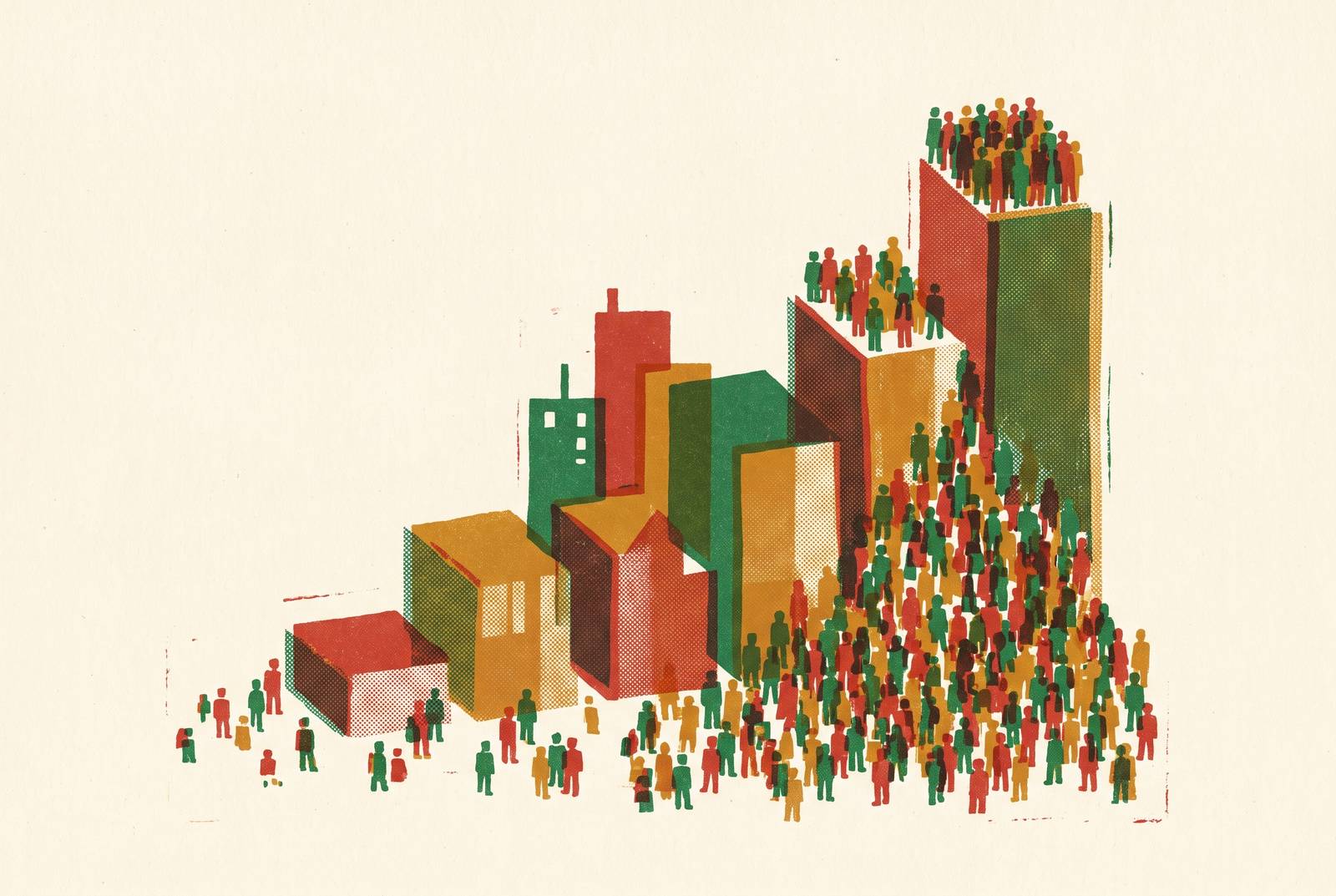
Civic participation in U.S. cities is not randomly distributed but follows income, and that gap means lower-income communities have systematically less influence over the decisions that shape their lives.
How income predicts civic participation across every measurable form of engagement
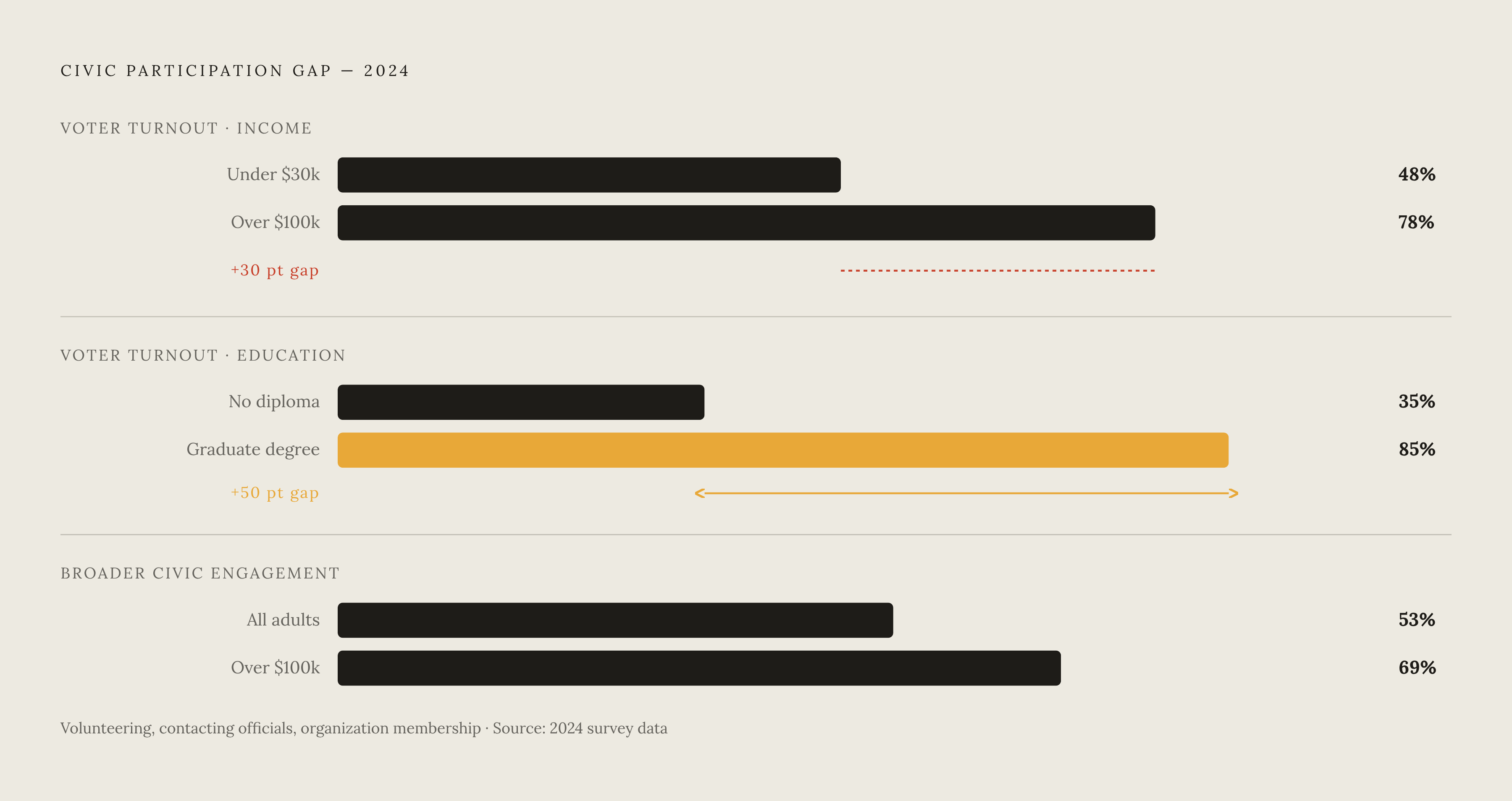
Start with voting, since it's the most-measured form of participation there is. Households earning under $30,000 turned out at 48% in the 2024 election. Households earning over $100,000 turned out at 78% Get Out the Vote: Cultivating Civic Engagement in Youth and Adults.
Education tells the same story from another angle. Americans without a high school diploma turned out at 35% in 2024. Those with graduate degrees turned out at 85%. Given how tightly education and income move together in the U.S., this is the same finding viewed from another angle.
But voting is only the most visible layer. Widen the lens to volunteering, contacting officials, and joining local organizations, and the gap persists. A nationally representative poll of 2,201 U.S. adults, conducted in August 2024 by the AAMC Center for Health Justice, found that 69% of adults earning $100,000 or more reported being civically engaged over the prior two years, against 53% of adults overall Get Out the Vote: Cultivating Civic Engagement in Youth and Adults. So the participation gap isn't a voting-booth phenomenon. It runs through every channel people use to make their voice heard.
Race adds another layer, and it doesn't operate independently of income. Hispanic Americans turned out at 52% in 2024, compared with 67% for white Americans and 63% for African Americans Get Out the Vote: Cultivating Civic Engagement in Youth and Adults. Given how closely racial income gaps track these turnout gaps, race and class appear to compound each other rather than function as separate forces. A 2026 Civic Information Index backs this up at the community level: Appalachian communities and communities with higher shares of Black, Hispanic/Latino, or Native American residents post lower civic health scores, and those low scores cluster in regions with long histories of racial and economic discrimination.
None of this is scattered randomly across issue areas either. The gap is largest where policy decisions hit lower-income lives the most directly: housing, transit, zoning, public safety. What follows traces this divide across three layers, voting, local government meetings, and the broader landscape of non-electoral engagement, and then digs into what's actually driving it.
What local government meetings look like, and who shows up to them
Local law-making follows a fairly standard sequence: an ordinance gets proposed, it goes through public meeting discussion, a committee reviews it, a vote happens, and the mayor or chief administrator signs off. Town Meeting and Representative Town Meeting structures, both formally include citizen voice, build that voice directly into the process on paper, but the pathway to that voice is not equally accessible in practice.
Federal law actually mandates inclusion in some cases. Under 24 CFR § 91.105, any jurisdiction receiving HUD assistance has to hold at least two public hearings a year, at two different points in the program cycle, with one happening before the draft consolidated plan goes out for comment. The regulation also requires jurisdictions to take real steps to bring in minorities, non-English speakers, and people with disabilities. The mandate exists. Whether it's met is the harder question, and the data on actual meeting attendance suggests it mostly isn't.
A 2026 arXiv paper by Olivia Martin and Amar Venugopal, "Participation and Representation in Local Government Speech," analyzed a decade of city council meetings across 115 California cities, making it the most comprehensive look at meeting participation compiled so far. The finding: people who show up and speak at these meetings skew substantially older, whiter, more male, and more liberal than the registered voter population they're supposedly representing. This pattern doesn't vary much by city size or type, which suggests the forces behind it, differences in the cost of attending, differences in perceived stakes, differences in civic norms, operate the same way regardless of local context.
Van Holm's 2019 study in the American Review of Public Administration adds a structural layer to this. Looking at small and mid-sized U.S. cities, Van Holm found that income inequality has a real, if mixed, effect on how much residents engage in departmental policymaking, even after controlling for government structure and community demographics. Beyond voting, a nationally representative poll (n=2,201 U.S. adults) found 69% of high-income adults (≥$100,000/year) reported being civically engaged in the prior two years versus 53% overall (the gap runs through volunteering, contacting officials, and organizational participation, not just the ballot box) Get Out the Vote: Cultivating Civic Engagement in Youth and Adults.
Why lower-income residents participate less, and why "apathy" is the wrong explanation
Call it apathy and you've misdiagnosed the problem. The Scholars Strategy Network's 2026 analysis finds that working-class and lower-income citizens aren't skipping civic life because they don't care or don't know what's happening. Many have looked at how politics works and concluded, reasonably, that it isn't working for them. Disengagement, in that light, reads less like a character flaw and more like a rational response to experience.
Then there's the simple mechanics of showing up. Work schedules, transportation gaps, and housing instability all cut into a lower-income resident's ability to participate, according to Kreitzer's analysis. An hourly worker who loses wages by attending a weekday hearing is making a real financial trade-off, not weighing convenience. Renters who move frequently run into re-registration requirements that pile friction onto an already time-strapped life.
The AAMC poll gets at this directly Get Out the Vote: Cultivating Civic Engagement in Youth and Adults. Adults who weren't civically engaged most often said they didn't have the time, or they didn't believe their participation would change anything. Neither of those is indifference. One's a resource constraint, the other's a judgment about efficacy, and both are entirely reasonable given what people have seen.
Trust factors in too, and it builds (or doesn't) over a much longer timeline than election season. Scholars Strategy Network research finds that most lower-income respondents say they rarely hear from political or civic organizations outside of campaign periods. That kind of sporadic contact breeds skepticism rather than trust. Building the kind of trust that gets someone to speak at a public hearing or push back on an elected official takes months, sometimes years, of consistent, visible presence, not a mailer every four years https://www.pewresearch.org/topic/politics-policy/political-civic-engagement/.
The trend line isn't encouraging either. In 2024, lower-income people across every racial group voted at lower rates than they had in 2020, and both the racial and the class turnout gaps grew wider, not narrower. There's a related cycle playing out in immigrant neighborhoods: areas with large low-income immigrant populations tend to get skipped over by campaigns because turnout there runs low, which starves those neighborhoods of investment and attention, which discourages the next round of turnout.
Layer legal and structural barriers on top of all this and the picture gets tighter still. Voter suppression tactics, gaps in accessible information, and language barriers don't replace the time and transportation problems, they stack on top of them. Consider voting leave laws: roughly 30 states require employers to give workers time off to vote, but the details vary enormously, some guarantee pay, others don't, leaving hourly workers in a lot of states with zero legal protection for the time it takes to cast a ballot. So when lower-income communities end up underrepresented in the rooms where transit routes, zoning maps, and public service budgets get decided, the outcomes tilt toward whoever actually showed up. It's the direct, traceable consequence of who's missing.
How the gap compounds when wealth concentrates in a city (the inequality-within-cities dynamic)
Here's where the data gets genuinely counterintuitive. Van Holm's 2019 research draws a distinction between two different things: the current level of income inequality in a city, and the direction it's moving. Rising inequality, measured as change over time, makes residents less likely to participate in government decision-making. But cities that already have a high level of inequality tend to show higher overall engagement rates.
Why would those two facts coexist Get Out the Vote: Cultivating Civic Engagement in Youth and Adults? Because "higher overall engagement" can hide who's actually doing the engaging. In a highly unequal city, wealthy residents participate more, and their activity can push the aggregate participation number up even as lower-income participation is falling in absolute terms. The city looks civically healthy in the topline number, while the gap between who's heard and who isn't is widening.
That masking effect lines up with the geographic pattern in the 2026 Civic Information Index, which finds lower civic health scores clustering in regions long shaped by racial and economic discrimination. The cities with the most concentrated, unequal power structures tend to be exactly the ones where the participation gap runs widest.
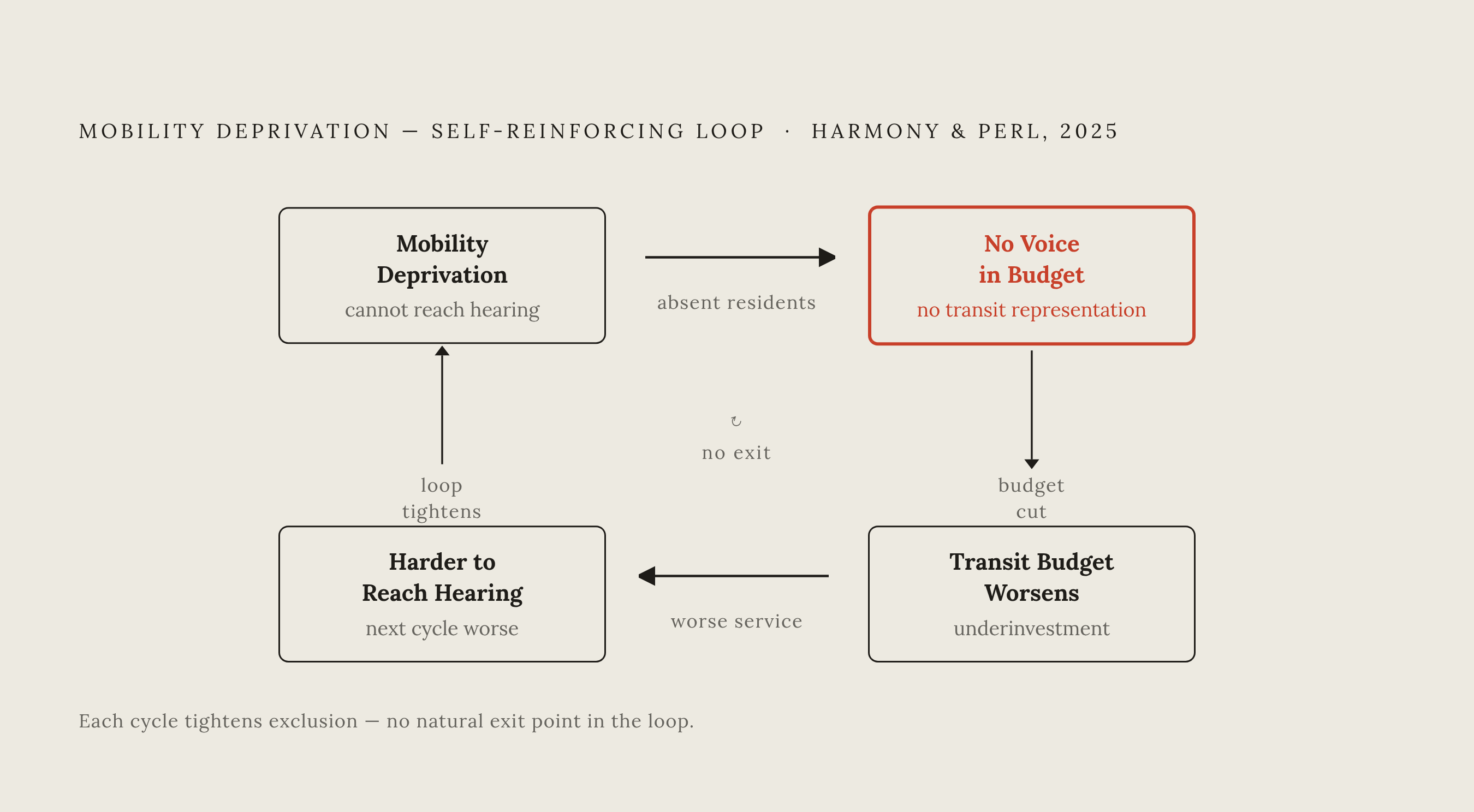
Transportation offers maybe the clearest mechanical example of how this compounds. A 2025 chapter by Harmony and Perl, "Transport, inequality and policy feedback," describes a loop where people experiencing mobility deprivation get steadily diminishing returns from transport policymaking. Someone who can't get to a hearing doesn't get to shape the transit budget, and a worse transit system then makes it even harder for that same person to reach the next hearing. The loop tightens with each cycle rather than loosening.
And the aggregate numbers, where they do shift, aren't shifting in a self-correcting direction. AAMC's August 2024 data shows civic engagement among baby boomers dropping from 56% to 50% between 2022 and 2024, even as overall civic engagement held roughly flat Get Out the Vote: Cultivating Civic Engagement in Youth and Adults. A flat topline paired with a declining subgroup suggests the underlying structure is not fixing itself.
Cities aren't a passive backdrop to any of this. Density, governance structure, and the degree of economic polarization within a city actively shape who shows up and who doesn't, which raises the question of what, if anything, closes that gap at the level of tools and structures rather than just describing it.
What existing civic infrastructure offers, and where it falls short for lower-income residents
On paper, the infrastructure for civic input looks fairly complete. Direct democracy tools, initiatives, referendums, petitions, let citizens put legislation directly to a vote, and indirect initiatives route through the legislature first. Between elections, contacting representatives and weighing in through the regulatory comment process are widely described as the most effective ways to move a specific issue. Public consultations themselves take several forms: public meetings, surveys, online forums.
But look closer at each of these and the same problem appears again. Petitions and initiatives require organizational resources, money, coordination, legal know-how, that most lower-income residents don't have access to. Contacting a representative or filing a regulatory comment only works if someone already knows the process exists, has the time to use it, and believes it'll actually produce a result. Public meetings, surveys, and online forums offer format diversity, sure, but access to each format still splits sharply along income, language, and digital-access lines.
Some places have built real accommodations. Certain municipalities publish official documents in multiple languages and provide translation at hearings. San Francisco lets noncitizens with children living in the city vote in local school board elections, regardless of where those kids go to school. These are genuine reforms, but the cities getting this right are still the minority, exceptions rather than the norm.
Digital tools don't automatically fix the underlying problem either. A 2025 Frontiers in Political Science study, using structural equation modeling on roughly 400 respondents inside local government agencies, found that digital readiness and service quality alone aren't enough to drive participatory democracy. Technology helps, but trust and access problems cause this, and it doesn't substitute for solving them.
And trust is its own separate crisis. The 2025 Edelman Trust Barometer, cited by the World Bank, found 61% of respondents globally report moderate to high grievance toward government and business worldbank.org. So even where the formal channel exists, a majority of people don't believe it'll respond to them. That's the real bottleneck. The infrastructure for participation exists on paper almost everywhere. The friction that remains around actually using it isn't spread evenly; it falls heaviest on the people with the fewest resources to spare.
Civic Technology and Platforms Closing the Gap
Some of the friction described above is genuinely solvable with better tools, and a few approaches are showing real traction. People Powered's 2025 roundup of digital participation tools points to participatory budgeting and online deliberation as the strongest categories, largely because they let residents weigh in on something specific and tangible without having to learn formal legislative procedure first.
The OECD took a harder look at the hype cycle itself. Its April 30, 2025 paper, "Tackling Civic Participation Challenges with Emerging Technologies: Beyond the Hype," examines AI, blockchain, and virtual reality as participation tools, and the framing matters: the analysis stresses the gap between potential and equitable implementation. A flashy pilot program means very little if it never reaches the neighborhoods that need it most.
One system that's cleared that bar: vTaiwan. Harvard's Ash Center documented, as of December 2025, that Taiwan's approach, combining government-built digital infrastructure with independently developed civic tech, has led the government to actually execute more than 80% of vTaiwan's proposals Get Out the Vote: Cultivating Civic Engagement in Youth and Adults ash.harvard.edu. That's a meaningful number: it shows hybrid official-and-independent tech models can produce actual government follow-through, not just a forum where people vent into the void.
In U.S. cities, the operational layer looks different, more incremental, less centralized. Platforms like Granicus, CivicPlus, and OpenGov, per a 2026 govtech analysis, now offer 311 request tracking, alerts across SMS, email, and WhatsApp, and participatory budgeting modules where taxpayers can simulate and actually allocate funds. Zencity takes a different angle, using AI to pull community sentiment from social media, local news coverage, and 311 systems in real time, giving city managers a read on public mood without waiting for the next quarterly town hall. Its real value is passivity: residents don't have to actively submit anything for their sentiment to register.
The World Bank's CIVIC Digital initiative tackles a different barrier directly, using voice-enabled consultation so people can participate regardless of literacy level or technical comfort. That's a meaningful design choice, because plenty of digital civic tools end up recreating the very exclusions they were built to fix. Constituent management systems that route citizen inquiries straight to elected offices are meant to close that same responsiveness gap, though solid third-party data on how well they're actually working is thin.
Tools that make citizens learn a new platform or navigate an unfamiliar bureaucratic interface tend to reproduce the very access gap they're supposed to close. Tools that meet people where they already are, SMS, voice, social media, existing neighborhood networks, carry a much better equity profile. AI adoption inside government is moving fast regardless: a 2026 State of Digital Government report found more than half of government organizations now use AI in some form, and a 2025 Ernst & Young survey put the share of local government leaders actively integrating AI into city operations at roughly two-thirds. The direction of travel is obvious; whether the rollout reaches the neighborhoods that need it most is still an open question.
Platforms that take a resident's plain-language idea and turn it into an actual drafted bill, routed through verified neighbor co-signatures straight to an elected official, are one emerging model. That's a genuine step past consultation. It moves someone from answering a survey to proposing the policy itself, which is a different kind of participation entirely, and it starts to close the credibility gap that a paper petition never really solved on its own.
Year-Round Organizing, Structural Reform, and the Evidence on What Works
Technology helps close some of this gap, but it doesn't close the trust gap on its own, and that's where organizing comes back into the picture. The Scholars Strategy Network's 2026 recommendation is blunt: year-round organizing beats episodic get-out-the-vote pushes, because sustained presence builds trained local leaders, real communication channels, detailed community data, and relationships that lower the personal risk of speaking up.
Short bursts of outreach around election season tend to build skepticism rather than dissolve it. Sustained, visible presence is what builds trust, and trust is the actual precondition for a lower-income resident to take the risk of speaking at a hearing, organizing neighbors block by block, or putting their name on a proposal.
There's a pipeline hiding in plain sight, too. The AAMC poll found 71% of 14- to 17-year-olds report being civically engaged, well above the 53% adult rate Get Out the Vote: Cultivating Civic Engagement in Youth and Adults. That's a striking number, but without the right to vote and with limited access to formal institutions, that early civic energy doesn't reliably carry into adult participation unless something structural supports the transition.
Two policy levers show the clearest, most direct connection to closing the income gap: language access reforms, multilingual documents and translated hearings, and employer voting-leave laws. Both work by cutting friction at the point of contact, rather than asking civic organizations to build trust from scratch every election cycle.
The format of participation itself matters more than it might seem. Moving people from optional public comment, where a hearing might cap speakers at three minutes and nothing visible happens afterward, toward structured pipelines where an idea becomes an actual draft, gets co-signed by neighbors, and reaches an official in a form they can act on, directly answers the efficacy problem. People stop showing up when they conclude nothing changes because of it. Formats that produce a visible, traceable outcome give people a reason to keep participating.
One open question the evidence doesn't resolve: government adoption of new civic technology is accelerating, but the communities most locked out of participation today are also the least likely to be early adopters of whatever tool comes next. Closing that gap isn't going to happen through availability alone. It takes deliberate design aimed at the people currently left out, not an assumption that better tools spread evenly on their own.
None of this is a mystery at this point. The causes are documented, the mechanisms are understood, and the interventions that actually move the needle are identifiable. What's left is the harder part: building civic infrastructure that treats lower-income residents as people who propose policy, not just people who get surveyed about it after the fact.
Sources
- Least Likely Voter Demographics in US Elections 2024-2025 - Rebecca J. Kreitzer
- Get Out the Vote: Cultivating Civic Engagement in Youth and Adults
- Participation and Representation in Local Government Speech
- Insights – The Civic Information Index
- Political & Civic Engagement
- Unequal Cities, Unequal Participation: The Effect of Income Inequality on Civic Engagement | Mercatus Center
- Strengthening Political Engagement Among Working-Class and Low-Income Communities | Scholars Strategy Network
- Restricted Use - À usage restreint Tackling civic participation challenges