Language Access Requirements for Government Public Meetings
Millions of non-English speakers are locked out of decisions reshaping their neighborhoods.
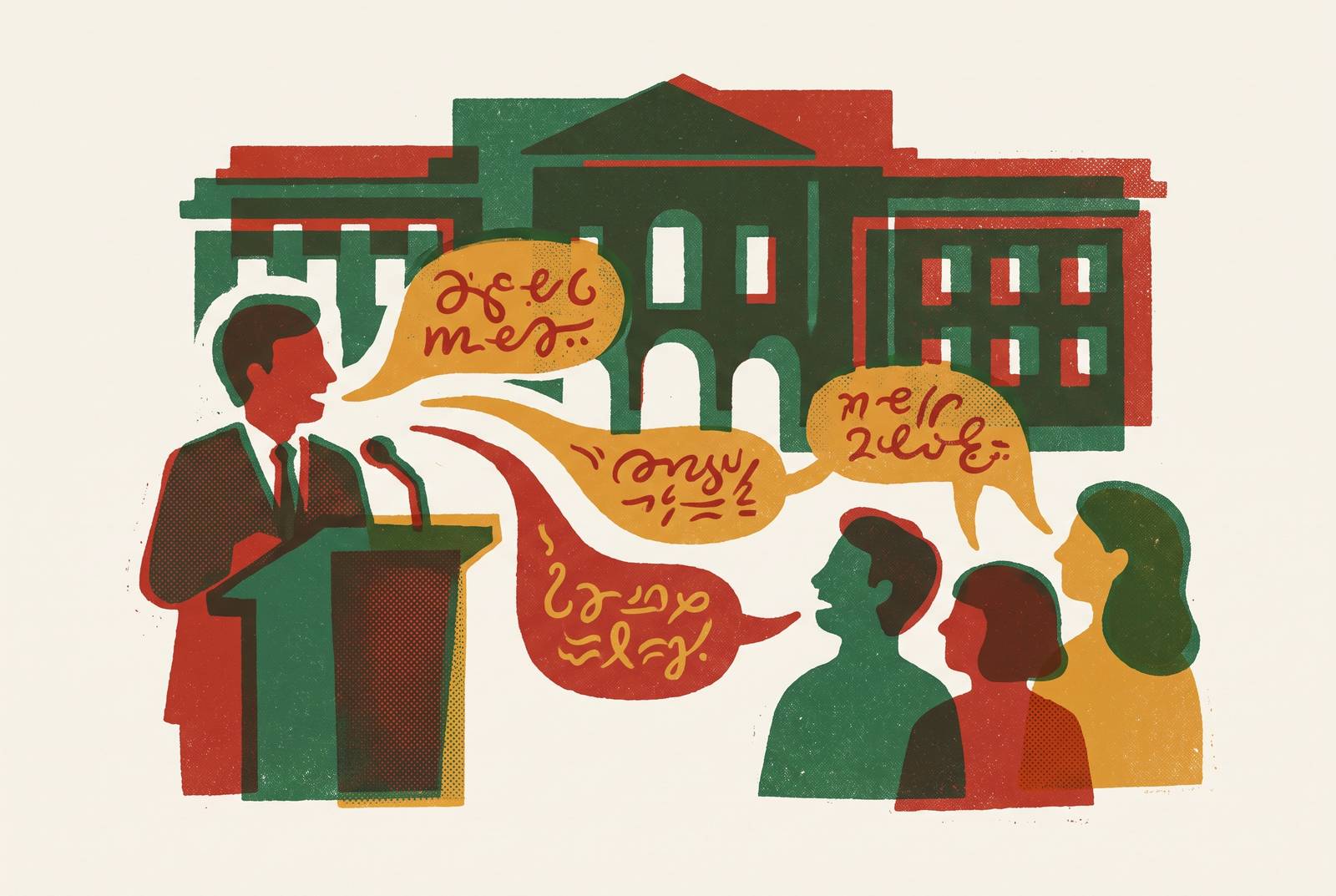
A resident who cannot follow the English spoken at a zoning hearing on their own block has no real way to object before the decision is made. A parent who cannot understand a school board discussion cannot give public comment on it, interpreter or no interpreter. That is a legal gap, not a hospitality one.
The scale of who this affects is not small. More than 67 million people in the United States speak a language other than English at home, and in New York City alone, nearly a quarter of residents qualify as limited English proficient. A city council meeting, a school board hearing, a zoning decision, held only in English, does not merely inconvenience a fraction of the public. It structurally locks out a substantial share of it, in city after city, county after county.
Why does this matter more at the public meeting than almost anywhere else in civic life? Because the public meeting is often the only venue where an ordinary resident gets to speak directly into a decision that reshapes their neighborhood: a rezoning, a school closure, a transit line, a rent increase. Taking away the ability to understand what's being proposed takes away the ability to be heard on it. Exclusion from the meeting produces exclusion from the decision, and that causal link is the stake every clause of law discussed in this piece is meant to protect.
The three-layer legal architecture that governs language access
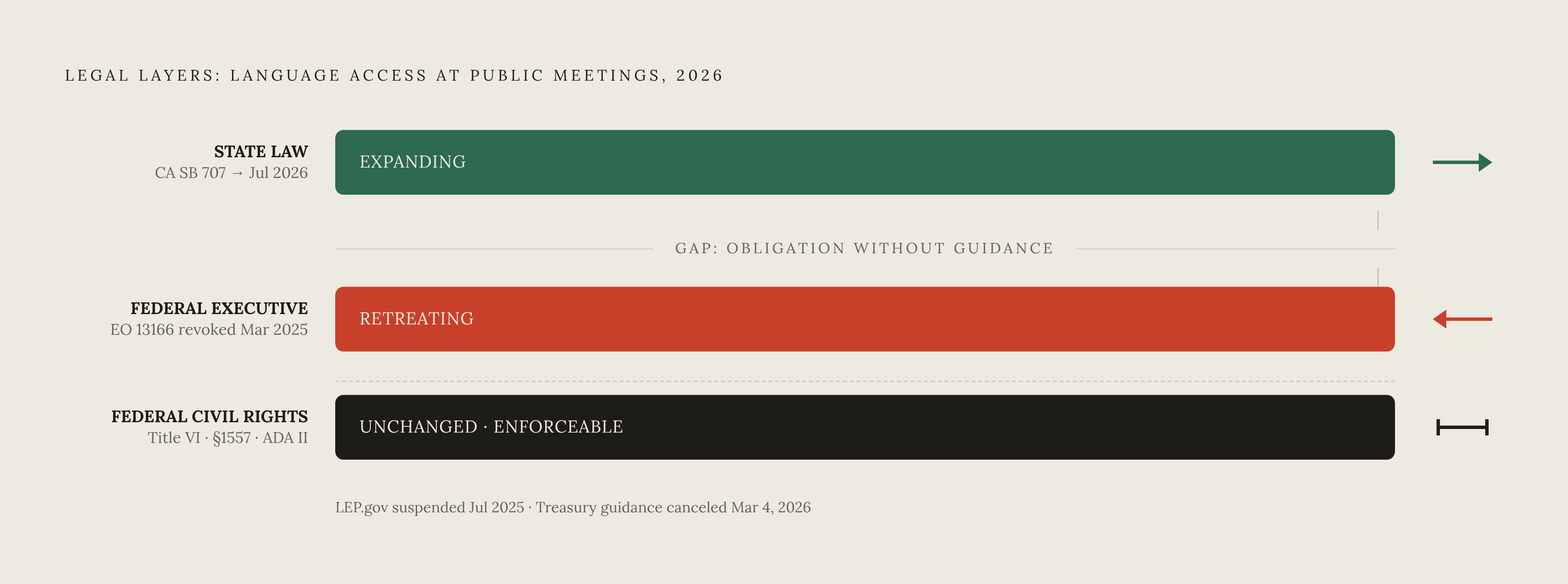
Nobody can answer "what does the law require here?" with a single sentence, because the law is not one thing. Language access obligations come from three separate, interlocking layers: federal civil rights law, federal executive policy, and state open-meetings statutes. As of 2026, all three layers are moving, and not in the same direction.
The first layer is federal civil rights law, and it has not budged. Title VI and Section 1557 still require any recipient of federal funding to ensure meaningful access for LEP individuals, exactly as they did before. What has changed sits one level down, in the guidance that agencies used to translate those statutes into daily practice. In March 2025, President Trump signed Executive Order 14224, declaring English the official language of the United States and revoking Executive Order 13166, a roughly 24-year mandate requiring federal agencies and their funding recipients to provide meaningful language access to LEP individuals. By July 2025, the government had suspended LEP.gov, which had served as the central repository for compliance manuals. Then, on March 4, 2026, the Department of the Treasury canceled its own Title VI language access guidance, a policy that had been in place since 2005. The law stayed put. The scaffolding around it did not.
A Department of Justice Final Rule issued in April 2024 requires state and local governments to make their websites and mobile applications accessible to people with disabilities, including web content that meets WCAG 2.1 Level AA standards. A DOJ Interim Final Rule published April 20, 2026, then set firm compliance deadlines: larger municipalities have until April 26, 2027, and smaller municipalities and special district governments have until April 26, 2028. Skipping those deadlines carries penalties that are not abstract. Non-compliance can trigger legal action under the ADA and the loss of federal funding.
The third layer is state open-meetings law, and it is expanding even as federal executive policy retreats. California has produced the clearest example of where this layer is headed, and its new statute reads less like a state quirk and more like a national preview. What exactly does that statute require, and why should anyone outside California pay attention to it, is worth walking through in detail?
California SB 707's requirements
California Senate Bill 707, signed into law in October 2025, marks the most significant update to the state's open-meeting laws in decades. Its core move treats accessibility as comprehension and participation. Being allowed to sit in the back of a city council chamber has never been the same thing as being able to understand what's happening at the podium, and SB 707 writes that distinction directly into law.
The law's reach is broad. It applies to virtually every California legislative body governed by the Brown Act: city councils, county boards of supervisors, school districts, community college districts, transit authorities including BART, LACMTA, and VTA, utility districts, water agencies, housing authorities, ports and airports, regional bodies such as SCAG and SANDAG, and state commissions operating under the Brown Act. Bodies serving larger populations, classified as "eligible legislative bodies," carry the strongest obligations under the statute.
Hybrid meetings with two-way audio and video remote participation become mandatory for eligible legislative bodies starting July 1, 2026. Second, real-time subtitling becomes required, starting the same date, for any portion of a meeting that is broadcast or live-streamed. Third, and perhaps most consequential, eligible legislative bodies must translate meeting agendas and participation instructions into any "applicable language" by July 1, 2026. An "applicable language" is defined with a specific threshold, a language spoken by at least 20% of the local LEP population, as measured by census data, and crossing that threshold triggers the translation requirement. Crossing it means translation stops being optional.
What happens when an agency ignores it? The consequences are not symbolic. Failing to translate an agenda is not a paperwork lapse; it is grounds to invalidate whatever the meeting decided. The law is built to treat language access as a core operational requirement, and jurisdictions elsewhere in the country will likely watch how California enforces the 20% threshold and the July 2026 deadline as a preview of where their own state legislatures may be headed.
What the federal rollback removed
The most consequential misunderstanding floating around city halls and community meetings right now is the idea that Executive Order 14224 ended language access obligations, but it didn't. The order removed the federal government's internal mandate and its compliance infrastructure for language access, but it left the underlying civil rights statutes untouched. That distinction, between the obligation and the guidance that helped agencies meet it, determines what a citizen can still enforce today.
What actually disappeared is specific. EO 13166, which required federal agencies and recipients of federal funding to develop language access plans and provide meaningful access to LEP individuals, was revoked. LEP.gov, the site that housed compliance manuals, self-assessment tools, and agency guidance documents, was suspended by July 2025. The Department of the Treasury's Title VI language access guidance, in place since 2005, was canceled on March 4, 2026. DOJ guidance that previously directed agencies toward multilingual services now redirects resources toward English-language education and assimilation.
None of that touched the statutes themselves. Title VI of the Civil Rights Act still prohibits national origin discrimination by any recipient of federal funding, and courts have long held that denying language access can itself constitute that kind of discrimination. Section 1557 of the Affordable Care Act still extends comparable protections across federally funded health programs. ADA Title II still requires accessible public meetings, on its own separate enforcement timeline. And state laws, including SB 707 in California along with open-meetings statutes elsewhere, operate independently of whatever federal executive policy happens to say in a given year.
So what's the actual practical problem this creates? Agencies that built their compliance programs around LEP.gov's checklists and technical assistance no longer have that scaffold to lean on. They remain legally obligated to provide meaningful access, but they are now doing it without the tools the federal government used to hand them. One might raise the obvious objection here: if the guidance is gone, are the statutes still enforceable in any practical sense? They are. Courts, not federal agencies, are the ones who ultimately interpret Title VI. Private plaintiffs and civil rights organizations retain the ability to bring suit, and state attorneys general keep their own enforcement authority under parallel state statutes. Removing agency guidance removes a convenience. It does not remove a courtroom.
How communities pushed back and the legislation that resulted
Law does not move only downward, from statute to citizen. It moves the other way too, and the past year offers a documented case of exactly that. The federal rollback produced an immediate legislative response, with bills introduced in both chambers of Congress that trace directly back to constituent pressure and organized community advocacy.
Judy Chu, Grace Meng, Dan Goldman, and Juan Vargas introduced the Language Access for All Act of 2026 on January 23, 2026, aimed at codifying EO 13166 into statute and protecting language access for tens of millions of LEP individuals. In July 2026, Senators Andy Kim, Mazie Hirono, and Kirsten Gillibrand introduced the Senate bill, with the House version serving as the companion, to codify language access standards for federal services. Judy Chu introduced the Language Access Board Act of 2026, designated H.R. 8604, which would create an independent Language Access Board inside the federal government and require every federal agency to give LEP communities access to public-facing resources comparable to what fluent English speakers already get.
None of these bills appeared out of nowhere. Each was introduced explicitly in response to pressure from LEP communities and the organizations that represent them, including the American Translators Association, the Asian American Advocacy Fund, Chinese for Affirmative Action, and dozens of other civil rights and health organizations that formally endorsed the Language Access for All Act. Trace the timeline and the pipeline becomes visible: a federal policy change affecting roughly 25 million people produced organizing, constituent advocacy, and formal bill introduction within months.
That raises an important question for anyone reading this as a citizen rather than a policy analyst. Understanding what current law requires is the starting material for knowing what to actually ask a representative to change, and knowing which of the three layers, federal statute, federal guidance, or state law, is the one worth pushing on.
What local governments are doing
Compliance with all of this is not theoretical. A growing number of local governments have already put real-time AI translation into their public meetings, and the ones that have report real increases in participation from residents who were previously shut out.
North Las Vegas, Nevada has run real-time AI translation at its public meetings since 2023, the first jurisdiction in the state to do so, in a city where roughly 40% of the population speaks a language other than English at home. Large TV screens display translations as they happen, and residents can scan a QR code to pull translation into virtually any language on their own phones, with audio included specifically to address literacy barriers.
San Jose, California brought in Wordly AI translation services for its city council in 2024, and Mayor Matt Mahan reported a surge in Spanish speakers participating in council meetings once the service launched. Los Angeles County took a similar path after a crisis: the Board of Supervisors used AI translation tools during press conferences through the January 2025 wildfires, then adopted the same service for its regular board meetings later that year. Kansas City, Missouri incorporated AI for real-time interpretation through its Office of Language Access, established in 2024. New Orleans began offering AI translation through Boostlingo at its regular city council meetings in December.
Sunnyvale, California adopted real-time translation across dozens of languages, including Spanish, Mandarin, Cantonese, and Hindi, with access delivered on a resident's own device. One Sunnyvale resident said it was the first time they felt they truly had a voice in city decisions. That single sentence names what all of this legal architecture, federal statute, state law, ADA deadline, is ultimately in service of. Not paperwork. A voice in the room.
Translation tools are not the only model on the table. Petaluma, California took a structural approach in 2022, forming a 36-member Fairground Advisory Panel to deliberate the future of the city's 55-acre fairgrounds, with the city providing compensation, language access, and support to make sure participation reached across the community. The city ultimately accepted the panel's recommendation to take over management of the site. Boulder, Colorado has run something similar since 2023, when the Center for Democracy Innovation at the National Civic League piloted a Community and Council Forum, a first-of-its-kind deliberative session folded directly into official council meetings, built on inclusive digital language tools and a rebuilt approach to neighborhood governance.
These examples, lined up, form a pattern. Some cities reached for technology first: real-time subtitles, QR codes, AI interpretation piped straight to a resident's phone. Others reached for structure first: paid advisory panels, redesigned forums, deliberate seats at the table for voices that used to sit outside it. Both paths lead toward the same legal floor described earlier, the one built from Title VI, Section 1557, ADA Title II, and now SB 707. The floor is the law. What each city builds on top of it shapes whether a meeting technically complies or a resident who speaks Mandarin or Spanish or Hindi actually gets to stand up and be understood.
Sources
- SB 707 Compliance Guide for California Public Agencies
- Reps. Chu, Meng, Goldman, and Vargas Introduce Bill to Protect Multilingual Services in the Federal Government
- Senate bill would codify language accessibility standards targeted by Trump
- Bill Proposed in US Congress to Create Federal Language Access Board - Slator
- New Federal Language Access Bill Proposed in US House of Representatives - Slator
- Gillibrand, Colleagues Introduce Legislation To Permanently Make Federal Services Language Accessible - Kirsten Gillibrand
- Executive Order 13166
- Senators Kim and Hirono Introduce Legislation to Permanently Make Federal Services Language Accessible - Senator Andy Kim