Algorithmic Bias in Predictive Policing and Its Legislative Responses
Historical arrest data bakes decades of biased enforcement into supposedly objective algorithms.
Predictive policing runs on a simple pitch: feed a computer years of crime data, and it'll tell officers where trouble is most likely to happen next. But the data these systems learn from came out of decades of uneven enforcement. That means the "objective" output is often just a mirror of old policing patterns wearing a new coat of math. That feedback loop, not any single bad actor or bad line of code, is why legislative responses now range from disclosure rules to outright bans on certain uses.
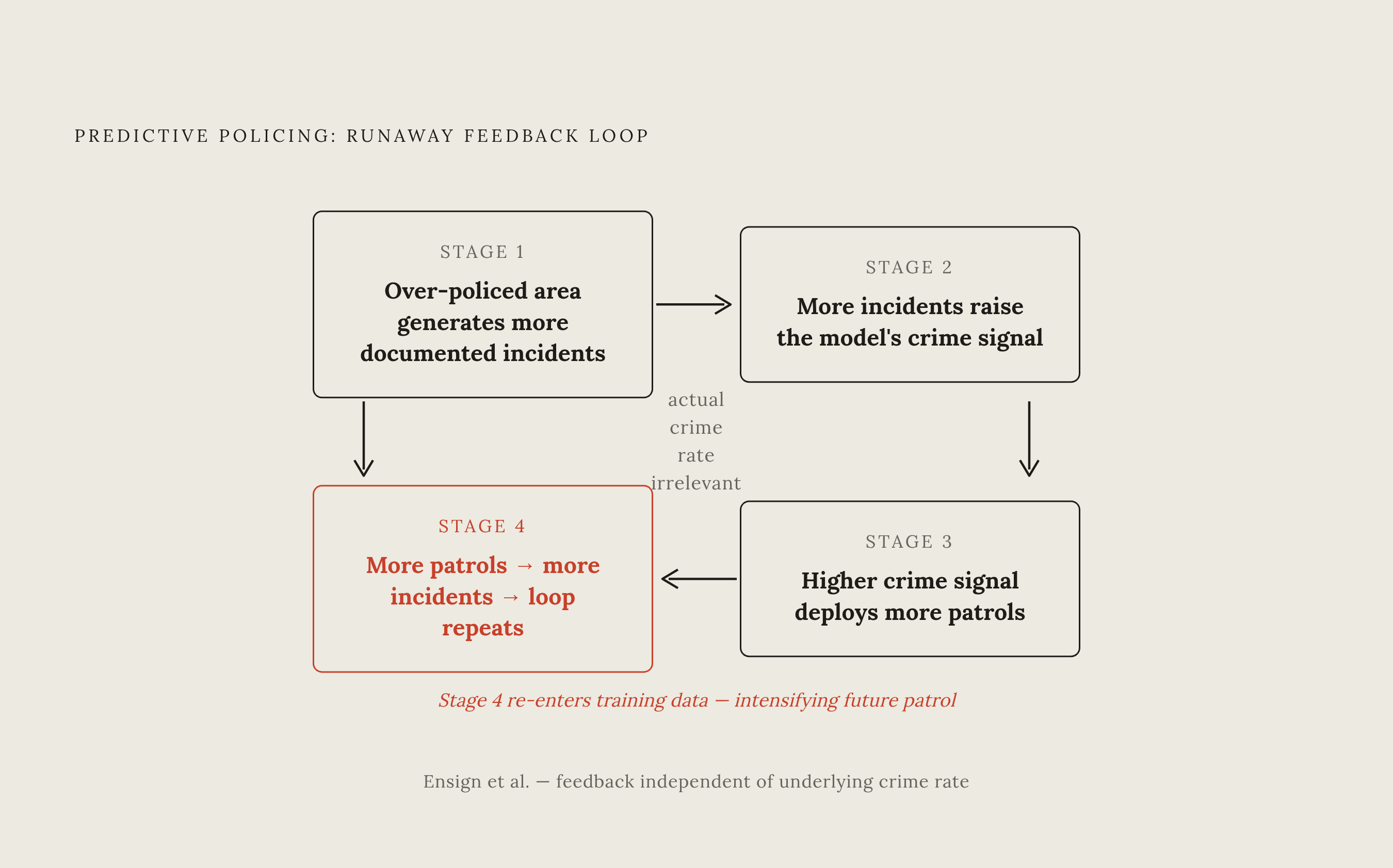
Two flavors of the technology exist. Place-based systems flag hot spots: specific blocks or intersections where crime is statistically likely at certain hours. Person-based systems go further, scoring individuals by risk using inputs like prior arrests or even victimization history. Both draw from the same well, historical crime records, stop data, arrest logs, all run through a machine learning model that spits out either a map or a score. Departments deploy patrols based on that output. Those patrols generate new arrests and stops, and that new data gets fed right back into the model. The loop closes on itself.
LAPD and NYPD were among the first big departments to adopt these tools, and the practice has since spread across several states and major cities. NYPD's Patternizr digs through a decade of crime complaints, matching method, location, and timing to link cases together, which gives a sense of just how much historical data these systems chew through. 360iResearch estimates the market grew substantially in 2025, projects continued growth in 2026, and forecasts it will more than double by 2032, a compound annual growth rate of 12.64%. This is not a technology in retreat. Departments like it because it promises efficiency: smarter deployment, faster response, a sheen of objectivity that individual officer judgment supposedly lacks. Whether that promise holds up is the real question, and the record so far says mostly no.
Why historically biased data produces structurally biased predictions
The AI Now Institute coined a useful term for this back in 2019: "dirty data," meaning data "derived from or influenced by corrupt, biased, and unlawful practices," including discriminatory enforcement. Even when race or age are stripped out as variables, the data is still shaped by decades of decisions about who got stopped and where. Removing a column in a spreadsheet doesn't undo the pattern baked into every other column. You can build a model that never looks at race and still get a race-correlated output, because the arrest counts it learns from were never race-neutral to begin with, something most defenses of these tools skip past.
Walk through the mechanism. A neighborhood gets over-policed, so it generates more documented incidents. More documented incidents look like a higher crime signal to the model. A higher crime signal triggers more patrol deployment, and more patrol deployment produces more documented incidents. Round and round, regardless of whether the underlying crime rate in that neighborhood is actually higher than anywhere else. Researchers Ensign and colleagues formalized this as a "runaway feedback loop": increased patrol leads to more detected incidents, which re-enters the training data, which intensifies future patrol, independent of the crime rate actually occurring on the ground.
Recent research backs this up in specific, measurable ways. A Springer study (S4) looking at the Chicago Crime Dataset found that conventional predictive models disproportionately flag minority and historically over-policed neighborhoods as high-risk, and the risk estimates were driven mainly by variables tied to enforcement intensity, not by actual crime incidence. A separate GAN-based simulation out of the University of Maryland and Jagannath University (2025), running 264 simulation trials across more than 145,000 Part 1 crime records from Baltimore (2017-2019) and over 233,000 from Chicago (2022), found a Pearson correlation of 0.83 between the percentage of White residents in a neighborhood and the likelihood of detection, and -0.81 for the percentage of Black residents. That's about as clean a confirmation as quantitative research gets: the patrol-detection pipeline encodes neighborhood racial makeup as a structural predictor, whether anyone designed it to or not.
Opacity makes the whole thing worse. Many city governments have offered no public description of what data went into their models or how outcomes got evaluated. The NAACP has raised concerns about proprietary, black-box algorithms limiting public scrutiny of policing and resource decisions. A better filter can't clean this up on its own, no matter how well it's tuned. The bias is in the structure of decades of enforcement records, not in a variable you can drop from the model, and that's why departments claiming "objective" systems keep producing the same old outcomes.
What the evidence shows: disparate impact in practice
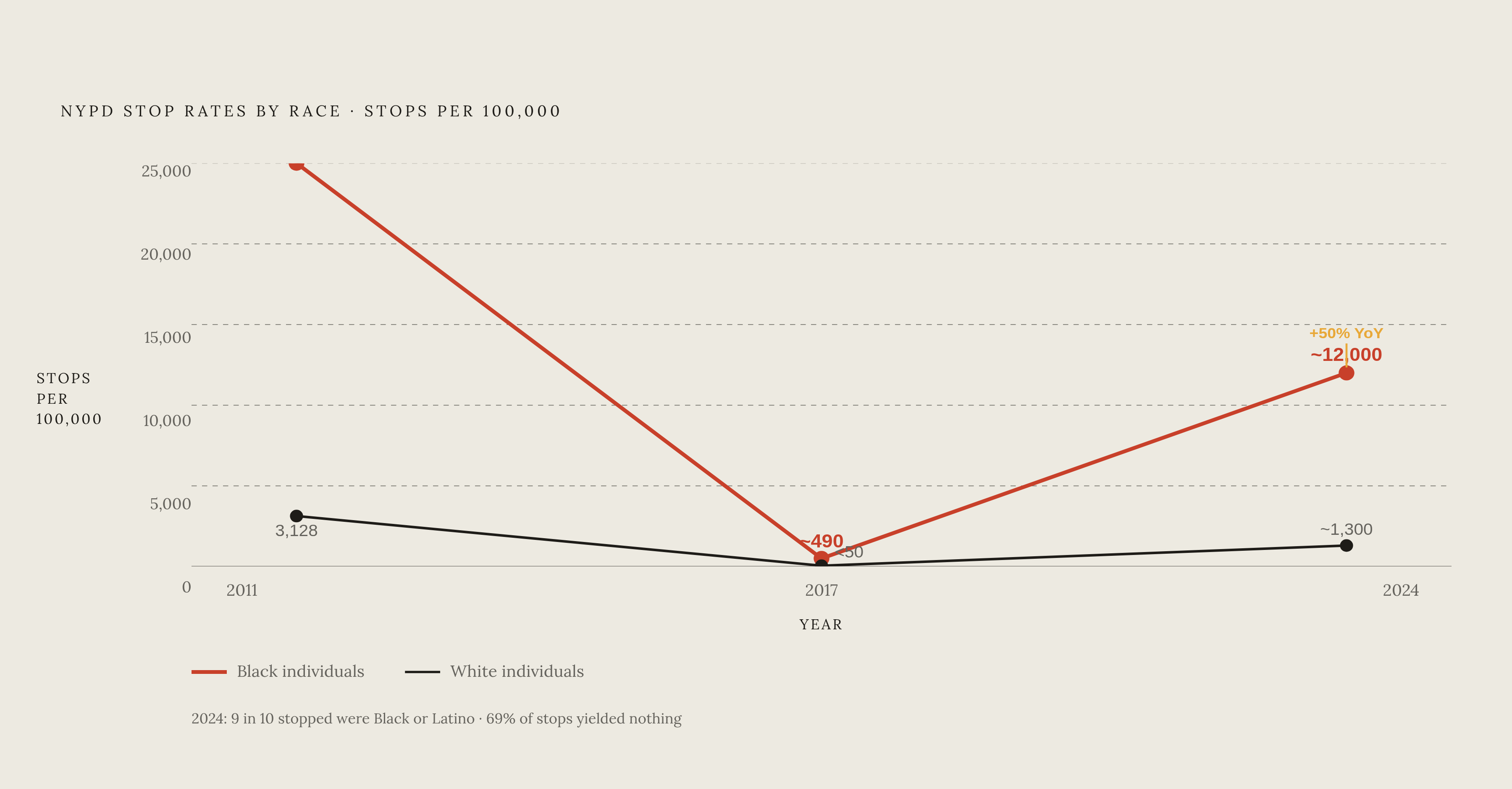
NYPD's stop-and-frisk data offers the longest running real-world record of what happens when predictive policing meets a major department. In 2011, stops peaked at nearly 25,000 per 100,000 Black individuals, compared to 3,128 per 100,000 white individuals. After computer-assisted tools came online, stops dropped sharply, falling to under 500 per 100,000 Black people and under 50 per 100,000 white people by 2017.
Then came 2024. The New York Civil Liberties Union (2025) reports the highest stop count since 2014, a 50% jump over the year before, with 9 of every 10 people stopped being Black or Latino. And the yield on those stops was thin. Only 11.72% of the more than 685,000 stops in 2011 led to an arrest or summons. In 2024, 69% of stops resulted in nothing at all, no arrest, no summons, and only 6% of that year's arrests involved a white person. Of the ten precincts with the highest stop rates, nine sat in predominantly Black and Brown neighborhoods, over 80% residents of color, and six were over 90%.
Research looking across multiple jurisdictions has found that predictive policing systems tended to amplify existing discriminatory enforcement patterns rather than correct them. This isn't only a big-city problem, either. In one municipality, an investigative outlet dug into a predictive policing tool and found its crime predictions carried an accuracy rate under 0.5%. The tool barely worked at predicting crime, on top of being unequal in who it flagged.
The GAN simulation put numbers to just how extreme this gets. Baltimore's detected mode showed a mean annual Disparate Impact Ratio as high as 15,714 in 2019. Chicago showed under-detection of Black residents, with a Disparate Impact Ratio of 0.22. Gini coefficients ranged from 0.43 to 0.62 across every condition tested, holding steady no matter how the simulation was tweaked.
Overseas, Amnesty International's 120-page report on UK police forces describes automated predictive systems as "supercharging racism." Statewatch reports that the UK's AI re-offending risk tool profiles more than 1,300 people daily, with serious concerns that racism and data inaccuracies keep shaping imprisonment and parole decisions. In 2020, more than 1,500 mathematicians signed a letter urging their colleagues to stop building predictive policing tools. That's a discipline turning on its own output.
Where the proponents' case stands up or doesn't
Supporters of the technology don't argue from thin air. McKinsey Global Institute research suggests that integrating AI into law enforcement could lower urban crime rates by 30 to 40 percent and cut emergency response times by up to a third, figures that departments cite often when defending these tools. And there are cases where algorithm-based analysis clearly does good. Marinus Analytics, a Carnegie Mellon spinout, applies AI and graph analytics to find missing persons pulled into sex trafficking networks. That's the same underlying toolkit, aimed at a genuinely different problem.
The distinction between place-based and person-based tools is where the argument actually has to be settled, though, and it's where the proponent case starts to narrow fast. Evidence for crime reduction is strongest for place-based systems tied to specific categories of crime. Person-based risk scoring is where the bias evidence gets damning, and where constitutional worries around Equal Protection and the Fourth Amendment sharpen considerably. Anyone defending predictive policing broadly, without drawing that line, is defending a category that doesn't hold together.
Even technical fixes have limits. CTGAN-based debiasing approaches, tested in the GAN simulation research (S3), can partially redistribute detection rates, but they can't erase structural disparity without policy changes running alongside them. Meanwhile, the Springer paper (S4) found that bias-controlled models do produce meaningfully different hotspot predictions and reduce measures of disparate impact. That confirms two things at once: current models really are biased, and mitigation really is possible, but only with transparency, fairness-aware modeling, and ongoing auditing layered on top. The proponent case survives, but only for a narrower set of uses than most departments are actually running. Legislation has had to draw lines between types of use instead of issuing a blanket yes or no.
Constitutional pressure points that shaped the legislative conversation
Several constitutional threads run through this debate, and none of them have been fully resolved by a court yet. The Fourteenth Amendment's Equal Protection Clause is the most obvious one: if a predictive system disproportionately targets communities because of historically skewed data, that starts to look like discriminatory state action.
The Fourth Amendment raises a related but distinct concern. Person-based systems that flag someone for extra surveillance before any crime has occurred touch directly on questions of reasonable search and seizure, especially when a risk score factors into a stop or a detention decision. And there's a further due process problem: when a vendor's algorithm is protected as a trade secret, a defendant has no real way to challenge how their risk score got generated. The outcome might look neutral on paper, while the process behind it stays entirely closed off to scrutiny.
The NAACP has framed this directly, and a letter from a group of senators to the Department of Justice cited "mounting evidence that predictive policing technologies do not reduce crime... instead, they worsen the unequal treatment of Americans of color." That's language pitched at a civil rights violation. Yet no landmark court ruling has settled any of this specifically for predictive policing algorithms, despite a constitutional fight this loud. That gap, real constitutional concern with no judicial resolution in sight, is what pushed the fight toward city councils, state legislatures, and eventually federal lawmakers instead.
City and state-level responses: transparency mandates, bans, and surveillance ordinances
Local surveillance ordinances were the first wave of pushback. Activists in cities including Seattle, Berkeley, Nashville, and Cambridge pushed through laws requiring oversight of how surveillance technology gets bought and used, though the scope, process, and enforcement teeth differ quite a bit from city to city. Some ordinances sit at the transparency end, simply requiring public documentation of what's in use and what data feeds it. Others go further and ban person-based predictive tools.
New York City's Public Oversight of Surveillance Technology Act, the POST Act, is a good case study in what transparency-only rules can and can't do. It required the NYPD to publish impact assessments of its surveillance tools. Reviews of how the Act played out show disclosure can surface real information, but also how little that disclosure accomplishes when there's no enforcement mechanism attached to it. Transparency without teeth just produces a longer paper trail.
State legislatures have moved fast, and the pace keeps climbing. Lawmakers across the country have introduced a rapidly growing number of AI-related bills, with a significant share signed into law in 2025 alone. Colorado's AI Act, SB 24-205, was signed in May 2024 and was supposed to take effect June 30, 2026 after a special-session delay in 2025. It got replaced entirely by SB 26-189, signed May 14, 2026, which pushed the effective date to January 1, 2027. The law regulates "high-risk" AI used in consequential decisions tied to government and legal services, and it's the most far-reaching state AI statute currently in force, though the 2026 replacement notably scaled back broader algorithmic discrimination protections that had existed in the original 2024 version.
At the federal level, Senator Wyden introduced the Algorithmic Accountability Act of 2025 (S.2164), with co-sponsors including Senators Warren, Booker, Heinrich, Luján, Merkley, Hirono, and Schatz. It would direct the FTC to require impact assessments of automated decision systems. It's currently sitting in the Committee on Commerce, Science, and Transportation, with no floor vote scheduled. Federal AI legislation has faced significant obstacles reaching a floor vote in the 119th Congress, despite numerous bills being introduced, a stall widely attributed to gridlock, tech industry lobbying, and disputes over whether federal law should preempt state law.
One moment stands out as close to bipartisan consensus: a 99-1 Senate vote on July 1, 2025, stripped an AI preemption provision out of the One Big Beautiful Bill Act, which effectively let state-level AI law keep developing without a federal override hanging over it. But the executive branch has pushed the opposite direction. Executive Order 14179, signed January 23, 2025, directed federal agencies to remove barriers to AI innovation and undo policies tied to the prior administration's AI executive order, prioritizing speed over caution. Executive Order 14365, signed December 11, 2025, went further, directing the Department of Justice to stand up an AI Litigation Task Force aimed at challenging state AI laws directly. So state legislatures are sprinting ahead, and the federal government is actively working to slow them down.
What international legislative frameworks resolved, or didn't
The EU AI Act is the most direct legislative swing at this problem anywhere in the world. Its prohibitions became applicable in February 2025, after the Act entered into force in August 2024, and Article 5 bans marketing or using AI systems to predict the likelihood that someone will commit a crime. That's a real, enforceable ban on a category of person-based predictive policing.
But the exception built into that ban does a lot of quiet work. It only permits AI that supports a human assessment already grounded in objective, verifiable facts directly tied to criminal activity, with no carve-out for specific serious crimes. That sounds narrow in a good way, until you notice how much depends on how "supporting a human assessment" gets interpreted in practice. A 2026 academic critique published in ScienceDirect argues the Act doesn't establish enough safeguards, oversight, or enforceable remedies tailored to the specific risks of predictive justice tools, and warns the ban might end up legitimizing practices that don't actually square with fairness or fundamental rights. A floor got built here. Whether it's high enough is a separate question, and one that particular jurisdiction hasn't answered yet.
Canada has taken a lighter-touch, process-first route. The Treasury Board's Directive on Automated Decision-Making already requires algorithmic impact assessments for federal agencies, and the Canadian Human Rights Commission has called for mandatory regulation to go further. The Law Commission of Ontario is expected to publish final recommendations on law enforcement AI use sometime in 2026.
The UK, meanwhile, is still at the talking stage. The Home Office formally opened a consultation on police use of facial recognition in December 2025, following policing minister Sarah Jones's announcement two months earlier and a July 2025 commitment from then-Home Secretary Yvette Cooper, made before a House of Lords committee, to build "a proper, clear governance framework." That's a real shift in posture from prior UK policy, but a consultation isn't a law on the books.
Across every jurisdiction examined, a pattern holds. Transparency and impact assessment rules appear first in these laws and tend to stick around. Outright bans arrive later, loaded with exceptions, and enforcement mechanisms lag behind the language of the laws almost everywhere. No jurisdiction, not the EU, not Canada, not the UK, not any individual state, has solved the feedback loop at its source. Banning a tool doesn't cleanse the historical enforcement data waiting to train whatever replaces it, and an impact assessment doesn't automatically force a fix once it turns up a problem.
What effective oversight of these systems requires
Three things separate a law that changes outcomes from one that just generates paperwork, and most current legislation only manages the first.
Data accountability comes first: auditing, and where needed correcting, the historical enforcement data used to train these models. The Springer research (S4) already showed bias-controlled models produce meaningfully different predictions. This kind of correction is technically achievable. It has to happen at the data layer, not downstream of it.
Algorithmic transparency is the second piece: public disclosure of what systems are running, what data feeds them, and how their outputs get evaluated over time. The proprietary vendor wall that groups like the NAACP have flagged is a policy choice, not a technical necessity, and legislatures can override it with disclosure requirements, the same way New York's POST Act tried to, just with sharper enforcement behind it this time.
Third, none of this works without ongoing, independent auditing paired with real consequences when a system's outputs skew the way NYPD's stop data or the Baltimore and Chicago simulations did. A law that requires an impact assessment but doesn't require anyone to act on what that assessment finds is documentation, nothing more. The gap between those two things, a finding and an actual response to it, is where most of the current legislative landscape, city ordinances, state statutes, the EU Act itself, still sits.
Sources
- Algorithmic Bias and the Erosion of Procedural Fairness in Predictive Policing
- Unmasking Algorithmic Bias in Predictive Policing: A GAN-Based Simulation Framework with Multi-City Temporal Analysis
- Rebalancing the algorithm: pathways for mitigating bias in predictive policing | Service Oriented Computing and Applications | Springer Nature Link
- Artificial Intelligence in Predictive Policing Issue Brief
- cigionline.org
- sciencedirect.com