Constituent Engagement Practices of High-Performing City Councils
Most city councils treat constituent input as a queue, not a system.

High-performing city councils share one trait that separates them from the rest: they treat constituent input as a system, not a queue. A resident's concern doesn't just get received. It gets tracked, assigned, worked, and closed, with a visible answer at the end. That's the whole game, and most councils still don't play it.
The gap isn't about motivation. Nobody's slacking off. It's structural. Councils running on email inboxes, spreadsheets, and phone logs lose visibility the moment a request crosses department lines. CivicTrack's 2026 guide names the usual failure points: requests that vanish, no clear owner, departments duplicating the same work without knowing it, and reporting that tells leadership almost nothing. All four are symptoms of one thing missing: an actual system.
That absence produces a specific kind of bias. Reactive councils end up responding to whatever's loudest that week, not what actually matters most to the community. The tools they use decide their priorities for them, whether anyone intends that or not.
And the volume keeps climbing. Granicus's 2026 Trends in Civic Engagement report, drawn from a survey of over 125 public sector practitioners and 287 government organizations, found agencies published 2,478 engagement projects in 2025, up from 2,069 in 2023. Staff capacity hasn't kept pace. A large majority of practitioners in that same survey cite limited resources as a major challenge, and 66% say engagement makes up 5% or less of their city or county budget. That constraint is exactly the reason a system needs to be built. It's the reason one is necessary.
What a closed-loop engagement system looks like in practice
When the jargon is stripped away, "closed-loop" means something simple: a resident's input goes in, gets routed to a specific person, moves through a process anyone can check on, and comes back around with a visible answer, either confirming the input got used or explaining why it didn't. That return trip is the part almost every fragmented system skips.
Four pieces make this work.
Centralized intake pulls every request into one place, no matter which door it came through, phone, email, web form, in-person. Automated routing sends each request to the right staff member or department without someone manually forwarding an email and hoping it lands. Status visibility gives both frontline staff and leadership a real-time read on what's open, what's in progress, and what's resolved. Constituent history logs every interaction a resident has ever had with the city, so follow-up carries context instead of starting from zero each time.
The 311 model handles a lot of this for physical service requests: potholes, missed trash pickup, a downed tree limb. But 311 leaves a gap. Constituent casework, policy questions, and the kind of concern that doesn't fit a service code often live outside that system. Municipal CRM platforms exist specifically to close that gap.
High-performing council members don't just wait for complaints to land, either. They show up at neighborhood association meetings, business group gatherings, community org events, and gather input there too. A real system captures that relationship-based input the same way it captures a walk-in complaint, instead of treating it as separate and informal.
The "closing the loop" half of this is becoming non-negotiable. Resident expectations around follow-through have been rising, with a growing emphasis on seeing how feedback actually shaped an outcome. Keeping plans "off the shelf" after adoption, instead of letting them gather dust, is now treated as its own discipline. Granicus's 2026 data backs this up in one sense and complicates it in another: 70% of agencies report back to their communities to maintain trust. That's real progress. It also means close to 30% still don't close the loop.
How intake design determines whether constituent input reaches the right decision-maker
Intake design sounds like a back-office detail. Intake design sounds like a back-office detail, but it decides whose voice actually gets heard. It decides whose voice actually gets heard.
Residents who write emails, pick up the phone, or walk into city hall are self-selecting. They tend to be older, more comfortable with bureaucracy, and more likely to have engaged before. Multi-channel intake, built with intention, widens that field considerably.
Standardizing intake means every channel captures the same basic fields: issue type, location, resident identity (optional), urgency. Skip this step and routing becomes guesswork, and reporting becomes close to meaningless, because there's no consistent data to report on.
Format changes who shows up. When one civic platform updated its event feature, 54% of attendees turned out to be people who'd never contributed to their city's consultation process before. Changing the front door changed who walked through it. The City of Welland's 2026 Municipal Budget engagement leaned on allocation exercises, mapping tools, and visual surveys rather than dense text forms, and it drew a different kind of participant.
Accessibility belongs in this conversation too. A city government added real-time meeting translation, a joint effort between its equity, access, and inclusion manager and the city clerk's office, built specifically to remove a barrier for non-native English speakers. That's an equity decision as much as a technical one.
Plain-language tools and AI-assisted drafting push the barrier down further. When a resident can describe a concern in their own words and have that turned into structured, actionable language, the distance between "I have an idea" and "an elected official actually sees it" shrinks a lot. That's the underlying logic behind platforms that convert citizen ideas into formally structured proposals and route them straight to elected officials. Skipping standardized intake means a council ends up with feedback it can acknowledge but never systematically act on.
Routing and ownership: the step where most councils lose accountability
Every request needs a name attached to it and a clock running. Without both, "we received your concern" is the end of a process, not the start of one. It's the end of one.
Manual forwarding can't do what automated case assignment does. Automated routing applies the same rule every time, stamps a timestamp on the request, and leaves an audit trail leadership can actually review later. Granicus's data shows 59.6% of practitioners cite competing internal priorities as a major challenge. In an environment where staff are stretched thin across a dozen initiatives, automated routing keeps a request from sitting in someone's inbox waiting for a slow week that never comes.
Department silos work against routing by nature. A sidewalk complaint that touches both public works and transportation planning needs an escalation rule, not just an assignment rule, or it'll bounce between departments until someone gives up on it.
NYC Mayor Mamdani's creation of a new Office of Mass Engagement is a useful data point here. It exists specifically because civic engagement efforts across the city had been siloed and duplicated for years. That's being treated, at the mayoral level, as a failure of organizational design.
The strongest practice on record: define service standards, expected response time and resolution time, at the category level. Ownership without a clock attached isn't really ownership. And reporting on routing performance, response times, department-level bottlenecks, how often things get escalated, gives leadership the data to step in before a quiet backlog turns into a public failure.
How neighbor co-signatures and verified community backing separate serious proposals from noise
Public comment periods and online petitions share a weakness that's easy to miss: both aggregate sentiment without establishing who's actually behind it. A petition with thousands of signatures can't tell a council whether those signers live in the district, are affected by the issue, or are bots.
Verified neighbor co-signatures change that signal. A proposal backed by verified local residents carries a different kind of weight than a raw comment count. It tells a council: this is organized, this is local, and these are the people it actually affects.
Organized Neighborhoods of Palm Springs (ONE-PS) shows what this looks like structurally. Established by the Palm Springs City Council in 2005 and written into the municipal code, it now includes 52 member neighborhood organizations as of 2026. Formalizing neighborhood structure gives resident input institutional standing instead of leaving it as informal noise.
Sustainable Cincinnati's "People Over Pavement" campaign makes the organizing logic concrete. Engagement specialists put in close to 495 combined hours and knocked nearly 8,000 doors. What came out the other end wasn't a petition. It was clearly prioritized resident transportation preferences, carrying the weight of demonstrated consensus rather than a stack of signatures.
Format matters as much as volume here. A structured proposal backed by verified local co-signatures is something a council can act on. An unstructured pile of comments usually isn't, no matter how large it is. Platforms combining AI-drafted legislation with verified neighbor co-signatures and direct routing to elected officials are built around exactly this principle: turning what used to be grassroots noise into something closer to credible legislative input. Research on civic participation consistently finds that trust reduces perceived barriers to participation and lends legitimacy to government initiatives. Verified community backing builds that trust from both directions at once.
Where AI fits into engagement workflows
AI adoption inside government agencies moved fast. Granicus's 2026 report shows the share experimenting with AI jumped from 35% in 2024 to 71% using it in 2025. Governance didn't keep pace with that shift.
The gap appears clearly in the numbers. Only 44% of agencies have AI policies in place, and nearly 29% aren't even sure whether a policy exists. IDC's 2025 research adds a sharper edge to that: 56% of employees use AI tools their organization never approved, while only 23% use AI tools the organization actually governs.
Where AI is genuinely earning its place, the examples are specific and bounded. Swindon Borough Council used AI translation and cut translation costs by 99.6%, with an estimated £680,000 in annual savings projected by 2026/27. That's a clear, auditable use case with a defined edge. North Somerset Council used AI to help draft Education, Health and Care Plans, cutting drafting time from two to three weeks down to around 20 minutes, with human review still built into the process. St Helens Borough Council uses Microsoft Copilot Studio to match residents with care technology and auto-draft personalized care plans, again with a human checking the output before it goes anywhere.
The common thread: speed gain, accountability retained. Most agencies using AI right now are pointing it at feedback synthesis, taking large volumes of messy, unstructured resident input and turning it into summarized themes. That task suits AI well and frees staff for the judgment and relationship work that has to happen after. A second, related use is drafting: AI turning a resident's plain-language concern into a formally structured proposal, cutting down the expertise barrier that's historically locked out anyone without a law degree or a lobbyist on retainer.
There's a clear line on the other side, though. AI shouldn't operate unsupervised on final decisions, on constituent-facing messages sent without disclosure, or in any interaction where a resident has no way of knowing they're talking to a machine. Emerging state-level AI legislation is beginning to set disclosure and governance requirements for government use of AI in constituent interactions. High-performing councils treat AI as an infrastructure decision that comes with governance attached.
Participatory budgeting and plan transparency as engagement that produces visible results
Budget engagement got more deliberate across North America through 2025. Social Pinpoint's year-in-review describes a shift away from showing residents a finished budget and asking for reactions, toward education-first engagement that helps residents understand trade-offs before they're asked to weigh in.
Welland's 2026 Municipal Budget engagement used allocation exercises, mapping activities, and visual surveys to make a technically dense process feel approachable. The underlying idea: residents engage with more depth and seriousness when they're given tools to explore actual constraints.
The same momentum showed up across Australia and New Zealand in 2025, driven by similar pressure: demonstrating transparency, fairness, and accountability in how money gets allocated, especially where funding decisions bump up against questions of equity and access.
Plan transparency is really the "off the shelf" problem in a different outfit. The Town of Carrboro's Downtown Area Plan and the Town of Innisfail's Napoleon Lake South Development project both illustrate the fix: dedicated digital project pages updated over time, instead of a static PDF that gets adopted and forgotten.
The payoff appears in Granicus's 2026 numbers. 77% of agencies believe their engagement efforts led to more successful implementation of projects, a notable jump from the year before. And 52% agree engagement activities are building public trust. 77% of agencies believe their engagement efforts led to more successful implementation of projects, a notable jump from the year before, and 52% agree engagement activities are building public trust, which is a real majority. It also means close to half of agencies aren't yet convinced their own engagement work is building the relationship it's meant to.
What high-performing councils do at the neighborhood level that others don't
Neighborhood-level government is where residents feel city hall most directly, in the pothole outside their door or the crosswalk they cross every morning. It's also, often, where formal engagement structures are thinnest or missing.
Organized Neighborhoods of Palm Springs is one working model: 52 formally recognized neighborhood organizations, written into the municipal code, established by the city council itself. That structure gives neighborhood-level input official standing instead of treating it as background chatter.
NYC's Public Engagement Unit, now under the Mayor's Office of Mass Engagement and Commissioner Tascha Van Auken, gets held up as a blueprint for a specific reason: it goes to residents instead of waiting for them to find the system on their own.
Sustainable Cincinnati's door-knocking campaign shows what that looks like on the ground, nearly 8,000 doors, and it produced something concrete: a raised crosswalk on Storrs Avenue in Lower Price Hill. That project started with resident advocacy back in 2021 and ended in actual construction, built by neighbors who kept showing up and stayed in relationship with city officials over years.
A related shift gaining traction: department-level engagement hubs, replacing a single citywide portal with entry points organized around the specific programs residents already interact with. Meet people where their actual stake is, instead of routing everyone through one generic front door.
The trust research lines up with this too: educational programs run by local governments strengthen participation by teaching residents how government actually functions in practice. Closing that knowledge gap is part of the job at the neighborhood level. High-performing councils don't treat neighborhood engagement as a communications task. They treat it as an early-warning system, ground-level signal that tells them where things are breaking down before a complaint ever reaches an official channel.
Measuring whether engagement is working: what the data makes visible
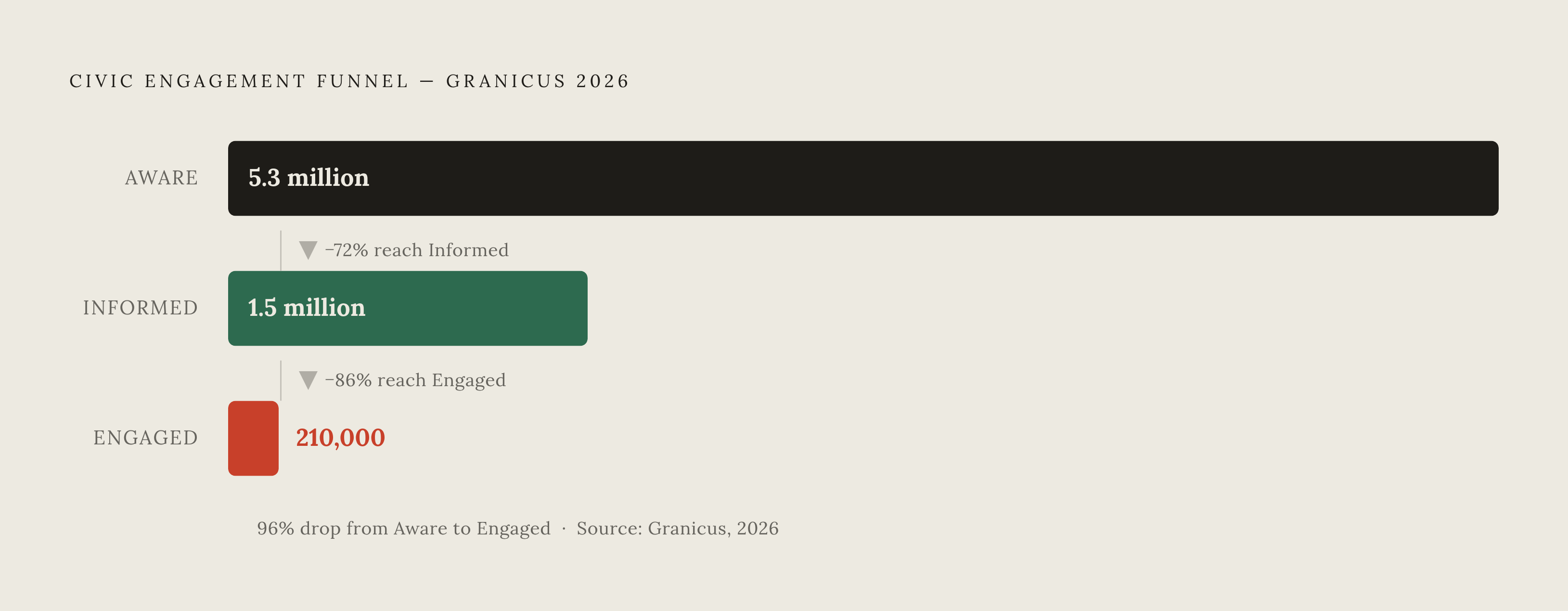
Granicus's 2026 numbers show that in 2025, over 5.3 million users were "Aware," 1.5 million were "Informed," and 210,000 were fully "Engaged." Those categories aren't just labels for a dashboard. They're a diagnostic. The drop-off between Aware and Engaged shows exactly where a system is losing people, and by how much.
That same report shows over 71% of agencies now use engagement data to identify community needs and shape policy decisions. That's the signal engagement has moved from a compliance checkbox to an actual strategic input.
Structured request management makes visible a set of things a fragmented system never surfaces at all: request volume broken down by type, department, and geography; response and resolution times measured against stated service standards; recurring issue patterns that point to something systemic rather than a one-off complaint; and constituent history detailed enough to spot underserved populations who quietly stop engaging after one bad experience.
That last point deserves a second look. A resident who reaches out once, gets no clear answer, and never tries again does not appear as a complaint in any system. They appear as silence. Fragmented systems can't tell the difference between a resident who's satisfied and one who's given up. A closed-loop system can, and that distinction is where the real measure of whether engagement is working actually lives.