Community Benefits Agreements and How Residents Negotiate Them
Residents can extract concrete concessions from developers by negotiating before approvals lock in.
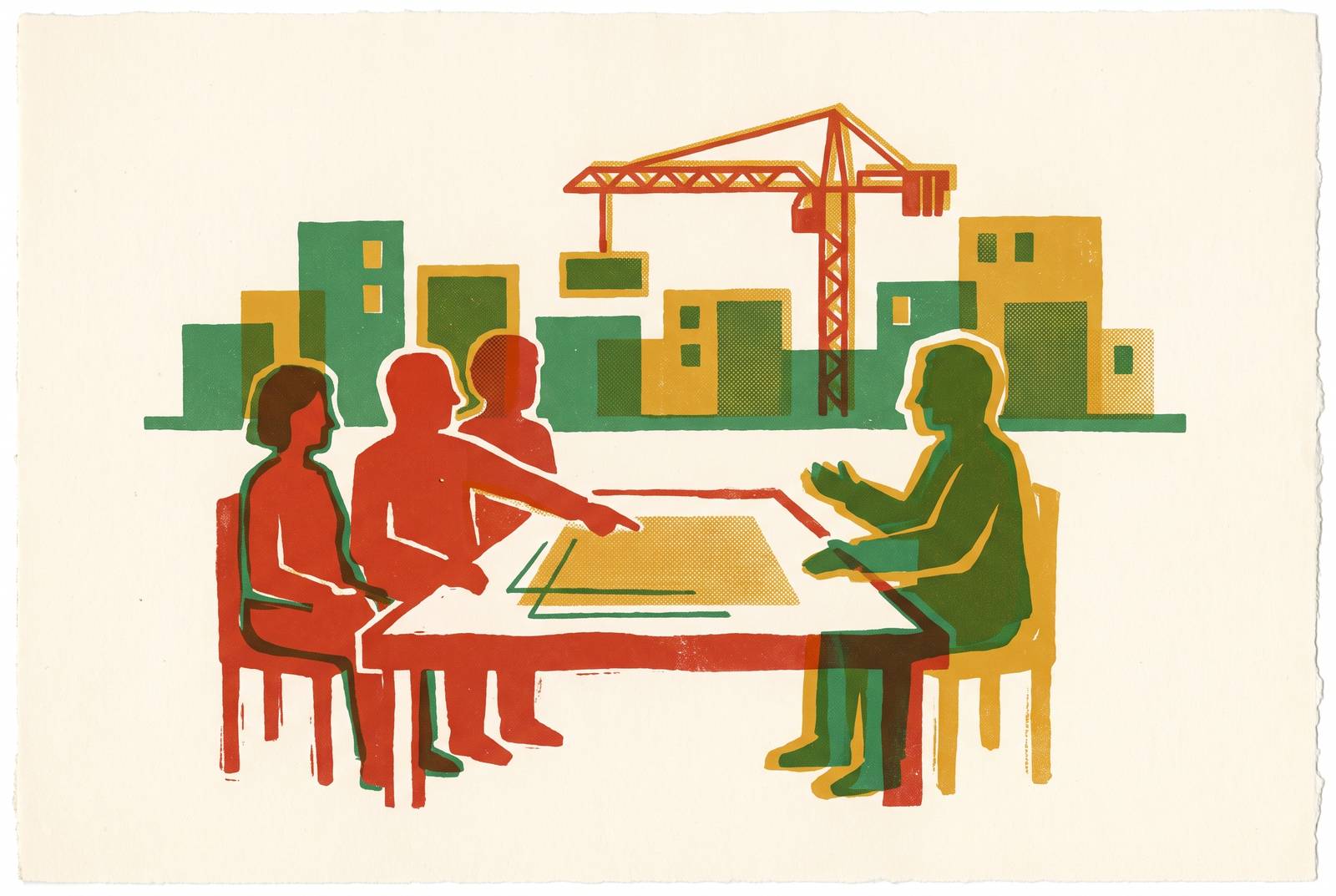
Community Benefits Agreements turn a developer's promises into something a resident can actually sue over. A CBA is a legally binding contract, not a courtesy meeting or a glossy slide deck about "engagement." Get the negotiation right, and a neighborhood can walk away with local jobs, capped utility rates, and millions of dollars in community funds. Get it wrong, or skip the legal groundwork entirely, and what looks like a win on announcement day evaporates by the time construction crews show up.
Why the moment a developer announces a project is already late, and what timing controls
By the time a press release goes out announcing a new data center, arena, or mixed-use tower, the clock is already running. A CBA is most effectively negotiated before the project goes to the city for approval. That pre-approval window is the only period where the community holds real leverage, because the developer still needs something residents can help deliver or block: political goodwill, community support at hearings, an absence of organized opposition.
Once zoning is approved and permits are issued, that leverage mostly disappears. The developer got what it needed. Why would it keep negotiating in good faith after the fact?
Timing cuts both ways. Offer benefits too early, before a project has a concrete shape, and they can look like a pre-emptive bribe, something offered to buy silence before anyone's raised a concern. Offer them too late, after approvals are locked in, and they look like damage compensation, a consolation prize for a fight already lost. The workable window sits in between: after the project is public and its outlines are known, but before the zoning board, the planning commission, or whatever body holds approval authority has signed off.
A coalition that already exists, built around housing, labor, or environmental organizing before any developer showed up, wins because organizing infrastructure was already in place, unlike a coalition that forms only in reaction to a project announcement. A coalition that forms in reaction to a project announcement can still win. But a coalition that already exists, one built around housing, labor, or environmental organizing before any developer showed up, can move on day one instead of spending the first six weeks figuring out who's in the room. In a negotiation where every week matters, that head start is not a small advantage.
Who needs to be in the room and how the group governs itself
A CBA coalition of five people from one block will not be taken seriously, and it shouldn't be. Credibility here isn't just a strategic nice-to-have, it's structural: a developer's attorneys will look for any excuse to argue the group at the table doesn't actually speak for the neighborhood. A narrow coalition hands them that excuse for free.
So who belongs in the room? Residents directly affected, both geographically and economically, come first. Beyond them, the coalition typically pulls in community organizations working on affordable housing, environmental justice, and immigrants' rights, plus faith-based groups with deep roots and standing in the area. Labor unions deserve particular attention here: janitors, hotel workers, clerical staff, building trades. Nearly every successful CBA campaign has had a union at the table, in part because unions bring organizing capacity and negotiating experience that grassroots groups are still building.
Legal counsel isn't optional, either. A CBA is a contract, and contracts have enforcement clauses, definitions, and loopholes that need a trained eye before anyone signs. Civil rights organizations can help too. The NAACP has published standardized CBA templates that grassroots coalitions can adapt, which matters a lot for groups negotiating their first agreement.
Now, the harder issue: representativeness. The same skew that appears at public hearings, where the loudest and most available voices dominate while renters, non-English speakers, and people working two jobs stay home, occurs inside the coalition itself. Reaching those residents takes deliberate outreach.
Internal governance is where a lot of coalitions quietly fall apart. Agendas need to get hashed out among coalition members before anyone sits across from a developer. If the group walks in with three different factions pushing three different priority lists, the developer's team notices immediately, and negotiating leverage shifts to them. Transparency inside the coalition, about who's negotiating what and why, matters just as much as transparency with the public outside it.
Research, power mapping, and knowing what you're negotiating for
Before any coalition sits down with a developer, it needs to understand the project cold: footprint, subsidies, supply chain, environmental impact, timeline. Vague objections don't move a negotiation. Specific ones do.
Power mapping is the next layer. Who actually holds approval authority over this project? Who has the developer already been talking to, quietly, before the public announcement? Which local officials have relationships that could get activated on the coalition's behalf? These aren't rhetorical questions, they're the actual groundwork of the campaign.
A few things every coalition should nail down early:
- Whether public money, tax breaks, or public land are part of the deal. This is often the single biggest leverage point, because public subsidy usually comes with public accountability strings attached.
- What approvals the developer still needs, and from which specific bodies (zoning boards, permitting offices, utility commissions).
- What comparable communities negotiated in similar deals. The UC Berkeley Possibility Lab, working with California Forward, built an Energy Project Benefits Agreement Database specifically to help identify what successful agreements tend to have in common.
- What the local labor market actually looks like, so hiring commitments in the final agreement are realistic rather than aspirational numbers nobody can hit.
Then comes the internal work that's easy to skip and costly to skip: agreeing, as a coalition, on what's non-negotiable and what's tradeable. Walking into a room with a developer without that clarity means negotiating against yourself as much as against them.
What to demand, what to trade, and what to watch for in the negotiation itself
Walk in with a ranked list. Know in advance what the coalition will fight to the mat for, and what it's willing to trade away for something better. Negotiations that arrive without that ranking tend to cave on the wrong things under time pressure, simply because nobody agreed beforehand what mattered most.
Bring alternatives, too. A coalition that only says "no" to a developer's proposal starts losing credibility fast, because it looks like it's negotiating on reflex rather than on substance. Come with a counter-proposal ready. If the developer says a specific local-hire target isn't feasible given the trade skill pool available, the coalition needs a fallback that's grounded in the actual local labor market, not just a lower number pulled from thin air.
One might argue that the strongest CBAs borrow heavily from other cities' templates. Sometimes they do, but the most durable ones are actually built from an honest read of what this specific project means for these specific residents, not copy-pasted from other cities. A generic ask list signals the coalition didn't do its homework, and developers notice that too.
What makes a demand actually enforceable later comes down to specificity:
A percentage of local hires, stated as an actual figure or share rather than described in vaguer terms."
- A dollar wage floor, not "good jobs" or "family-sustaining wages."
- A defined timeline for affordable units or job training programs, not "as soon as feasible."
- A named party responsible for each commitment, not an unassigned obligation floating in the text.
Vague language is where CBAs go to die quietly, years after the signing ceremony.
Why most CBA failures happen after signing
The negotiation is the easy part. Developers make all kinds of promises during project pitches, community meetings, glossy renderings with "community benefits" bullet points on a slide. Plenty of those promises never make it into the actual approval documents. And even the ones that do get written down go unmonitored if nobody's specifically assigned to watch them.
A CBA without enforcement provisions isn't really a weak CBA, it's closer to a letter of intent with better branding. So what separates an enforceable agreement from a symbolic one?
Enforceable CBAs share a few features. Measurable goals, specific numbers instead of directional language like "increase" or "improve." Defined timelines attached to every commitment. Named responsible parties for each obligation, so there's no ambiguity about who's accountable when something's missed. A real monitoring plan, meaning someone collects the data, on a set schedule, and someone else reviews it. And a clear process for what happens when a commitment gets missed, whether that's a penalty, a renegotiation trigger, or legal recourse.
Who actually does the enforcing depends on the structure of the deal. Private CBAs put that weight on the coalition itself. The same organizing infrastructure that won the agreement has to stick around for years afterward to monitor it. That's a heavier lift than it sounds, since coalitions built around a single fight can dissolve once the ribbon gets cut.
Public CBAs shift that responsibility to city administration, as in Lancaster's data center agreement. That can mean more institutional staying power, but it's still subject to political will. A new administration with different priorities can let enforcement slide even when the contract language is airtight.
Institutionalizing CBAs so residents don't have to fight the same battle every time
Negotiating a CBA from scratch, every single time a developer shows up, is exhausting and inefficient. Some cities have started building standing legal frameworks instead, so residents aren't reinventing the coalition-building playbook with every new project announcement.
Detroit got there first. It passed the first ordinance in the country requiring CBAs for large, publicly subsidized developments, which moved the CBA from a private negotiating tool into official city policy. That's a meaningful shift: instead of hoping a coalition can organize fast enough and hold enough leverage, the law requires the conversation to happen.
Cuyahoga County, which includes Cleveland, passed a similar Community Benefit Ordinance in August 2026. Memphis took a different but related approach, passing an ordinance that captures 25% of AI data center property taxes, up to $100 million, to fund public-purpose projects within five miles of the data centers themselves. It's an early model for how cities might handle the current wave of data center development without relying on a resident coalition to negotiate every single deal from zero.
Digital tools and civic technology that make organizing and monitoring more accessible
As of 2026, digital and hybrid tools for organizing and public deliberation have moved past the experimental phase. The real question facing coalitions now is how to use these tools without leaving out the residents who need a seat at the table most.
Open data platforms are doing a lot of the early research legwork. Data.gov hosts over 250,000 datasets which is useful groundwork for a power-mapping exercise or for backing up a specific demand with actual numbers instead of anecdote. City-level portals, in places like Chicago and San Francisco, go a layer deeper with neighborhood-specific data that can anchor an evidence-based ask.
Participatory budgeting offers a related, instructive model. New York City runs one of the largest participatory budgeting programs in the country, letting residents propose and vote directly on projects like school upgrades or park improvements. It's not a CBA, but it proves something adjacent and important: structured, technology-supported participation can produce decisions that actually stick.
For coalitions preparing to negotiate, a publicly available database cataloging community benefits frameworks is a concrete starting point, letting a coalition see what others have secured and use that as a floor rather than a guess.
None of these tools replace the organizing work itself, the coalition-building, the power mapping, the ranked list of demands walked into a room. But they narrow the information gap that's historically favored developers with in-house research teams over residents working nights and weekends to hold a neighborhood together during a fight that shouldn't have to start from zero.