Successful Citizen-Led Legislation Campaigns at the County Level
County commissioners are closer and more reachable than most activists realize.
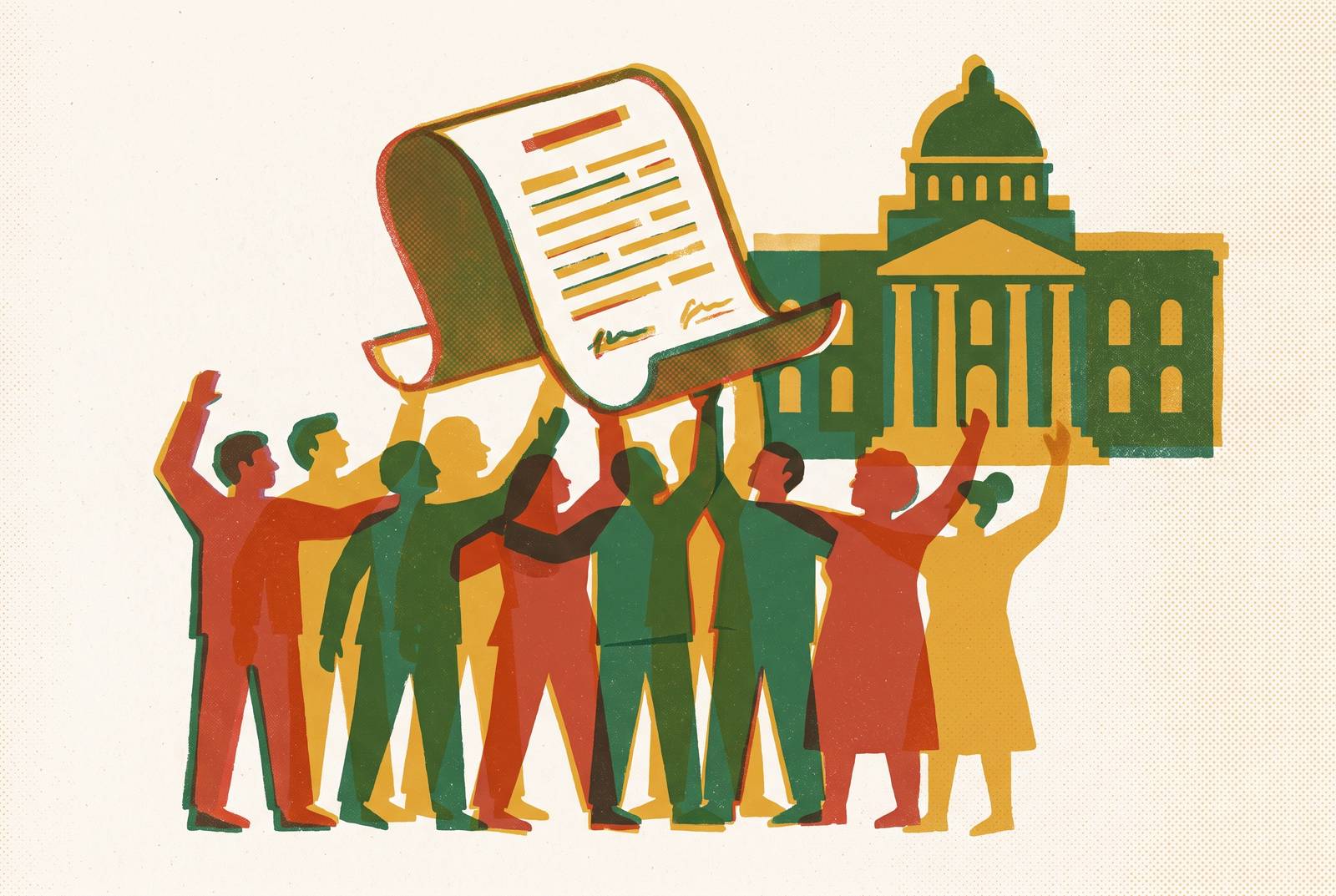
County ordinances get passed by a Board of Commissioners, full stop, and none of the usual suspects — state legislators, judges, anyone in Washington — touch that authority. That single fact changes the whole calculus for citizens who want to change a local law, because the process is smaller and faster and far more reachable than most people assume, yet most people organize as if they were still fighting Congress.
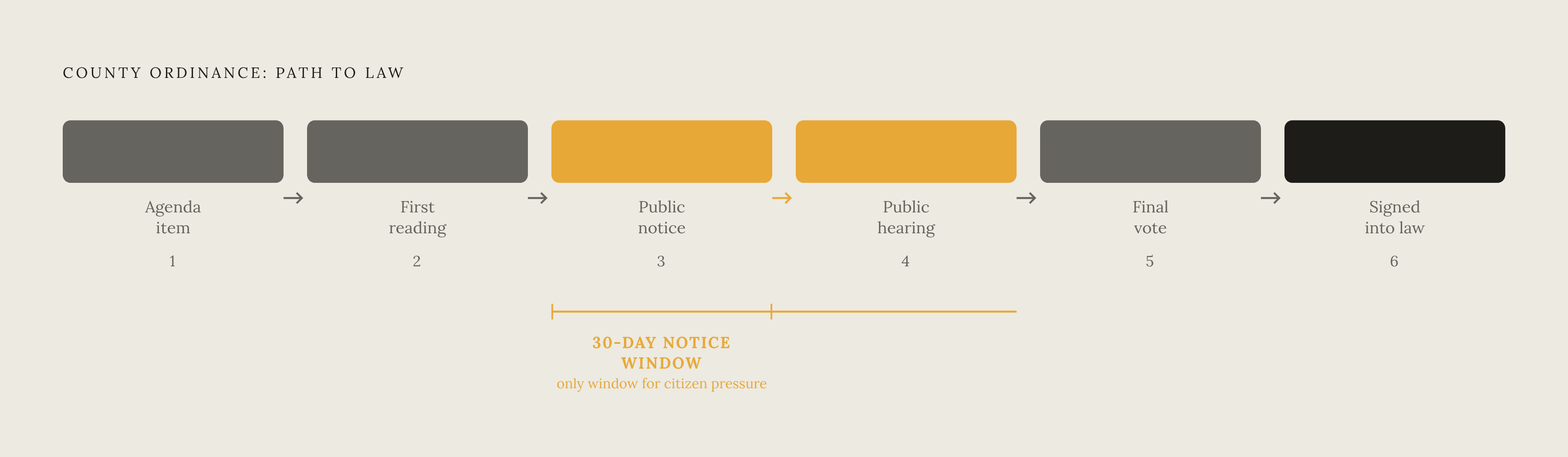
Here's the lifecycle: an item lands on the agenda, gets a first reading, sits through a public notice period, gets a hearing, gets a final vote, then goes to whoever signs it into law locally. Somewhere in the middle sits a 30-day notice window, and that window is where campaigns actually get won or lost. It's the stretch between "here's a proposal" and "here's a vote," the only stretch where citizen pressure has anywhere to land. Most people don't know it exists, and that gap in civic knowledge, more than anything else, is why well-meaning campaigns show up too late to matter.
One more thing before getting into what works: county government is widely regarded as a more accessible and responsive layer of government than state or federal. That matters more than it sounds like it should, because trust changes how officials receive a knock on the door or a call to the office. A commissioner sits close, often a neighbor down the street, reachable in ways a distant figure behind three layers of staff never is.
What the campaigns that actually won have in common
No single formula guarantees a win, but look across the campaigns that actually landed an ordinance, and four features keep showing up. The fourth one is the one most people skip, and it's the one that decides everything else.
First, they worked inside the formal process, using actual public hearings, actual comment periods, and actual officials with actual jurisdiction.
Second, they built community credibility before they ever asked officials for anything, with co-signers, neighbors, and local organizations all on record before the ask went in.
Third, the demand arrived as a concrete, actionable proposal. A petition says "we're upset." A draft ordinance says "here's the fix," and officials can act on the second one more readily than the first, which is a big part of why some campaigns clear the finish line and others just make noise.
Fourth: they mobilized during the notice window, before the vote was already locked in. Timing carries most of the weight here, and most losing campaigns figure that out one news cycle too late, right around the time the vote they never showed up for gets finalized without them.
Grand Rapids, Michigan makes the case for speed and density together. Neighbors who'd felt shut out of decisions affecting their community organized with others and secured $20 million for their community. The speed came from numbers showing up inside the right window, not from any single dramatic moment.
California Common Cause's work on SB 1439 shows the opposite end of the spectrum: durability over speed. The campaign helped secure a structural reform barring local elected officials from taking contributions over $250 from special-interest entities with business pending before them. That rule is now baked into how local politics runs, well past the news cycle of any press release that covered it.
The failures share a pattern too, worth naming plainly instead of dancing around: energy without structure. Rallies show up with no proposal attached, proposals arrive with no co-signers behind them, and co-signers often have no idea which official actually holds jurisdiction, and any one of these gaps can stall a campaign that had real public support behind it. Most losing campaigns manage to hit two or three at once. Producing that outcome takes no bad luck at all — it takes skipping steps that were visible the whole time, if anyone had bothered to map them out first.
How neighbor co-signatures turn an idea into something officials have to take seriously
Elected officials hear complaints constantly. What they rarely get is a structured proposal with verified local support attached, and that scarcity is exactly what makes co-signatures powerful.
So why does a signature from an actual constituent outweigh one from an online petition with signers scattered across three other states? It comes down to verification. An anonymous name on a web form is easy to wave off, but a named neighbor, in the district, attached to a specific proposal, is a voter the official has to account for, and a list of them becomes a bloc the official can't dismiss the same way.
Neighbor to Neighbor in Massachusetts built its whole model around this mechanism, running campaigns that translated into 11 endorsed seats across Springfield, Worcester, and Lynn. That's a durable political presence built door by door, over years of sustained work, a pace no viral petition matches in a weekend.
Ohio Citizen Action worked a similar mechanism at a different scale: canvassing 70 of Ohio's 88 counties and knocking on more than 344,000 doors. That scale of verified, in-person contact is what gave the organization standing with officials across the state.
There's a second effect here, easy to miss. Asking real neighbors to put their name on a proposal forces the proposal to get sharper, because vague ideas don't survive that process, and nobody signs something half-formed, so the draft gets refined before it ever reaches a hearing room.
Some local campaigns have taken this furthest by sustaining structured public dialogue over many years rather than a single push. The proposals that emerge from that kind of sustained engagement carry a built-in community buy-in that a large signature count, on its own, struggles to replicate.
Translating a plain-language idea into a proposal officials can act on
Most citizens who make it to the hearing room don't stall out because they lack conviction. They stall out because they show up with a comment instead of a document, and that's a fixable problem, worth being blunt about.
Here's the distinction that matters: officials and their staff need proposals in legislative form, with defined scope, operative language, and clear jurisdiction. A letter doesn't have that, and neither does a petition summary. Getting from a plain-language complaint to something that reads like an ordinance used to mean hiring a lawyer, hiring a lobbyist, or knowing someone on the inside willing to draft it for free. That gatekeeping filtered out plenty of good ideas for no reason other than access to drafting, which is a bad reason for an idea to die.
That gate is loosening, and this is the part most campaigns still haven't caught up to. The same AI tools local governments use to simplify public communications and summarize meeting materials can help ordinary citizens turn a plain-language idea into a properly structured draft ordinance. A 2024 Harvard study, cited in research from ICMA, put it this way: AI "presents the opportunity to reallocate routine tasks, allowing bureaucrats to concentrate on complex decisions that require human judgment." Flip that around and it applies just as well to citizens on the other side of the desk. The drafting layer that used to require professional access is now something a motivated organizer can handle directly, no law degree required.
What lands at the hearing changes because of this. Officials get a document they recognize, one they can actually route through the process, and it signals something beyond the words on the page: a well-structured draft with neighbor co-signatures attached reads as an organized citizen effort, distinct from one frustrated resident venting for three minutes at the microphone.
Sit with this for a second: the gap between having an idea and having an actionable bill now owes more to access to technology than to access to specialized knowledge. That's a genuinely new condition for citizen organizing, and the campaigns that catch up to it first get a real head start on everyone still writing letters.
How successful campaigns build and use official access at the county level
County commissioners are more reachable than most people assume. Small offices, public meeting schedules, and an expectation built into the job itself of direct contact with constituents add up to a level of access state legislators simply don't offer.
Campaigns that win tend to identify one or two commissioners likely to be sympathetic before the notice period even opens. Building access means showing up before the ask exists: attending regular public meetings, raising the issue informally, establishing over time that the campaign is organized and isn't going away after one bad news cycle.
One might argue that showing up early risks looking presumptuous. Yet the record suggests the opposite problem is far more common: campaigns that only appear once the ask is fully formed read as unfamiliar faces demanding something out of nowhere, and that's a harder sell than a face commissioners already recognize.
Tone matters more than it used to. Local officials frequently note that the quality of constituent engagement they receive has become harder to work with. That's a low baseline to clear, which means a campaign that stays respectful and structured stands out precisely because so much of what officials hear these days doesn't.
The trust differential compounds this. County officials are more likely to treat constituent engagement as legitimate when it comes through the proper channel: hearings, comment periods, direct contact with the right person's office.
California Common Cause's SB 1439 campaign succeeded partly for this exact reason. It engaged officials directly with a specific, codifiable ask, the $250 contribution limit, rather than a vague call for "more accountability." Specific asks are easier to say yes to, because they're easier to defend afterward, and defensibility is what officials actually weigh when they cast the vote.
Media and social attention help too, as a supplement to the mechanics above, rarely as a stand-in for them. A documented campaign with visible community support makes inaction politically costlier than action. Put the full chain together: the right official, the right proposal, visible constituent backing, timing inside the notice window. Miss any one piece, and the whole thing stalls.
What the county level offers that state and federal campaigns can't
Zoning, public health rules, local environmental regulation, housing, transit: nearly everything that shapes daily life close to home runs through county authority. That makes this the layer where the distance between an idea and a law is shortest. Fewer intermediaries stand between citizens and commissioners, legislative cycles run shorter, and the coalition needed to move something is smaller too, sometimes just a few hundred organized neighbors rather than a statewide network.
State and federal campaigns generally need professional infrastructure: paid lobbyists, legal teams, sustained fundraising. Most citizens don't have that, and building it from scratch is its own multi-year project, one most volunteer campaigns never finish. County campaigns run on a lighter footing. Organized neighbors carrying a credible, well-drafted proposal is enough, and that's precisely the scale most people underestimate.
The trust advantage shows up again here, and it's structural, not incidental. Local government sits closer to constituents than state or federal tiers, which means officials are more likely to respond when a constituent reaches out directly instead of through a staffer three layers removed.
County wins compound too, in a way that's easy to overlook. A successful ordinance in one county becomes a template other counties lift and adapt. California's campaign contribution reform, the same one behind SB 1439, is the kind of structural change that can travel once it takes hold. Local first, then it travels — that's the pattern worth remembering, and it's also the argument against skipping the county level to chase a bigger stage first.
There's a pathway worth naming for counties where the commission itself won't move. Citizen initiative power exists in a meaningful number of states, letting voters propose and pass laws directly and bypass an unresponsive commission entirely. That's not the first tool to reach for, but it's real, and knowing it exists changes the leverage a campaign holds even before using it.
Underneath all of this sits a simple observation worth ending on. Neighborhood and county democracy gets the least professional advocacy attention of any layer of government, with fewer lobbyists working this level and less institutional opposition standing in the way. For organized citizens with a structured proposal and verified neighbor support behind it, the odds favor them here more than at the state house, and far more than in Washington.