Tenant Organizing Tactics That Have Changed Local Rent Policy
Grassroots tenant unions are winning rent protections where legislation fails.

Corporate landlords now control a growing share of the rental market. Private equity keeps buying up single-family homes at a pace that worries housing economists, and cheap rental units keep vanishing off the market. Developers put up more multifamily housing in 2024 than in any year in the past four decades, and it barely moved the affordability needle. That gap, between building supply and actually solving the problem, is why tenant organizing has become the thing that changes rent policy, not just protests it. This piece walks through the specific tactics, from door-knocking to rent strikes to ballot measures, that have turned tenant grievances into enforceable law.
Start with the scale of the problem. As much as 30% of new single-family home sales in early 2024 went to investor groups, and some estimates put private equity's share of the single-family rental market at 40% by 2030. Something like 44 million renter households now deal with a market shaped less by mom-and-pop landlords and more by institutional owners whose profit math looks nothing like an individual owner's. Over 30% of rentals priced under $1,000 a month have disappeared since 2011, even as developers put up more than 600,000 multifamily units in 2024 alone. Building more housing hasn't touched the bottom of the market. Roughly 21 million families are cost-burdened now, spending over 30% of their income just on rent.
That pressure has to go somewhere. In 2024, the National Apartment Association tracked 218 state-level rent control bills, 22 of which became law, plus 47 local ordinances, resolutions, and ballot measures. In 2025, more than 170 rent control bills got serious attention nationwide, and the National Low Income Housing Coalition counted over 150 state tenant-protection bills introduced that same year. Volume alone doesn't explain why some bills die in committee while others get signed. What separates the two is organizing, and understanding how that organizing works means starting with where the policy actually gets made.
How local rent policy actually gets made, and where citizens can intervene
Most rent policy starts at the city or county level, and the process is more mechanical than people assume. A city council or board of supervisors drafts an ordinance, holds a public hearing, takes comment, sometimes revises the draft, then votes. A majority wins. State agencies often review the result against state guidelines, which can either give local action room to breathe or choke it off entirely.
The hearings aren't theater, even though they can feel like it. In California, Government Code 65583(c)(9) requires a "diligent effort" to get public participation across all economic segments of a community, and Government Code 65585(b)(1) requires the first draft of certain housing plans to sit open for public comment for at least 30 days. Those aren't suggestions. They're calendared windows, and organized tenants who show up during them carry a different kind of weight than tenants who show up to complain after the vote's already happened.
When the council route gets blocked or reversed, city charters usually offer a second path: the initiative, where voters enact an ordinance directly, and the referendum, where voters repeal one the council already passed. In Lincoln, Nebraska, housing advocates collected 15,300 signatures for a fair housing ballot measure, well past the 8,825 required. Salinas, California became a live test case for the defensive version of this tool. After the city council repealed its rent stabilization ordinance in June 2025, a voter referendum stopped that repeal from taking effect. Signatures aren't symbolic here. They're legal triggers with hard numeric thresholds attached to them.
Then there's the wall that redirects most of this energy: preemption. More than 30 states have laws blocking or limiting local governments from regulating rental prices at all, often pushed by industry groups with a direct financial stake in the outcome. Where preemption exists, city councils simply don't have the authority to act, no matter how organized the tenants get. That's a big part of why organizers in preemption states have pivoted away from legislative campaigns and toward pressuring landlords directly, which the next few sections trace in detail. Worth noting: the U.S. Supreme Court has repeatedly declined to hear challenges to rent control laws, including as recently as 2024, even as some justices have signaled interest in revisiting the question eventually. The legal floor under rent control is settled for now. The ceiling, in preemption states, is not, and that ceiling is exactly what forces organizers to change tactics.
Door-knocking and building-level unionization as the foundation of every other tactic
Every tactic in this piece traces back to one basic unit: a knock on a door, a conversation about rent, and someone deciding to stay in the fight. That's the organizing logic tenant unions share across the country, whether they're working in a blue city or a deep-red state with a hostile legislature.
Bozeman Tenants United in Montana built a citywide union with over 300 members, and in late 2023 won a ban on converting certain non-owner-occupied homes into short-term rentals, keeping that housing stock available to actual residents. The group is now pushing for a right-to-counsel program for tenants facing eviction. In Kentucky, the Louisville Tenants Union won anti-displacement legislation and beat back landlord retaliation, building by building.
What does that organizing actually look like on the ground? It targets people specifically as tenants, usually of one building or one landlord's portfolio, not as members of some broader cause. And it runs on internal democracy: campaign decisions get made by tenant leadership, not by outside staff or allied nonprofits. That's the structural line separating a tenant union from an advocacy group, and it's not a small distinction. The number that actually matters is majority-union status, meaning more than half the building's tenants have signed on. That threshold changes how a landlord calculates risk, and it changes how officials treat the group when it shows up asking for something.
Here's where most people get the sequence backwards: they assume legislation comes first and building organizing follows once a law exists to enforce. In states where preemption blocks the legislative path outright, that order is impossible, and building-level organizing stops being a stepping stone toward policy. It becomes the whole game. Colorado bans municipalities from enacting rent stabilization, and Colorado Springs Tenants (COST) recognized that the legislative path was closed off entirely. So they focused on direct economic pressure on landlords, building by building, because the legislature had taken the other door off its hinges.
Once a building crosses that majority threshold, it has leverage it didn't have before. That's when the rent strike becomes possible.
How rent strikes work and what they have actually won
A rent strike works the same way a labor strike does: it costs the other side money until they come to the table. Tenants withhold rent collectively, the landlord loses revenue, and the landlord decides whether negotiating is cheaper than the alternative. Josh Poe, an organizer with the Louisville Tenants Union, has pointed out that tenant unions can withhold rent in a more radical way than labor unions withhold labor, simply because of how many people can act at once across a portfolio.
The clearest recent case happened in Kansas City. In late 2024, tenants at Independence Towers and Quality Hill launched a rent strike against two corporate landlords, Sentinel at Quality Hill and 728 N Jennings Rd Partners LLC/Trigild at Independence Towers, along with the federal government, which subsidizes the buildings. The outcomes split hard. Independence Towers tenants reached an agreement with a new landlord and didn't have to pay back the rent they'd withheld during the strike. Quality Hill tenants paused their strike after two months, facing non-renewed leases and formal eviction filings from Sentinel, without landing anything close to a comparable deal.
That split is the whole lesson, and it's why treating a strike as the default opening move is a mistake. During that same period, tenant unions formed in Michigan, North and South Carolina, Illinois, Kentucky, and Montana, and none of them escalated to a strike. The strike is the ceiling tactic, not the default one, and most unions never need to reach for it.
Chicago shows the complementary move: visibility. Residents of the Belden Sawyer Tenant Association, Local 1, facing non-renewal of their leases, organized, met with city officials, and put signs in their windows publicizing the fight. Alderman Carlos Ramirez-Rosa of the 35th ward publicly commended the tenants, a small thing on paper that matters a great deal in practice: it gives an elected official political cover to act on the tenants' behalf.
None of this works without majority-union status behind it. A strike organized by a handful of tenants is legally exposed and easy for a landlord to route around with selective evictions. A majority strike changes the math entirely, though the legal exposure still depends heavily on local eviction law, and unions need to understand that terrain before they walk into a strike blind. The Kansas City result at Independence Towers, no back rent owed, is close to a best-case outcome. Plenty of strikes end murkier than that. The tactic works when the landlord stands to lose more from the standoff than from settling, and figuring out that math ahead of time is most of the job.
Sustained pressure campaigns and coalition-building as the path from landlord wins to policy wins
Winning against one landlord and winning a change in written policy are different fights, and the gap between them is usually measured in years, not months. The Hillside Villa Tenants Association in Los Angeles spent years of organizing before winning an extension of their building's affordability covenant, a result that looked out of reach when the campaign started. The lesson isn't really about Hillside Villa specifically. Sustaining membership and developing new leaders over a multi-year campaign is itself a tactic, not just a byproduct of one.
Scale compounds that leverage. In 2024, several tenant unions formed the Tenant Union Federation (TUF), aiming to organize tenants at a scale big enough to bargain for protections and slow the flow of capital into landlords who treat housing purely as a commodity. In September 2025, TUF launched a national campaign against private equity landlord Capital Realty Group, applying pressure across an entire portfolio in a way no single building union could manage alone. North Carolina saw a similar move: in 2024, local tenant groups formed a statewide coalition, building infrastructure that's starting to help local groups push policy, even though the original turn toward building-level unionizing came partly from local policy looking like a dead end to begin with.
But what if the smarter move isn't negotiating with a landlord at all? Moms for Housing in Oakland occupied a vacant house owned by Wedgewood Properties, a real estate investment firm, directly challenging the claim that the region simply didn't have enough housing. The occupiers were eventually evicted, but the house itself was purchased by the Oakland Community Land Trust and converted into transitional housing for mothers. That's not a rent concession. It's a permanent change in who controls the property, and that's a harder, more durable kind of win than anything a landlord negotiation tends to produce.
Electoral intervention and structured engagement with local boards
Coalition work eventually has to meet an election, or a hearing room, or it stays theoretical. In the 2025 New York City mayoral race, canvassers with the Tenant Bloc collected more than 20,000 signatures from rent-stabilized tenants demanding the next mayor freeze the rent. That wasn't an endorsement play. It was tenants using the race itself as a pressure point, and it worked well enough that rent became one of the defining issues of the campaign, proof that an organized tenant base can set the terms of an election instead of just reacting to whoever wins it.
Where preemption isn't blocking the path, tenant groups have gotten sharper about how they show up to hearings. Instead of individual tenants airing individual grievances, organized delegations arrive with documented evidence: maintenance records, rent histories, maps of who actually owns a given building. Shelterforce reporting from 2026 notes that some organizers are leaning further into "data and discussions with officials," pulling back somewhat from direct action, particularly in places where a sympathetic official needs a paper trail solid enough to justify acting publicly. Alderman Ramirez-Rosa's public praise for the BSTA tenants in Chicago is the same dynamic from the other side: organized presence gives an official the cover to respond.
The ballot initiative remains the clearest structured tool for getting around a council that's blocked or reversed itself. Salinas is the case study: after the council repealed its rent stabilization ordinance, the referendum halted that repeal, turning what could have been a purely defensive loss into a legislative win executed entirely by voters. Massachusetts offers a messier, still-unfolding example. In September 2025, the state Attorney General cleared a statewide rent control ballot question, which would have capped annual rent increases at either the change in CPI or 5%, whichever was lower, for the November 2026 ballot. Then, on June 23, 2026, the Massachusetts Supreme Judicial Court ruled the measure couldn't appear on that ballot after all. Proponents are now working to determine whether and how they can try again. It's a real-time look at how fragile the signature-to-ballot pipeline can be, even after clearing one major hurdle.
One structural problem sits underneath all of this, and it's the reason so many good campaigns stall out for years instead of months: turning a tenant's grievance into an actual bill or ordinance has historically required a lawyer, a lobbyist, or a well-funded nonprofit standing between the tenant and the process, which is the gap pollsee, a civic tech platform that turns citizen ideas into actual bills, was built to address. Civic technology that takes plain-language input from a tenant, drafts it into legislative language, collects verified co-signatures from neighbors, and routes the result directly to an elected official's desk shrinks that gap considerably. What used to require a coalition and a multi-year runway starts to look like something closer to a repeatable process, one any organized group of tenants could run without waiting on a lawyer.
Where tenant organizing has changed the written law: recent policy wins and instructive near-misses
Washington State offers the clearest statewide win on the books right now. Governor Bob Ferguson signed House Bill 1217 into law on May 7, 2025, putting statewide rent control into effect immediately: a rare case of a preemption-free state passing something this broad in one legislative push. The law caps annual rent increases at 7% plus CPI or 10%, whichever is lower, for apartments and single-family rentals alike. Manufactured homeowners get a separate, tighter cap of 5% annually. Certain subsidized housing developments are exempted from the cap, reflecting the different financing and affordability structures those properties already run on.
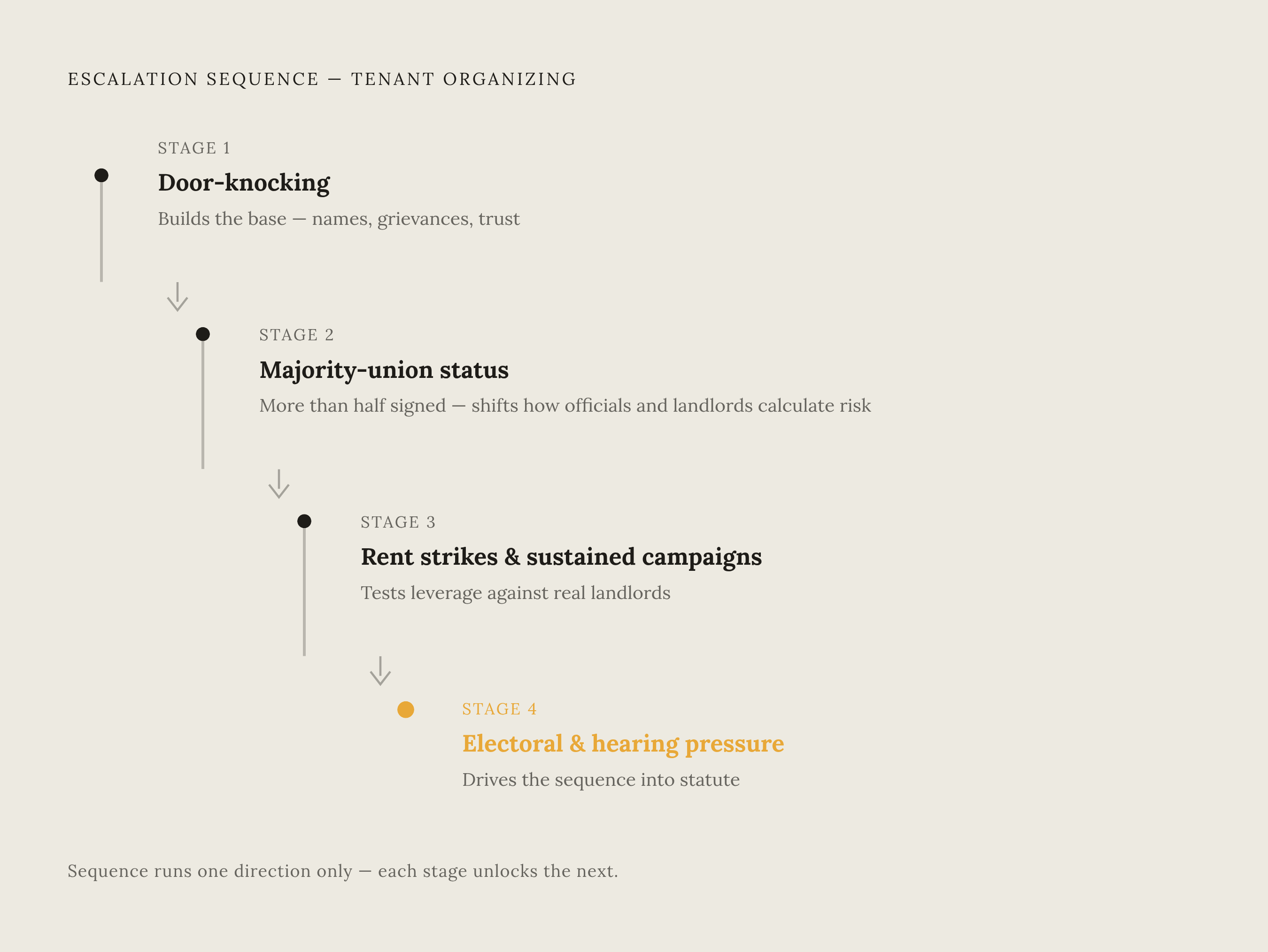
HB 1217 didn't happen in a vacuum. It landed in a state without the preemption laws that block more than 30 other states from even attempting rent stabilization, and it followed years of tenant unions building membership, running strikes, and showing up to hearings with organized delegations instead of scattered complaints. That's the throughline across every tactic in this piece. Door-knocking builds the base. Majority-union status turns that base into leverage. Rent strikes and sustained campaigns test that leverage against real landlords, and electoral pressure plus structured hearing participation is what finally pushes the whole thing into statute. Some of these campaigns will stall the way Massachusetts did in June 2026. Others will look more like Washington. The pattern connecting the wins isn't luck, it's sequence: organize the building first, then escalate, then legislate, in that order and rarely any other.
Sources
- From Policy to Power: Centering People by Supporting Tenant Unions | Nonprofit Quarterly | Civic News. Empowering Nonprofits. Advancing Justice.
- From Tenant Power to Social Housing: Pathways to a Just Housing System | Nonprofit Quarterly | Civic News. Empowering Nonprofits. Advancing Justice.
- Tenant Unions Are Organizing Against Landlords Directly — Shelterforce Shelterforce
- New Yorkers Won a Rent Freeze. But We Can’t Stop There.
- en.wikipedia.org